The Complete Guide to Bracelets: Types, Sizing & How to Choose

This post may contain affiliate links. Read our affiliate policy
The listing says "7 inches, 14k, lobster clasp." Not one of those numbers tells you whether the bracelet will clear your knuckles, spin so the clasp rides on top of your wrist, or pop open on a train railing. This bracelet guide converts the specs into decisions: how to measure a wrist, which constructions survive daily wear, and which single part fails first.
A bracelet has a harder life than any other piece of jewelry: dragged across desks, caught in sleeves, soaked every time you wash your hands, and unlike a ring, it swings. That is why we spend as much of this guide on clasps and sizing as on style.
Table of Contents
- What Actually Matters When You Buy a Bracelet
- Bracelet Types, Style by Style
- Bracelet Size: Measuring Your Wrist
- Tennis Bracelets Explained
- Clasps: The Part That Fails First
- Tennis Bracelets Worth Buying
- Gold Bracelets: Karat, Weight and Value
- Charm Bracelets and How They Grow
- Bangles, Cuffs and Rigid Bracelets
- Bracelets for Men: Width and Proportion
- Sterling Silver Bracelets Worth Buying
- Stacking and Layering Bracelets
- Cleaning and Everyday Care
- FAQ
What Actually Matters When You Buy a Bracelet
Five variables decide whether a bracelet gets worn or lives in a drawer: fit, construction, closure, metal, and weight. Style is the sixth, and it is the one every product page leads with.
Fit is first because a bracelet has to be loose enough to move and tight enough to stay. Too tight and it presses on the wrist bone; too loose and it slides over the hand, or the clasp migrates to the top where it snags.
Construction is how the metal is formed and joined. A bracelet built from individually soldered links behaves nothing like one built from a folded metal ribbon at identical width and price. Soldering fuses two pieces of metal with a melted filler alloy; a soldered link is a closed link, and closed links are what keep a bracelet on your arm. Open jump rings — links simply bent shut — are the most common failure point on cheap pieces.
Closure deserves its own section below. A necklace clasp sits protected at the back of the neck; a bracelet clasp is exposed on the outside of the wrist and takes direct impact all day.
Metal sets cost, color, and how the piece ages. Karat is the proportion of pure gold in an alloy out of 24 parts. According to Brilliant Earth's gold karat guide, 14K gold is 58.3% pure gold and 41.7% alloying metals, while 18K is 75% pure gold. Higher karat means richer color and a softer metal that scratches more readily, which matters more on a wrist than anywhere else.
Weight is the honest proxy for value in solid metal. Two bracelets of identical karat, width, and length can differ by half in grams if one is hollow, and hollow links dent permanently when crushed.
Bracelet Types, Style by Style
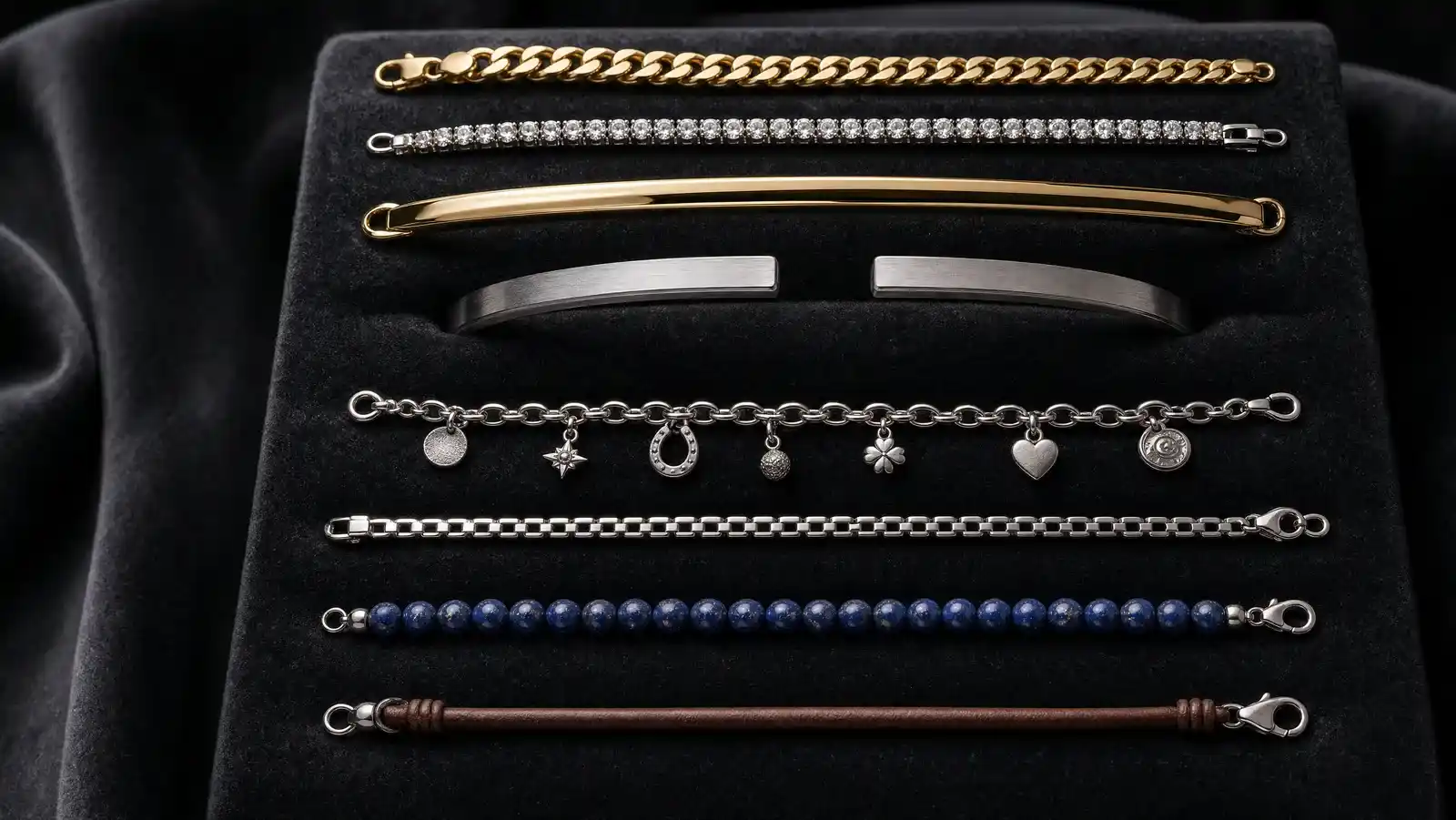
Bracelet names describe structure, not appearance. There are only a handful of underlying forms, and everything on a retail page is a variation of one.
| Type | What it is | Closure | Everyday verdict |
|---|---|---|---|
| Chain / link | Repeating metal links, flexible | Clasp | The default. Repairable, wide price range |
| Tennis / line | A single continuous line of matched stones | Clasp, usually with safety | Fragile-looking, needs the best clasp you can get |
| Bangle | Rigid closed circle, no clasp | None, or hinge and box catch | Slides on; sizing is by hand, not wrist |
| Cuff | Rigid band with an open gap | None | Adjustable by gentle flexing, which fatigues metal |
| Charm | A link base built to carry attachments | Clasp | Grows over time; weight grows with it |
| Beaded | Stones or metal beads on cord or wire | Elastic, or clasp | Cheapest to break, cheapest to restring |
| Cord / leather | Woven fiber or leather | Clasp, knot, or slider | Wears out rather than breaks |
| Mesh / watch-style | Fine woven or articulated metal band | Fold-over or magnetic | Comfortable, hard to repair invisibly |
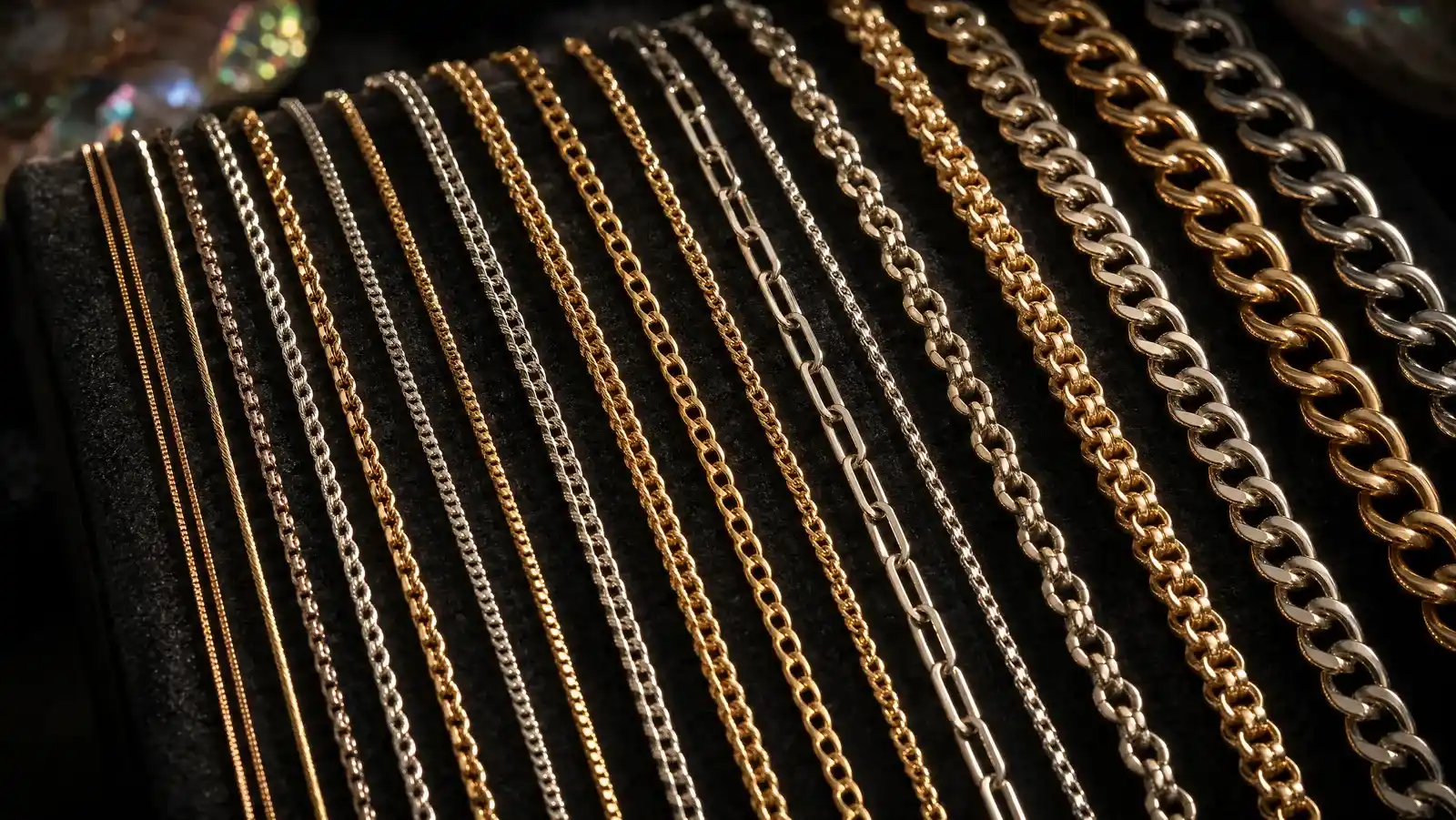
Chain bracelets borrow their vocabulary from necklaces — cable, curb, Cuban, figaro, rope, box, herringbone — and each construction carries the same strengths and weaknesses to the wrist, amplified by the extra abuse. Our guide to types of necklace chains explains how each link is built and which ones a jeweler can repair invisibly.
Two things change when a chain becomes a bracelet. A flat construction like herringbone kinks far more easily on an arm that bends than on a neck that does not, and width reads bigger on a wrist than on a chest. We are keeping this section deliberately compressed, because the full breakdown of bracelet types deserves an article of its own with each construction photographed at real size.
Bracelet Size: Measuring Your Wrist
Measure the wrist, then add for fit. Those are two separate numbers, and confusing them is the single most common sizing mistake.
Step one: measure. Wrap a flexible tape or a strip of paper around your wrist just below the wrist bone. David Yurman's sizing guide gives the same instruction for its printable sizer: wrap it just below the wrist bone and tighten to a comfortable fit. Snug, not compressed, read to the nearest eighth of an inch.
Step two: add for fit. Greenwich Jewelers publishes three allowances: add about a quarter inch for a snug fit, half an inch for a classic fit with gentle movement, and three-quarters of an inch or more for a loose drape.
Where most wrists land, according to Greenwich Jewelers, is between 6.5 and 7 inches for women's bracelets and between 7.5 and 8.5 inches for men's. David Yurman's published size chart runs women's wrists from 5.0–5.5 inches at X-Small to 7.0–7.5 inches at X-Large, and men's from 6.5–7.0 inches at X-Small to 8.5–9.0 inches at X-Large. Yurman's advice when you fall between two sizes is to take the larger one.
Three cases break the wrist-measurement rule:
- Bangles are sized by the hand, not the wrist. Greenwich Jewelers directs you to measure across the widest point of the hand, usually at the knuckles, with the thumb tucked across the palm. That is the opening the bangle has to pass.
- Wide and rigid pieces need more room. A broad cuff contacts a longer stretch of a tapering arm than a fine chain does, so the same numeric length fits tighter.
- Wrists swell. Heat, exercise, salt, and time of day all change the measurement, so measure at the end of a warm day to get the size that stays comfortable.
For the full charts, metric conversions, and the trick for sizing a gift without asking, see our bracelet size guide.
Tennis Bracelets Explained
A tennis bracelet is a flexible line of matched stones — almost always diamonds — set in identical links that repeat all the way around the wrist. It has no center stone and no focal point. That uniformity is the design, and it is why matching matters more here than in any other piece.
The name comes from a broken bracelet at the U.S. Open. Sotheby's tells it this way: "During an exceptionally long rally in the 1987 Grand Slam, Chris's diamond eternity bracelet snapped mid-game. Refusing to continue playing until her bracelet was recovered, officials halted the game till, at last, it was found." The date is disputed. Mental Floss reports the incident actually happened in 1978, the year the Open moved to Flushing Meadows, and quotes Evert's publicist Tami Starr: "Chrissie recalls that she was wearing a diamond and gold bracelet, and it broke and fell onto the court in an early round of the Open, and they had to stop play while she looked for it." Mental Floss notes that Evert herself has endorsed 1978, and that her jewelry collection with designer Monica Rich Kosann carries "Born 1978" on the product page.
The mechanical lesson survives the date argument: the original tennis bracelet fell off, and everything about how these are built today answers that.
What separates a good one from a bad one is consistency. Every stone should read the same color and brightness as its neighbors, because one grayer stone in a long line is visible across a table. Settings should sit level, and the links between them should articulate freely so the bracelet drapes rather than arcs. For the setting styles, stone-matching standards, and carat-weight math in full, see what a tennis bracelet actually is.
Clasps: The Part That Fails First
Almost every lost bracelet is a clasp story. The metal did not snap; the closure opened, or the tiny ring attaching the closure did.
Spring ring is the small hollow circle with a lever you push with a fingernail. Light, cheap, and built around the weakest common mechanism in jewelry: grit gets in, the spring loses tension, and it stops fully closing before it stops closing at all. Fine for a delicate chain worn occasionally; wrong for a bracelet you sleep in.
Lobster claw is the same spring principle in a stronger housing with a bigger, stiffer gate, and it is the sensible default for most chain and charm bracelets. It still fails eventually — springs are consumables — but it fails slowly, with a gate that feels loose for weeks before it lets go.
Box clasp is a wedge-shaped tongue that clicks into a hollow box. It is standard on tennis bracelets because it sits flush, adds no bulk to the line of stones, and holds by geometry rather than a spring. Its weakness: a bent tongue stops clicking, and you cannot see the tongue while wearing it.
Fold-over and slide-lock closures use a hinged lever or a friction plate, and are common on watch-style and mesh bands.
Magnetic clasps trade security for one-handed operation. We would avoid them on anything valuable.
The upgrade that matters most costs almost nothing. Robinson's Jewelers describes a safety clasp as a secondary latch — a figure-eight catch or a small safety chain — that connects the two ends of the bracelet independently, so if the primary clasp fails the safety catch still holds everything together. Two things now have to go wrong at once, and any jeweler can add one.
Check the jump ring too. The clasp is often attached by a single small ring, and if that ring is merely bent closed rather than soldered, it is the real weak link regardless of what the clasp costs. Our guide to necklace clasp types breaks down each mechanism and its failure mode in detail, and a closer look at bracelet clasp types is here.
Tennis Bracelets Worth Buying
We will not pretend there is one right tennis bracelet. There is a right set of checks, and most disappointing purchases fail at least one of them.
Check the matching before the carat weight. Total carat weight is the number retailers lead with because it is easiest to compare, and it tells you nothing about whether the stones match. A well-matched three-carat bracelet outperforms a four-carat one with visible color variation, in every light.
Check the setting style against your life. Prong settings show the most of each stone and catch the most on fabric; bezel and channel settings hide more and snag far less. For daily wear rather than occasions, that trade is usually worth making.
Check the clasp and demand a safety. A tennis bracelet is the piece with the most value per inch and the flattest, least reassuring closure. A box clasp with an integrated safety catch, or an added figure-eight, is not optional at this price.
Check the articulation. Held by one end it should hang in a smooth curve, not a stiff arc. A bracelet that will not bend freely rides up the arm and stresses individual links.
Check the metal weight where the links meet. Thin bridges between settings are where these break. Lift it; a well-made line bracelet feels heavier than it looks.
Lab-grown diamonds have changed the arithmetic here more than in any other category, because a tennis bracelet is dozens of small stones rather than one large one. Our shortlist and the criteria behind it appear in the tennis bracelets we recommend.
Gold Bracelets: Karat, Weight and Value
Two words in a gold listing do different jobs, and shoppers routinely read one as the other. Karat is purity. Construction is how much gold is actually there.
On purity, Brilliant Earth's gold karat guide puts 14K at 58.3% pure gold with 41.7% alloying metals, and 18K at 75% pure gold. Jewelers conventionally hallmark that fineness 750. Lower karat is harder and more scratch-resistant. Because a bracelet takes more surface abrasion than a necklace, we lean 14K for daily wear and reserve 18K for occasions.
On construction, the Federal Trade Commission's Jewelry Guides set the definitions. Under 16 CFR 23.4(b), a product may be described as "vermeil" only if it has a base of sterling silver coated on all significant surfaces with gold or a gold alloy of not less than 10 karat fineness, of reasonable durability and a minimum thickness throughout equivalent to two and one half microns of fine gold. The Guides also state that calling a piece vermeil is deceptive when the sterling has been covered with a base metal such as nickel and then gold plated, unless that is disclosed. For plated goods, 16 CFR 23.3(c)(2) directs that the karat fineness of the plating be designated with equal conspicuousness to the term used, in forms such as "14 Kt. Gold Overlay."
The practical ranking for a bracelet, best to worst: solid gold, gold-filled, vermeil, plated. Plating wears through faster on a bracelet than on any other piece, because the underside is in constant contact with a desk, a sleeve, and skin.
Ask whether the piece is solid or hollow before comparing prices. A hollow link bracelet at the same width and karat contains far less gold, dents rather than scratches, and cannot always be repaired cleanly. Our guide to gold chain necklaces covers the same arithmetic with weights, and the best gold bracelets has its own article.
Charm Bracelets and How They Grow
A charm bracelet is a base and a plan. The base is a link bracelet chosen for one property: links open and thick enough to accept a jump ring or a charm clip, and strong enough to keep accepting them as the piece gets heavier.
Rolo and curb bases are traditional because their links are individually accessible and thick-walled. Snake-chain bases, used by the large bead systems, work differently: beads thread on rather than hang off, so the bracelet carries weight in compression instead of pulling at single points.
Three mechanical facts govern how a charm bracelet ages.
- Charms attach through the weakest metal in the piece. An open jump ring bent shut with pliers will eventually spring. Soldered rings and lobster-clip charms do not.
- Weight compounds. Each charm adds mass and a new pivot. A base link that was adequate empty can distort once eight charms hang from it.
- Charms collide. Enamel chips, plating rubs, and soft stones abrade against neighboring metal all day, so spacing matters and the softest charms should not neighbor each other.
The clasp also does double duty here, since you unclip a charm bracelet far more often than other pieces. That argues for a lobster claw over a spring ring, and a safety chain once the piece is valuable.
Buy the base with the finished bracelet in mind, not the first charm. Upgrading later means transferring every charm and often replacing jump rings. Our step-by-step approach, including spacing and balancing weight around the wrist, is in how to build a charm bracelet.
Bangles, Cuffs and Rigid Bracelets
Both are rigid. The difference is whether the circle is closed.
A bangle is a continuous rigid ring with no clasp, or a hinged version that opens on a pin and shuts with a box catch. A cuff is a rigid band with a gap, slipped on sideways and worn without any closure. The terms get used interchangeably in retail copy, and open "cuff bangles" sit in between.
The consequences are practical. A solid bangle has to clear your knuckles, which is why Greenwich Jewelers measures across the widest point of the hand rather than around the wrist. A bangle that clears the hand comfortably will also spin and slide; that is the trade.
A cuff avoids the hand problem entirely, but at a metallurgical cost. Every time you flex a cuff open to put it on, you work-harden the metal at the same point. Repeated bending is what eventually cracks a cuff, and it cracks at the back, opposite the gap. Set a cuff's opening once at a jeweler's and stop adjusting it.
Hinged bangles solve both problems and add a third: the hinge pin and catch are small, load-bearing, and hidden, and that is where a hinged bangle fails.
The word bangle is commonly traced to the Hindi bangri, a glass wrist ornament, and the form is one of the oldest in jewelry precisely because it needs no mechanism. If you are choosing between the two forms, bangles versus cuffs goes through the decision in detail.
Bracelets for Men: Width and Proportion
Men's bracelets are sized off a longer baseline. Greenwich Jewelers puts most men's bracelets between 7.5 and 8.5 inches, and David Yurman's men's chart runs from 6.5–7.0 inches at X-Small to 8.5–9.0 inches at X-Large. Measure and add the same fit allowance as anyone else; the numbers move, the method does not.
Width is where men's pieces go wrong, and the rule is proportional rather than absolute. A wide, heavy link on a slim wrist reads as costume; a fine chain on a broad wrist disappears. Hold a ruler against your wrist before ordering, because a piece looks more substantial worn than it does in a product photograph.
Beaded bracelets are sold by bead diameter, stepping up in single millimeters. Larger beads mean fewer beads and a chunkier, more segmented look; smaller beads drape closer to the skin and read quieter.
Three construction notes specific to this category:
- Elastic is a consumable. Stretch cord perishes, and it usually goes without warning. It is cheap to restring, and worth restringing before it snaps rather than after.
- Stainless steel and titanium are harder than gold or silver. They resist scratching far better on a wrist that meets desks and steering wheels, and are correspondingly hard to resize or repair.
- Leather and cord fail predictably. They fray rather than break suddenly, which makes them the lowest-risk material to wear daily.
If you wear a watch, decide which wrist the bracelet lives on before you buy; metal against a watch case scratches both. Our picks and the width-to-wrist reasoning behind them are in the best men's bracelets.
Sterling Silver Bracelets Worth Buying
Sterling is defined by a number. According to the Federal Trade Commission's Jewelry Guides, the terms "solid silver," "Sterling Silver," "Sterling," or the abbreviation "Ster." may not be used unless the product is at least 925 parts per thousand pure silver. That is what the 925 stamp means: a legal threshold, not a marketing claim.
The remaining portion is alloy, usually copper, added because pure silver is too soft to hold a form. Tarnish is the silver itself reacting with sulfur compounds in air, sweat, and cosmetics to form a dark silver sulfide film; the copper reacts too, so sterling tarnishes faster than pure silver. The film sits on the surface rather than running through the metal, which is why polishing restores it.
What to look for in a sterling bracelet:
- A visible 925 or "sterling" stamp, plus a maker's mark. An unstamped "silver" bracelet is not a bargain, it is an unanswered question.
- Solid links rather than hollow. Hollow sterling dents on the first hard knock and is difficult to push back out.
- Anti-tarnish treatment, understood honestly. Rhodium plating genuinely delays tarnish, and it is still plating: it wears at contact points and eventually needs redoing.
- Repairability. Sterling solders easily and cheaply, a real advantage of the metal. Ask before buying anything with fused or glued components.
We would avoid "silver-tone," "silver-plated," and "German silver" for a bracelet. The first two are coatings that rub off exactly where a bracelet meets a desk, and German silver contains no silver at all — it is a copper-nickel-zinc alloy, and nickel is a common contact allergen.
Our guide to the best sterling silver chains explains what plating buys you in practice. The specific pieces, budget through heirloom, are in sterling silver bracelets we rate.
Stacking and Layering Bracelets
Stacking means wearing several bracelets on one wrist. It looks casual and is largely a materials problem.
Hardness is the constraint nobody plans for. Diamond is the hardest natural material, and it abrades gold, silver, enamel, and pearl every time they touch. A diamond tennis bracelet worn against a gold bangle scratches the bangle, not itself. Separate hard from soft, or accept the patina.
Rigid pieces protect flexible ones. A bangle holds its position; a chain migrates. A bangle between two chains gives each some space and reduces tangling, the main practical failure of an all-chain stack.
Three visual rules do most of the work. Vary the width rather than repeating it, since three bracelets of identical width read as one thick band. Keep one piece dominant and let the others support it. And mix metals deliberately across the whole stack rather than accidentally in one spot.
Watch the clasp count. Every clasp you add is another thing that can open, and clasps tangle with neighboring links. Stacks built around bangles and cuffs have fewer moving parts than stacks built from chains.
Comfort decides whether a stack survives the first week. One that clicks against a keyboard all day comes off by lunchtime; if you type for a living, build the stack on your non-dominant wrist.
Our detailed approach to widths, spacing, and metal mixing is in how to stack bracelets without clashing.
Cleaning and Everyday Care
Most bracelets do not need anything exotic. GIA advises that most colored gems can be cleaned with warm water, mild dish soap without detergents, and a soft brush, and recommends using a soft, clean toothbrush kept exclusively for jewelry. Rinse thoroughly and dry completely, especially the clasp, where trapped water and soap film cause more trouble than dirt.
The place to be careful is ultrasonic cleaning. GIA warns that ultrasonic cleaners should not be used on gemstones with surface-reaching breaks that have been filled with a substance such as oil, resin, or a glass-like material; on organic gem materials such as pearls, coral, ivory, or amber; or on gems coated with a non-permanent substance like plastic or wax. GIA's position is that this kind of cleaning is best left to jewelry professionals who understand different gem materials.
Habits that extend a bracelet's life:
- Last on, first off. Put the bracelet on after lotion, perfume, and sunscreen, and take it off before washing dishes, swimming, or the gym.
- Inspect the clasp monthly. A gate that feels loose, or a jump ring showing a visible gap, is a five-minute fix now and a lost bracelet later.
- Store flat and separated. Bracelets tangle with and scratch each other. Our jewelry storage guide covers cases, travel rolls, and tangle prevention.
- Have prongs checked annually on any stone-set bracelet; they wear thin from the same contact that scratches everything else.
Plated pieces should never meet abrasive polish, and sterling wants an anti-tarnish strip in storage rather than a sealed bag of damp air. The full method, including what is safe on which stone, is in how to clean a bracelet safely.
FAQ
What size bracelet should I buy?
Measure your wrist just below the wrist bone, then add for fit. Greenwich Jewelers suggests adding about a quarter inch for a snug fit, half an inch for a classic fit, and three-quarters of an inch or more for a loose drape, and puts most women's bracelets between 6.5 and 7 inches and most men's between 7.5 and 8.5 inches. David Yurman's guide advises taking the larger size when you fall between two.
How do I size a bangle?
Not by your wrist. Greenwich Jewelers directs you to measure across the widest point of your hand, at the knuckles, with your thumb tucked across your palm. A rigid bangle has to clear that measurement to go on at all, which is why a bangle that fits your hand is always loose on your wrist.
Why is it called a tennis bracelet?
Because one broke during a match. Sotheby's places the incident at the 1987 Grand Slam, when Chris Evert's diamond eternity bracelet snapped mid-game and officials halted play until it was found. Mental Floss reports the year is actually 1978, the year the U.S. Open moved to Flushing Meadows, and quotes Evert's publicist recalling that the bracelet "broke and fell onto the court in an early round of the Open."
Which bracelet clasp is most secure?
For a stone-set bracelet, a box clasp with a built-in safety catch: it holds by geometry rather than a spring, and two separate things have to fail. For chain and charm bracelets, a lobster claw with a safety chain added. Robinson's Jewelers describes that secondary latch as connecting the two ends independently, so the bracelet survives a primary clasp failure.
What does 925 mean on a bracelet?
It means the metal is at least 92.5% pure silver. The Federal Trade Commission's Jewelry Guides prohibit calling a product "Sterling Silver," "Sterling," or "Ster." unless it is at least 925 parts per thousand pure silver, so the stamp is a legal fineness claim rather than a style name.
Is vermeil the same as gold plated?
No, and the difference is defined in law. Under the Federal Trade Commission's Jewelry Guides at 16 CFR 23.4(b), vermeil requires a sterling silver base plated on all significant surfaces with gold of at least 10 karat fineness, at a minimum thickness equivalent to two and one half microns of fine gold. Ordinary plating carries no such base-metal or thickness requirement, and on a bracelet it wears through fastest on the underside.
Explore the full series
- Types of Bracelets: Every Style Explained — Link, bangle, cuff, tennis, charm, beaded and leather — how each is built, how it fails, and who it suits.
- Bracelet Size Guide: How to Measure Your Wrist — How to measure your wrist, the difference between wrist size and bracelet size, and inch/centimetre charts for women and men.
- What Is a Tennis Bracelet? Fit, Sizing and How to Buy One — Where the name came from, how one should actually fit, and what to check before buying a line of matched stones.
- Bracelet Clasp Types: Which Ones Actually Stay Closed — Every common bracelet clasp, its real failure mode, and which ones you can fasten one-handed.
- Best Tennis Bracelets: Picks by Carat and Budget — Picks by carat weight and budget, from sterling and moissanite up to lab-grown and natural diamond.
- Best Gold Bracelets: Karat, Weight and What Lasts — Karat versus weight, solid against hollow and gold-filled, and which gold bracelets survive daily wear.
- Charm Bracelets: How to Choose One and Build It Up — Choosing a base bracelet, what charms weigh, and how to build a collection that still closes properly.
- Bangle vs Cuff vs Link Bracelet: Which Suits You — Rigid against flexible: how bangles are sized, how cuffs adjust, and which one suits your wrist and habits.
- Best Men's Bracelets: Widths, Materials and Top Picks — Matching width to your wrist, what chain, beaded, leather and cuff styles actually wear like, and top picks.
- Best Sterling Silver Bracelets That Hold Their Finish — Why all sterling tarnishes, what rhodium plating buys you, and the silver bracelets that hold their finish.
- How to Stack Bracelets: Widths, Spacing and Metal Mixing — Widths, spacing and metal mixing — how to build a stack that sits right and does not scratch your watch.
- How to Clean a Bracelet: Gold, Silver, Beads and Leather — The safe method for gold, silver, stones, beads and leather, and what never to put in an ultrasonic.
More articles in this series are added as they publish.
About the Author
Alfreda Borror
Alfreda Borror is the founding editor of Opulent Opal, writing research-based buying guides on diamonds, birthstones, and fine jewelry.