Charm Bracelets: How to Choose One and Build It Up


This post may contain affiliate links. Read our affiliate policy
A fine chain bought for one small charm carries it happily at charm three. By charm eight it twists, the clasp rides on top, and one charm has slipped through a jump ring that was pinched shut with pliers and has sprung open again.
Or the other version: a threaded bead bracelet from one maker, and a gift bead from another that will not pass the first thread.
Both problems were settled at purchase. A charm bracelet is a system, not an object. You are buying a base that has to carry weight it does not have yet, and an attachment method that decides which charms you can ever add. Choose the system first; the first charm is the least important decision you will make.
This charm bracelet guide takes those decisions in order, ending with our method for spacing and balancing weight around the wrist. For how charm bracelets compare with every other construction, start with our complete guide to bracelets.
Table of Contents
- Charm Bracelet Types: Three Attachment Systems
- Choosing the Base Chain
- Sizing a Charm Bracelet
- Jump Rings: The Part That Loses Charms
- How to Build a Charm Bracelet: Spacing and Weight
- How Many Charms, and How Heavy
- Building It Up Over Time
- Care and Storage
- Choose the System First
- FAQ
Charm Bracelet Types: Three Attachment Systems
The attachment system decides which charms fit, how the bracelet is sized and how it fails. Our overview of types of bracelets files charm bracelets with the link constructions, but these three systems behave like separate products.
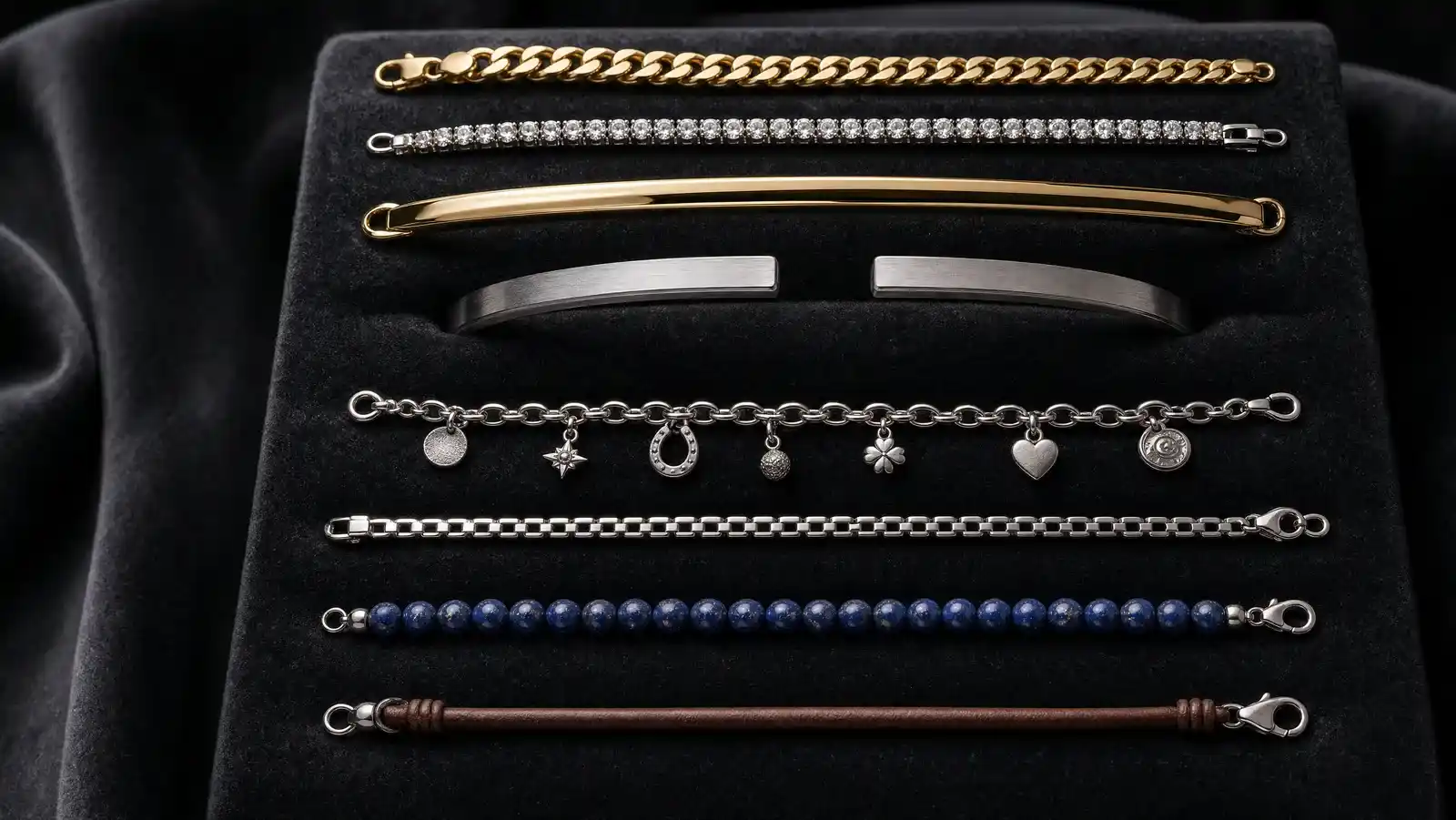
Dangle Charms on a Link Chain
The traditional form. Fewer Finer dates Tiffany & Co.'s first charm bracelet to the 1889 Paris Exposition: a chain-link bracelet with a single dangling heart. Each charm hangs from a link on a jump ring, split ring or clip; the base is the same kind of chain you would wear on a necklace, only shorter. Almost any charm with a loop fits. The weak point is the ring.
Threaded Bead Systems
The Pandora model. Beads with a wide centre hole slide onto a smooth, snake-style chain, with short threaded bands as stations. Pandora's patent for the system, US 7,007,507, granted in 2006, describes threaded keepers rotated onto those bands, which "restricts the movement of the beads on the strand and prevents bunching." On the bracelet, clips do that job: Pandora's size guide, a 2015 PDF still hosted on its site, builds from a bracelet, "a pair of clips," charms, then a safety chain.
Cross-brand fit is not guaranteed. The same guide says Pandora's Essence bracelets are "not meant to be used with Moments charms." If one maker's own lines do not cross over, another maker's beads are not promised to fit. Even Charmarama, a charm retailer, sizes one of its attachment links to fit "most Pandora style bracelets." Most is not all.
Composable Links and Wire Bangles
Nomination's Composable bracelet has no chain; the charms are the links. Its FAQ says each link "can be added, removed or replaced thanks to the ingenious spring mechanism hidden inside each Link," and measures approximately 1 cm wide and 0.9 cm high, in stainless steel (304 or 316). Composable links are, the FAQ adds, "for the most part, not compatible with bracelets from the Trendsetter Collection."
Wire bangles with slide-on charms belong here too: often cheap to start, but the circle cannot grow and charms bunch at the bottom.
| System | How charms attach | Mix brands? | Sizing | Typical failure |
|---|---|---|---|---|
| Dangle charms | Ring or clip through a link | Usually | Chain length plus charm room | Open ring; lost charm |
| Threaded beads (Pandora) | Beads over threads; clips fix sections | Not guaranteed | Pandora: wrist plus 2 cm | Chain stretches |
| Composable links (Nomination) | Spring-held links | Not guaranteed | Add or remove links | Charms displace plain links |
| Wire bangle | Charms thread onto the wire | If the loop clears | Fixed; size up | Charms bunch; wire bends |
Choosing the Base Chain
With dangle charms, the base does all the work.
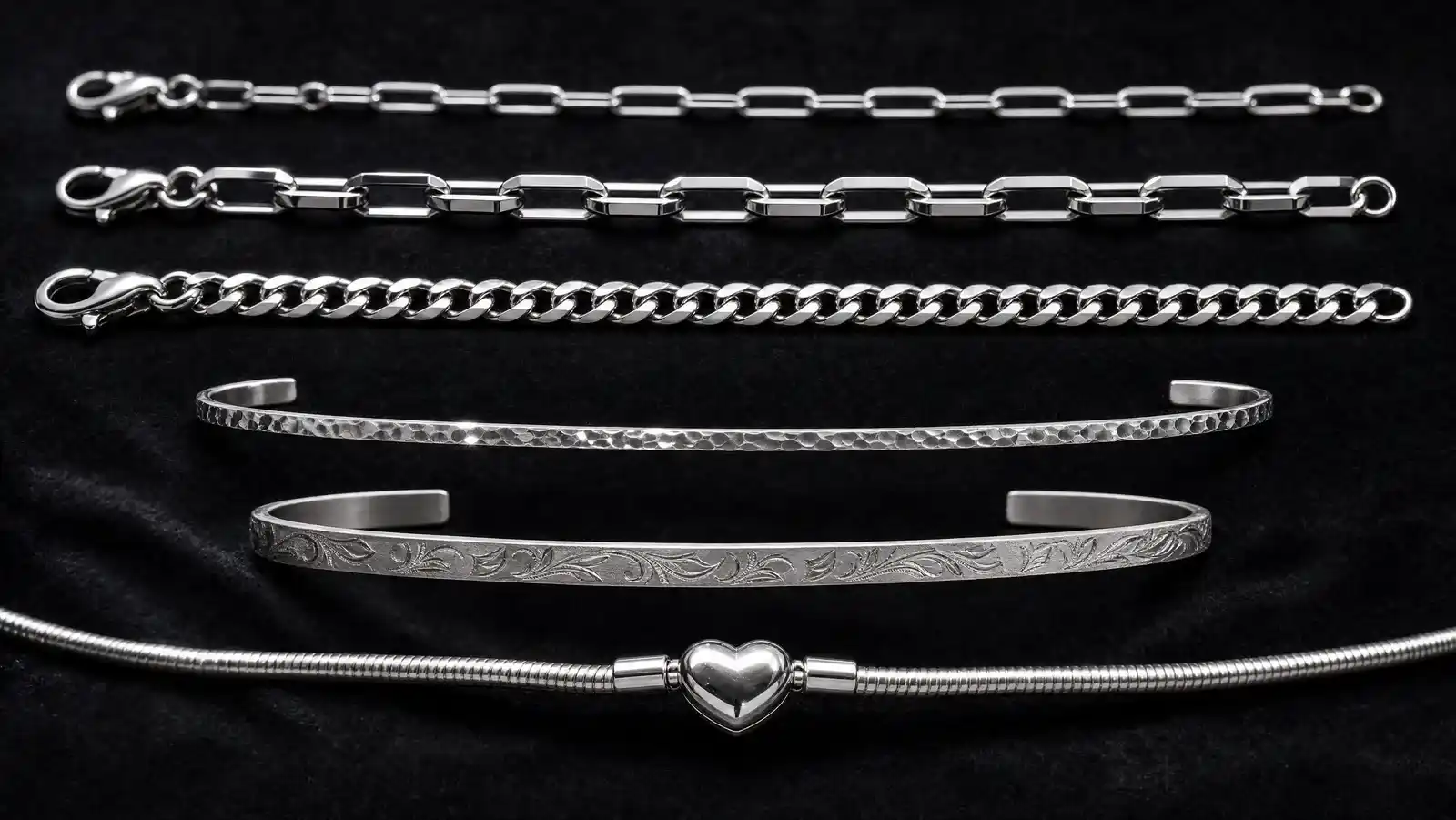
Link shape. Round links with open centres, such as rolo and belcher, take a jump ring from any side and let each charm hang straight. Our guide to types of necklace chains shows how each link is built, and the same geometry decides whether a link can carry a charm.
Solid, soldered links. Each charm's ring rubs one link every time you move. Hollow links dent, and a ring riding in one spot can wear through. We would buy solid links in heavier wire than an empty bracelet needs, every one soldered closed: an unsoldered link is an open jump ring by another name.
Metal. Decide it once, because every charm should match. Sterling silver is the traditional, affordable choice; karat gold costs far more per charm. We would avoid plated bases, since plating wears first where rings and charms rub, which here is everywhere.
The clasp. You open this bracelet to add and move charms, so we would choose a lobster claw sized for the finished weight, plus a safety chain once the piece is valuable. Our ranking of bracelet clasp types covers which closures stay shut.
Sizing a Charm Bracelet
Charms take up room inside the circle. They hang under the wrist as well as on top, and beads sit all the way round the chain, so the same wrist needs a longer bracelet.
Pandora's size guide puts a number on it: measure tightly where the wrist is broadest and add 2 cm. Its most popular size is 19 cm. It adds that a bracelet with only a few charms "might seem loose in the beginning," and that one worn often "will grow about 1 cm over the first year." So do not size down to make an empty bracelet look snug.
For a dangle bracelet, we would measure the same way and choose the looser end of a comfortable fit, so the charms can hang. Our bracelet size guide walks through measuring. Bangles cannot adjust, so Pandora recommends "a size larger than your wrist measurement" if you are adding charms to one.
Jump Rings: The Part That Loses Charms
When a dangle charm goes missing, look at the ring first.
- Open jump ring. A cut loop of wire, twisted open and shut. Charmco, a charm retailer, warns it "leaves room for the charm to catch and snag on something or even fall off your chain or bracelet." Every swing levers at the seam.
- Soldered jump ring. The seam is fused, "creating a seamless loop," in Charmco's words. Charmarama calls it "customary, and advised" to have a jeweller solder new additions, yet ships each charm with an open ring, so that step is yours.
- Split ring. A double coil like a tiny keyring; Charmarama's measures 5 mm across. Judy Larson, writing for Wirejewelry.com, notes split rings "will not open as easily as jump rings but will if enough force is applied."
- Lobster clip. Easy to move or swap, but it is a small spring, and springs wear.
Our approach: hang new charms on clips or split rings while you settle positions, then have the final placements soldered, the same bench job as a necklace chain repair.
How to Build a Charm Bracelet: Spacing and Weight
This is our method, not a published standard, written for a dangle bracelet; bead systems follow.
- Lay it out before anything is closed. Bracelet flat, clasp at the bottom, charms beside it. The link opposite the clasp is your centre, and it shows on top of the wrist when the clasp sits underneath.
- Start at the centre with your first or favourite charm, ideally a mid-weight one.
- Work outward in mirrored pairs. Each new charm goes the same number of links out on the opposite side from the last, heavy across from heavy, so neither half outweighs the other.
- Spread the heavy charms round the whole circle. Alternate heavy and light along each side. The clasp is a weight too, and with the charms spread evenly it settles under the wrist. A heavy cluster opposite it rolls the clasp to the top, where it catches.
- Leave links free. We leave at least one empty link between charms, more beside wide ones, so each hangs straight without striking its neighbour.
- Separate soft from hard. Enamel chips and softer stones scratch when heavy metal charms knock them all day. Give them empty links or light neighbours.
- Keep the clasp clear, with no charms on the links beside it.
- Test before you solder. Wear it for a day on clips or split rings. If it rolls, move a charm off the heavy side.
On a threaded bead bracelet, the clips do the sectioning. Two clips make three sections, the job Pandora's patent describes: keepers that stop beads bunching. Without them, beads slide to the lowest point. We keep the sections roughly even in weight and fill the centre one first, since it shows.
How Many Charms, and How Heavy
Capacity depends on bracelet length, link size and charm size, so no universal number exists. Makers publish figures for their own systems:
- Pandora's size guide says its classic bracelets "hold an average of 15-20 charms, spacers or safety chains," and caps its leather bracelets at "a maximum of 5–7 charms."
- Nomination's FAQ says most people need at least 18 links to complete a Composable bracelet. Decorate every one and that is your charm count.
- For dangle bracelets, ours is arithmetic: count the links, subtract the ones beside the clasp, and divide by your spacing.
Charm bracelet weight matters more than count and is published less. Pandora notes its bracelet "stretches over time as weight (e.g. charms) is put on the bracelet." On a link base the same load pulls links long and wears rings thin. We stop adding when a bracelet starts turning on its own or leaving marks, and start a second rather than overload the first.
Building It Up Over Time
- Choose a loose rule. Places, years, initials: a theme makes the next charm easier to pick.
- Settle the metal once. A plated charm among solid ones will look worn first.
- Gift the system, not just the charm. When you shop for a charm bracelet for women or men as a present, choose the base first, then write down its maker, line, length and metal for whoever adds to it next. That note stops a gift bead arriving that will not fit.
- When it is full, start a second bracelet in the same system, or move the overflow to a necklace, where a heavier charm hangs well on its own.
- Beside other pieces, a charm bracelet's charms catch on neighbours. Our guide on how to stack bracelets covers combinations; we give it smooth, plain neighbours and keep the watch on the other wrist.
Care and Storage
Dirt collects wherever a charm bracelet moves: in ring seams, around charm loops and between beads and chain. That is why how to clean a bracelet with charms differs from a plain chain. A polishing cloth cleans the surface, but only mild soapy water and a soft brush reach the rings. Keep silver dips away from enamel and stone-set charms, and dry threaded beads thoroughly.
Store it flat in its own compartment with the clasp fastened, so charms cannot grind against each other. Our jewelry storage guide covers compartments and travel.
Choose the System First
Pick the attachment system, then a base that can carry the finished weight, then size for the charms, then close every ring. After that, the charms are the easy part. If you are still weighing a charm bracelet against other constructions, our guide on how to choose a bracelet covers every type, metal and fit.
FAQ
How many charms go on a bracelet?
It depends on the system. Pandora's size guide puts its classic bracelets at an average of 15 to 20 charms, spacers or safety chains, and Nomination says most people need at least 18 Composable links. On a dangle bracelet, count the links and divide by your spacing.
Can you put any charm on any bracelet?
No. Dangle charms fit most link bracelets if the ring passes through the link, but threaded beads and composable links are system-specific. Pandora's guide says even its own Essence bracelets are not meant for Moments charms.
What bracelets can you add charms to?
Link bracelets with solid, soldered, open-centred links such as rolo or belcher; threaded bead bracelets; composable link bracelets; and wire bangles with a removable end. We would avoid plated, hollow or very fine chains.
Should a charm bracelet be loose or tight?
Looser than a plain bracelet, because charms need room inside the circle; Pandora adds 2 cm to a tight wrist measurement. Not so loose that it spins the clasp to the top.
How do you attach a charm to a bracelet?
Twist a jump ring open sideways with two pairs of pliers, add the charm and link, and close it flush, or better, have a jeweler solder it. Threaded beads twist over the chain's threads, and Nomination sells a tool, the Composable Key, for adding, removing or rearranging links.
About the Author
Alfreda Borror
Alfreda Borror is the founding editor of Opulent Opal, writing research-based buying guides on diamonds, birthstones, and fine jewelry.