Bracelet Size Guide: How to Measure Your Wrist

This post may contain affiliate links. Read our affiliate policy
The listing says 7.5 inches. Your wrist measures 7.5 inches. You order it, the clasp closes against skin, the bracelet cannot move, and it is back in the box by the weekend.
The whole method: wrap a flexible tape around your wrist at the wrist bone, then add a quarter inch to one inch depending on how you want it to sit. That sum is your bracelet size, not the number you measured. Below is the bracelet size chart in inches and centimetres, plus the exceptions it does not cover.
For the wider picture — styles, metals, closures — start with our complete guide to bracelets.
Table of Contents
- Wrist Size Is Not Bracelet Size
- How to Measure Your Wrist
- How Much Allowance to Add
- Bracelet Size Chart in Inches and Centimetres
- Average Bracelet Sizes for Women and Men
- How Bracelet Type Changes the Number
- Bangles Are Sized by Diameter
- Cuffs: Circumference Minus the Gap
- Small Wrists and Large Wrists
- Buying a Bracelet as a Gift
- What Can and Cannot Be Resized
- Getting the Number Right
- FAQ
Wrist Size Is Not Bracelet Size
Two numbers get called "bracelet size," and confusing them causes most returns. Your wrist size is the circumference of your arm. Your bracelet size is the finished length of the jewelry, measured end to end with the clasp closed. Ferkos Fine Jewelry: "Your wrist size is the measured circumference of your wrist while the bracelet length is the circumference of the jewelry." Plumb Club is blunter — "This is your wrist size and not your bracelet size."
The gap between them is the allowance: the slack that lets a bracelet rotate and clear the wrist bone. Order a 6.5-inch bracelet for a 6.5-inch wrist and you have ordered none.
Watch the wording. "Fits wrists 6 to 7 inches" is a wrist range; "7 inches" is a finished length. If a listing will not say which, ask.
How to Measure Your Wrist
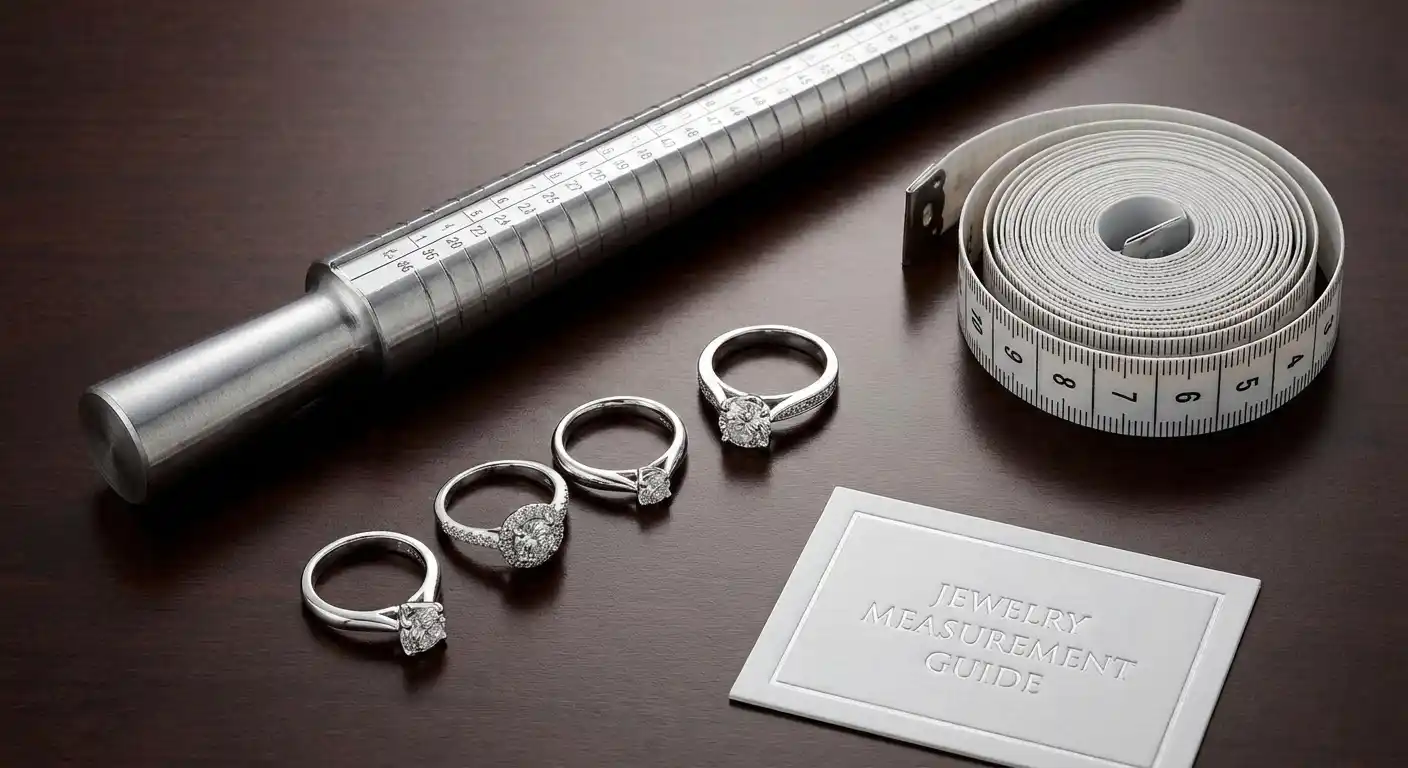
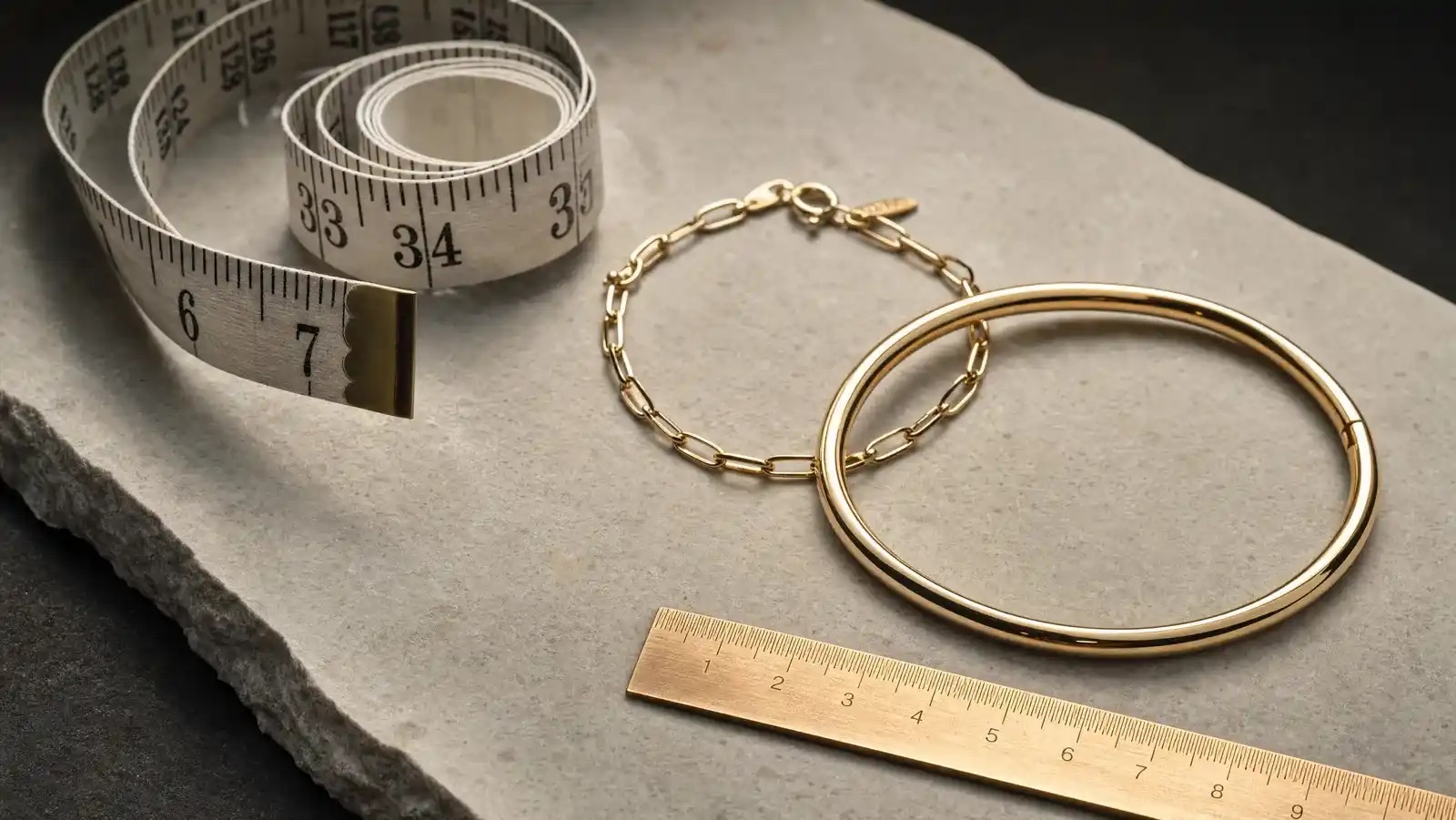
Use a flexible sewing tape, or a strip of paper and a ruler — not a rigid metal tape.
- Wrap it around your wrist at the wrist bone, on the hand side of the bone. REEDS Jewelers: "To get the perfect fit, measure your wrist at the wrist bone."
- Pull snug, not tight. Allowance gets added afterwards, deliberately, rather than absorbed into a loose measurement.
- For paper, follow oNecklace: "mark the point where it overlaps. Lay it flat and measure the length with a ruler." Plata de Santa Fe Jewelry suggests cutting the strip "as wide as the bracelet you would like to wear."
- Read to the nearest quarter inch, and measure twice on the arm you will wear it on. Finished lengths are mostly stocked in half-inch steps — James Avery gives the standard women's charm and multi-link length as 6.5 to 7.5 inches — so a finer reading rarely changes what you can order.
Same discipline as how to measure ring size: measure the body first, convert second.
How Much Allowance to Add
Published allowances cluster in a narrow band, and the spread inside it is taste rather than correctness.
- Snug. Greenwich Jewelers says to "add about a quarter inch for a bracelet that stays close without restriction."
- Classic. Greenwich again: "add half an inch for gentle movement and everyday comfort." Our default for a chain worn daily.
- Loose. Greenwich: "add three quarters of an inch or more for a loose, easy drape." REEDS Jewelers agrees, recommending three quarters of an inch to one inch "to allow for movement and flexibility."
To test one already on your wrist, Zadok gives the one-finger rule: "you should be able to comfortably slide one finger between the bracelet and your wrist." One finger, not two.
Bracelet Size Chart in Inches and Centimetres
Find your wrist measurement on the left and read across. Figures are finished bracelet lengths in inches.
| Wrist (in / cm) | Snug +0.25 | Classic +0.5 | Loose +1 |
|---|---|---|---|
| 5.25 / 13.3 | 5.5 | 5.75 | 6.25 |
| 5.5 / 14.0 | 5.75 | 6.0 | 6.5 |
| 5.75 / 14.6 | 6.0 | 6.25 | 6.75 |
| 6.0 / 15.2 | 6.25 | 6.5 | 7.0 |
| 6.25 / 15.9 | 6.5 | 6.75 | 7.25 |
| 6.5 / 16.5 | 6.75 | 7.0 | 7.5 |
| 6.75 / 17.1 | 7.0 | 7.25 | 7.75 |
| 7.0 / 17.8 | 7.25 | 7.5 | 8.0 |
| 7.25 / 18.4 | 7.5 | 7.75 | 8.25 |
| 7.5 / 19.1 | 7.75 | 8.0 | 8.5 |
| 7.75 / 19.7 | 8.0 | 8.25 | 8.75 |
| 8.0 / 20.3 | 8.25 | 8.5 | 9.0 |
Allowances follow Greenwich Jewelers and REEDS Jewelers; centimetres convert at 2.54 cm to the inch. Sellers outside the US quote finished lengths in centimetres:
| Length | cm | Usually sold as |
|---|---|---|
| 6.0 in | 15.2 | Petite women's |
| 6.5 in | 16.5 | Women's, small |
| 7.0 in | 17.8 | Women's, most common |
| 7.5 in | 19.1 | Women's large, men's small |
| 8.0 in | 20.3 | Men's, most common |
| 9.0 in | 22.9 | Top of standard stock |
Average Bracelet Sizes for Women and Men
If you cannot measure at all, these are the trade defaults.
- Women: 7 inches. REEDS Jewelers gives it as the industry standard; Plumb Club puts the range at "between 7 inches and 7.5 inches (18 to 19 cm), with 7 inches being the most common."
- Men: 8 inches. REEDS again gives the standard; Plumb Club says men's bracelets run "usually between 7.5 inches and 9 inches, 8 inches being the most common length."
Averages are a fallback, not a plan: a 7-inch bracelet on a 6-inch wrist carries a full inch of slack and spins the clasp to the front all day.
How Bracelet Type Changes the Number
The chart assumes a clasped chain or link bracelet, where you simply add your allowance and order that length. Other constructions do not obey it. Types of Bracelets: Every Style Explained covers what each style is; here is what each does to your number.
Tennis bracelets — a continuous line of stones in individual settings — want a tight size. Ferkos notes they are "heavier than other, more dainty bracelets because of all the diamonds," and that weight drags a loose one to the underside of the wrist.
Stretch and beaded bracelets need the least ease of anything here, because the cord already gives. Bead diameter sets the increments: on a strand of 10 mm beads, each bead moves the length by a centimetre.
Wide bracelets need more length than a fine chain at the same wrist size, for reasons of geometry rather than fashion. Your forearm is a taper, not a cylinder: a 5 mm chain sits in one narrow band at the wrist bone, while a 30 mm cuff spans a stretch of arm that is wider at its upper edge, so it binds there before it closes below. Width behaves on the wrist much as on the neck — our necklace chain guide covers how width and weight interact.
Bangles and cuffs ignore the wrist entirely. REEDS is explicit: bracelets without clasps "must fit over the widest part of the hand." Both get their own sections below.
Bangles Are Sized by Diameter
A rigid bangle is a closed circle. It has to clear your knuckles, then hang loose on a wrist narrower than your hand, so it is specified by inner diameter rather than length. Plumb Club: "The size of your hand and not your wrist determines your bangle size."
The Jewellery Room's method: "bring your thumb and little finger together as if you are putting on a bangle. Wrap a strip of paper or string around the widest part of your hand, which is usually across the knuckles." Divide that circumference by pi, roughly 3.14, for diameter. Its chart runs:
| Wrist measure | Bangle circumference | Bangle diameter |
|---|---|---|
| 5–5.5 in / 13–14 cm | 5.7–6.1 in / 14.5–15.5 cm | 1.8–2 in / 48–51 mm |
| 5.5–7 in / 14–17.7 cm | 6.5–6.9 in / 16.5–17.5 cm | 2.13–2.25 in / 54–57 mm |
| 7–8 in / 17.7–20.3 cm | 7.2–7.7 in / 18.5–19.5 cm | 2.38–2.50 in / 60–64 mm |
| 8.5–9 in / 21.5–22.6 cm | 8.2 in / 20.9 cm | 2.63 in / 67 mm |
Charts disagree about whether that first column is a wrist or a hand number, so read the seller's instructions. A correct bangle, per The Jewellery Room, is "slightly difficult to push over the knuckles but sit loosely on the wrist," and between sizes it recommends "choosing the larger one." A bangle fractionally too small is not tight, it is unwearable.
Cuffs: Circumference Minus the Gap
A cuff is an open band that slides on sideways through the gap between its ends, so its useful measurement is smaller than your wrist.
Plata de Santa Fe Jewelry separates the two figures sellers quote. Interior circumference is the inside measurement without the gap. Total circumference is that measurement "INCLUDING the gap" — its example being a 5 inch interior plus a 1 inch gap for a 6 inch total.
Which of the two a listing quotes decides what to order. Match a total circumference to your wrist: Plata de Santa Fe's worked example makes a 5-3/8 inch interior plus a 1-1/8 inch gap a 6.5 inch wrist size. Read an interior circumference as your wrist minus the gap, commonly half an inch to an inch, so a 7 inch wrist often takes a cuff listed near 6 to 6.5 inches.
Only the gap can be altered, and Plata de Santa Fe notes it adjusts "only if the gauge of the metal is light enough." A heavy silver cuff is effectively a fixed size. Its other warning: "NEVER 'squeeze' to tighten!!" Repeated flexing work-hardens the metal and loosens stone settings.
Small Wrists and Large Wrists
Below roughly 6 inches, standard stock stops working. Robinson's Jewelers: "For wrists under about 6 inches, the standard 7-inch bracelet is a recipe for a slip-and-slide situation." Two moves help.
Order less allowance, not more. Robinson's advises against automatically adding "lots of extra room," because "a petite wrist often needs a gentler, more snug fit to prevent sliding, especially for all-day wear. The bracelet should move slightly but not rotate completely around your wrist." A quarter inch is often enough. It also suggests 1.5 mm to 2 mm as the ideal tennis bracelet width on a small wrist.
Buy adjustability into the piece. The useful closures have more than one setting: a box clasp with a safety latch, a sliding barrel, a short extension chain. These are the mechanisms found at the back of a necklace, and our guide to necklace clasp types explains how each works. Read the bracelet clasp types on a listing as a sizing feature, not a detail.
Mainstream stock effectively ends at 9 inches — Plumb Club and Ferkos both cap the men's range there. Above it, a jeweler can insert links or fit an extender, or you order custom; REEDS offers custom sizing by special order and is upfront that it costs more and takes longer. Cuffs, wraps and cord designs scale without one. A rigid bangle will not.
Buying a Bracelet as a Gift
You cannot measure someone's wrist without explaining why. Here is what each workaround is worth.
- Measure a bracelet they already wear. By far the most accurate. Lay it flat, measure end to end with the clasp closed, and that is the finished length, directly comparable to a listing.
- Borrow a watch. A strap gives the circumference at the buckle hole they actually use, so you still add allowance.
- Compare to your own wrist. Rough, and useful only for choosing between petite and standard.
- Default to the standard. REEDS gives 7 inches for women and 8 inches for men. A reasonable guess and a poor plan.
Better to take sizing out of the decision. Adjustable styles are the safest gift: slider-cord bracelets, chains with an extender, wraps, and light-gauge cuffs all tolerate a wrong guess. Rigid bangles and fixed-length tennis bracelets are the least forgiving. If you are giving either, check the return policy first.
What Can and Cannot Be Resized
Resizability is a property of the construction, so learn it before you buy. Quick Jewelry Repairs reports that "link bracelets, bangle bracelets, and cuff bracelets can usually be resized pretty easily," while "certain bracelets made from wire or featuring intricate designs, might not be suitable for resizing."
Link and chain bracelets are the straightforward case. A jeweler can "lengthen or shorten it by removing or adding links and then reconnecting the bracelet using a soldering iron." How invisible the repair is depends on the link construction, as with necklaces — see types of necklace chains for which styles solder cleanly.
Bangles get cut and rejoined, a process Quick Jewelry Repairs calls "similar to ring resizing."
Tennis bracelets are shortened by taking out stone-set links. Zadok explains they can be "resized by adding or removing individual links, or by adjusting the clasp mechanism," and that when shortening, "you get to keep the removed diamond links." It warns that "dramatic changes can sometimes alter the drape, weight distribution, or how the clasp sits on your wrist."
Extender chains are the cheapest fix and the one nobody offers you. An inch or two rescues a bracelet that is slightly too small, and the clasp does the work instead of a torch. Quick Jewelry Repairs notes that resizing "can be expensive," so we would not buy the wrong size expecting a cheap fix later.
Getting the Number Right
Measure now, while a tape is in reach. Wrist bone, snug, twice, to the nearest quarter inch. Write it down: that number plus your preferred allowance answers every bracelet listing you will read for the next decade.
Then remember what it does not answer. A bangle asks about your knuckles, a cuff about its gap, a stretch bracelet for almost no ease at all.
Sizing is the part of this purchase with a right answer. The rest — style, metal, closure, what it should cost — is judgement, and we work through it in our guide to choosing a bracelet.
FAQ
What is bracelet size 7?
A finished length of 7 inches, or 17.8 cm, measured end to end with the clasp closed — not a wrist measurement. REEDS Jewelers calls 7 inches the industry standard for women's bracelets, and it typically suits a wrist of about 6.25 to 6.75 inches.
How big is a 7.5 bracelet?
7.5 inches, or 19.1 cm, of finished length — the top of the women's range and the bottom of the men's. Plumb Club puts the women's norm at 7 to 7.5 inches and the men's at 7.5 to 9 inches. On a 7-inch wrist it leaves the half inch of movement Greenwich Jewelers calls everyday comfort.
What size bracelet should I get?
Measure at the wrist bone, then add your allowance: about a quarter inch for snug, half an inch for everyday comfort, or three quarters of an inch to one inch for a loose drape, per Greenwich Jewelers and REEDS Jewelers. Order the total. If you cannot measure, REEDS' standards of 7 inches for women and 8 inches for men are the safest defaults.
Are bracelet sizes in inches?
In the US, yes, and stock mostly runs in half-inch steps — 6.5, 7, 7.5, 8 inches, as James Avery's size guide lists them — though some jewelers cut sizes in between. Sellers elsewhere list the same lengths in centimetres at 2.54 cm to the inch, so a 7-inch bracelet appears as 17.8 cm. Bangles are the exception, being specified by inner diameter rather than length.
What is the average bracelet size for a woman?
Seven inches. REEDS Jewelers gives it as the industry standard, Plumb Club calls it the most common size, and Ferkos Fine Jewelry puts the typical range at 6.5 to 7.5 inches.
About the Author
Alfreda Borror
Alfreda Borror is the founding editor of Opulent Opal, writing research-based buying guides on diamonds, birthstones, and fine jewelry.