What Is a Tennis Bracelet? Fit, Sizing and How to Buy One

This post may contain affiliate links. Read our affiliate policy
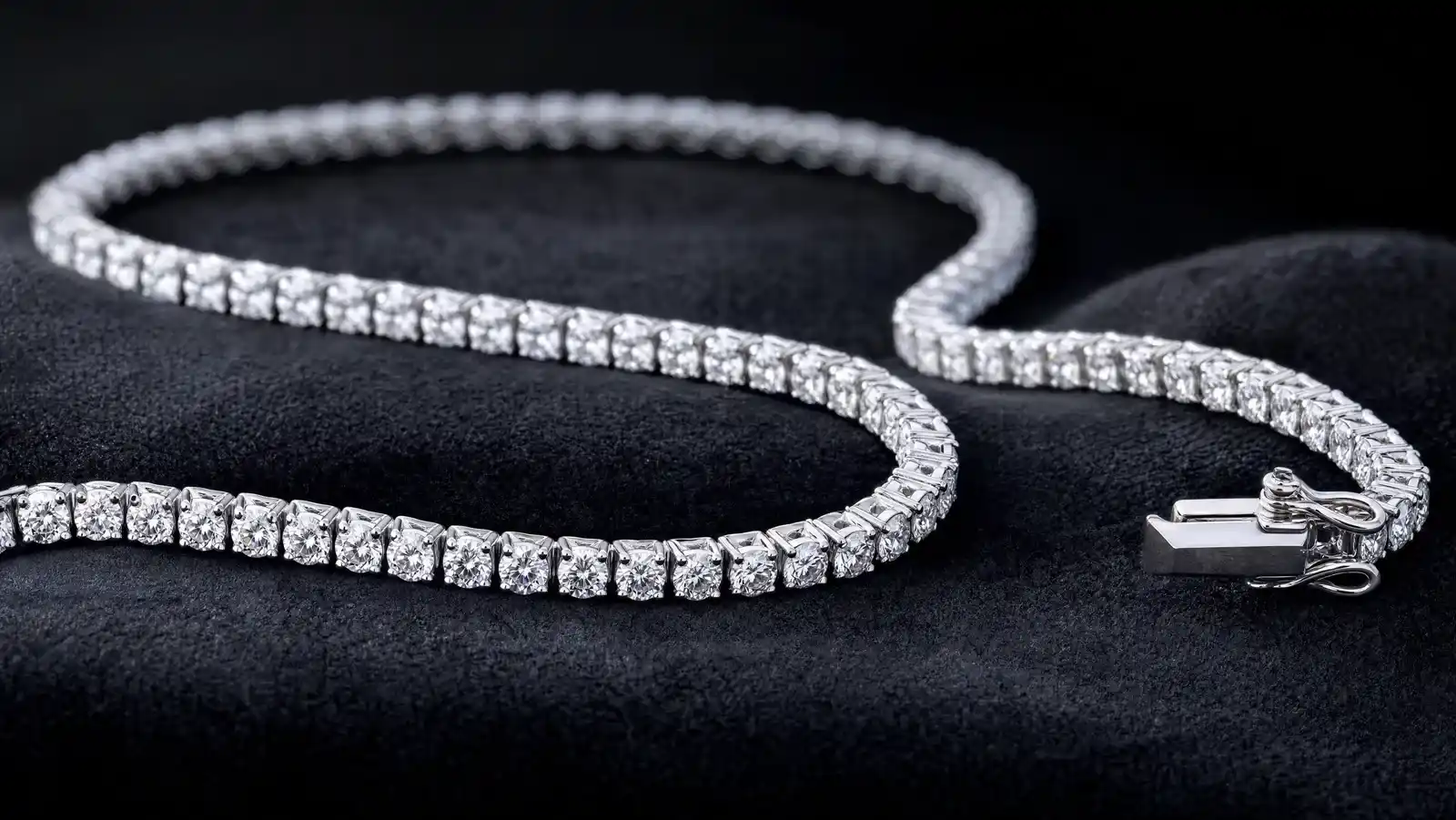
A tennis bracelet is a continuous, flexible line of individually set stones of near-identical size, cut and quality, running the whole way around the wrist with no centre motif and no plain stretch of chain. Two words do the work: continuous and matched. Almost every disappointing purchase in this category fails one of them.
Marketplaces are full of bar accents, five-stone stations and wave links sold under the name. They are not tennis bracelets, and the difference shows in the listing photo once you know what to look for. For the wider category, with every bracelet construction, closure and sizing method side by side, see our bracelet buying guide.
Table of Contents
- The Definition: Continuous and Matched
- Where the Name Came From
- How a Tennis Bracelet Should Sit on the Wrist
- Sizing: Wrist Measurement Plus an Allowance
- Why Tennis Bracelets Flip, and How to Stop It
- Clasps and Safety Catches
- Resizing: Adding and Removing Links
- Prong, Bezel and Channel Settings
- What the Stones Can Be
- Setting Types Compared
- Buying One: The Order of Decisions
- FAQ
The Definition: Continuous and Matched
Three features define the style; a piece needs all three.
Continuous. Stones run end to end, meeting at the clasp. No plain chain, no centre stone, no gap.
Matched. Every stone is close to the same size, shape, cut and grade, so the line reads as one band of light rather than a row of individuals. GIA's buying guide for tennis bracelets describes the style as a flexible band featuring a continuous line of individually set diamonds or gemstones encircling the wrist in a seamless design.
Individually set. Each stone sits in its own setting, and the settings link to each other. That articulation is what lets a rigid row of metal bend around a wrist.
Two checks on a listing photo. Follow the line all the way round: if the stones stop and a plain chain runs on to the clasp, or a larger stone, bar or nameplate interrupts the middle, you are looking at a line accent or a station bracelet. Then ask for a shot of the underside, which shows whether each stone has its own setting joined to its neighbours or whether they all sit in one stamped strip. Our glossary of the types of bracelets covers those styles; neither is this one.
Matching is where the money goes. Fifty small stones that agree with each other are harder to buy than one good stone, and one stone a grade warmer than its neighbours reads as a dull spot — which is why total carat weight alone never tells you what a bracelet is worth. Our diamond color chart explains the letter grades across a row, and our notes on diamond clarity cover why an SI inclusion that hides completely at 0.03 carats becomes easier to see as the stones get larger.
Where the Name Came From
The story every jeweler tells: at the 1978 US Open, Chris Evert's bracelet came off mid-match, she asked officials to pause play while she found it, and the style took her sport's name.
The outline is probably true; the details are folklore. Mental Floss, in its account of the term's origins, reports that the incident is commonly dated to 1987 but that Evert's publicist, Tami Starr, clarified in 2018 that it happened in 1978: "Chrissie recalls that she was wearing a diamond and gold bracelet, and it broke and fell onto the court in an early round of the Open, and they had to stop play while she looked for it." The same piece notes the phrase did not reach newspapers until the mid-1980s, that the match "doesn't seem to have been widely reported in print, either (if at all)," and that there is "no rigid record" that buyers flocked to the style afterwards. GIA dates the moment only to the 1980s.
The construction predates the name by decades, sold as a line bracelet or an eternity bracelet.
How a Tennis Bracelet Should Sit on the Wrist
The rule: snug enough that it does not spin freely, loose enough that it slides along the wrist as you move.
GIA's buying guide and Brilliant Earth's fit guide both say a proper fit leaves room to slip one finger between the bracelet and your wrist. VRAI's sizing guide supplies the other half: a properly fitted tennis bracelet "should rotate slightly but not slide over your hand or feel loose enough to fall off."
Too loose and the clasp migrates to the top of the wrist, where it catches on cuffs and desk edges; the line rides upside-down, stones against skin; and the whole thing slides over the wrist bone onto the back of the hand, where it gets snagged.
Too tight and the settings press into skin, leaving a row of small dents, while the hinge points work against a fixed radius all day. Brilliant Earth notes a too-tight fit can feel restrictive and put unnecessary pressure on the clasp.
Sizing: Wrist Measurement Plus an Allowance
Measure, then add. VRAI's guide says to wrap a flexible tape or string around your wrist "just below the wrist bone, where a bracelet naturally sits," and measure it flat. Its formula is wrist measurement plus half an inch to one inch: half an inch for snug, three quarters for classic and a full inch for loose. Brilliant Earth's chart runs 5.5, 6, 6.5, 7 and 7.5 inches, with 6.5 to 7 inches typical for women and 7.5 inches typical for men.
The allowance works differently here than on a chain bracelet of the same length. A chain drapes, so surplus pools at the bottom of the wrist. A tennis bracelet is a row of small rigid settings joined end to end, so it holds a rough circle. Extra length does not become drape. It becomes rotation. We take the snug end of the range for daily wear.
VRAI adds the point that matters most before you pay: tennis bracelets "are not adjustable, which makes getting the correct size essential for both comfort and long-term wearability." For the conversions and how the allowance changes by style, our bracelet size guide has the charts.
Why Tennis Bracelets Flip, and How to Stop It
A tennis bracelet is not evenly weighted around its circumference. The stones and settings sit on one face, and the clasp concentrates mass at one point. Give it room to move and gravity does the rest: the heaviest part settles at the bottom, and you get stones under the wrist and the clasp on top.
So flipping is a sizing problem before it is anything else. A bracelet that cannot rotate cannot flip.
- Fix the length first. Half an inch of surplus circumference is often enough to cause it. Have a jeweler take out a setting or two and most flipping stops.
- Then add a safety chain if it still travels. A short chain bridging the ends limits how far it can turn.
It is not only cosmetic: worn stones-down, a bracelet grinds its settings against desks all day, which is how prongs wear thin.
Clasps and Safety Catches
The clasp decides whether you still own the bracelet at the end of the day.
Box clasp with a safety catch. Robinson's Jewelers describes the mechanism plainly: the clasp works by inserting a springy tongue into a box-shaped housing until it locks, and "a separate safety latch, sometimes called a figure-eight safety, then closes over the connection."
Plain lobster clasp. A spring-loaded gate in a teardrop body, reliable when well made. But as Robinson's puts it, "a lobster clasp normally depends on its single spring-loaded mechanism, while a box clasp with a secondary latch provides two separate barriers against accidental loss."
Why insist on redundancy when a necklace gets by with one clasp? A necklace that opens still lies across your shoulders, so you feel it and catch it. A bracelet has nothing holding it: Robinson's notes that a tennis bracelet is flexible by design and can simply fall away if its closure opens.
The failure we see most is not a broken clasp but a safety catch that was never engaged, because nobody told the owner it was there. Fastening the box is step one of two. Our guide to bracelet clasp types covers every mechanism and the way each one actually fails.
Resizing: Adding and Removing Links
Yes, in most cases, and the work happens at the ends next to the clasp. Zadok's guide describes resizing a tennis bracelet by adding or removing individual links, with the jeweler taking out the excess and reattaching the clasp. Three consequences.
Uniform beats graduated. If every setting is identical, any of them can come out and the line still reads as one band. On a graduated bracelet, removing end links changes the taper, which is harder, dearer and visible if done badly.
Removing links removes carat weight. Take out four settings holding 0.05 carats each and the bracelet is 0.20 carats lighter than the figure on the box, so update the appraisal. Ask for the removed settings back: Zadok notes they can be saved for repairs or repurposed into earrings or a pendant.
Shortening is cheaper than lengthening. Zadok points out that extending costs significantly more, because you pay for extra metal and for new stones at market price that then have to match the old ones. Guessing a gift size, guess long.
Prong, Bezel and Channel Settings
GIA's buying guide describes three constructions.
Prong. Small metal claws hold each stone, most often four per stone. GIA notes prongs let the maximum amount of light in from multiple angles, which is why prong-set lines are the brightest. Estate Diamond Jewelry puts it bluntly: "Prongs, by their very nature and construction, snag. Clothing is a real threat to a prong setting." A snagged prong bends, a bent prong loosens, and a loose stone leaves somewhere you will never find it. Jewelers Mutual recommends professional jewelry inspections twice a year, and a daily-wear prong piece is exactly what they are for: retipping a claw is cheap, matching a replacement stone to forty-nine others is not.
Bezel. A thin metal rim wraps the girdle of each stone. GIA describes this as surrounding the stone with a rim for maximum protection. The rim blocks side light, so the line reads softer than a prong line of identical weight, but nothing protrudes and nothing catches.
Channel. Stones sit between two parallel metal strips, which GIA describes as a smooth, snag-free, streamlined surface. Most protective against knocks, most awkward to repair: the walls have to be reworked to reseat one stone.
What the Stones Can Be
Natural diamonds. The default and the dearest. A vendor who cannot state the color and clarity range across the line is telling you something.
Lab-grown stones. Same crystal and hardness, grown in a reactor rather than the ground, and far cheaper per carat, so a given budget buys better matching. Our comparison of lab grown vs natural diamonds covers resale, the real trade-off.
Moissanite. A different mineral, hard and durable, brighter in a way some people love and others find obvious, and commonly the route to a wide line of large stones for a fraction of what the same line costs in diamond. Our piece on moissanite vs diamond covers how the two behave under light.
Cubic zirconia. Cheap, convincing when new, and a consumable. CZ is softer than the alternatives, and a bracelet takes constant abrasion at desk height, so facet edges commonly dull within a few years of daily wear.
Setting Types Compared
| Setting | Security | Sparkle | Snag risk | Repair cost |
|---|---|---|---|---|
| Four-prong | Moderate; depends on prong condition | Highest | High; claws catch knitwear | Low to retip, high to match a lost stone |
| Bezel | Highest against knocks | Softer; the rim blocks side light | Very low | Moderate; the rim is reopened |
| Channel | High against impact | Bright along the row | Very low; flush surface | Highest; walls reworked per stone |
Buying One: The Order of Decisions
- Measure the wrist and settle the length. Everything else is preference.
- Choose the setting for the life the bracelet will have. Daily wear under sleeves points to bezel or channel; occasional wear with maximum light points to prongs.
- Insist on a box clasp with a safety catch, or price in a safety chain.
- Then pick stone type and carat weight, and ask for both numbers: a 3-carat bracelet of sixty stones and one of thirty look nothing alike on a wrist.
When you are ready to compare real pieces by carat weight and budget, our roundup of the best tennis bracelets does that work. If you are still weighing this style against a bangle, a cuff or a charm bracelet, our guide to how to choose a bracelet walks the whole category.
FAQ
How loose should a tennis bracelet be?
Loose enough for one finger between the bracelet and your wrist, and no looser — the test GIA's buying guide and Brilliant Earth's fit guide both use. In inches, VRAI's formula is your wrist measurement plus half an inch for snug, three quarters for classic and a full inch for loose.
What size tennis bracelet should I get?
Measure your wrist just below the wrist bone and add half to three quarters of an inch. Brilliant Earth's chart runs 5.5 to 7.5 inches, with 6.5 to 7 inches typical for women and 7.5 inches typical for men. Buying a gift blind, go up: shortening is much cheaper than lengthening.
Can a tennis bracelet be resized?
Usually. A jeweler removes or adds whole settings next to the clasp, as Zadok's resizing guide describes. Removing settings reduces the total carat weight, so update the appraisal and ask for the removed links back. Uniform bracelets resize cleanly; graduated ones are harder, because losing end links changes the taper.
Why does a tennis bracelet flip upside down?
Because it is too big and unevenly weighted. The stones and settings sit on one face and the clasp adds mass at one point, so a bracelet with room to turn settles heavy-side-down. Shorten it first: a safety chain is a second measure, not a substitute for length.
Does a tennis bracelet have to have diamonds?
No. GIA's buying guide defines the style as a continuous line of individually set diamonds or gemstones, so the construction is what counts. Lab-grown stones, moissanite, cubic zirconia, sapphires and rubies all appear in this format.
About the Author
Alfreda Borror
Alfreda Borror is the founding editor of Opulent Opal, writing research-based buying guides on diamonds, birthstones, and fine jewelry.