The Complete Guide to Engagement Rings & Wedding Bands

This post may contain affiliate links. Read our affiliate policy
Choosing an engagement ring is one of life's most significant purchases—a symbol of commitment that will be worn and cherished for decades. Whether you're shopping for a surprise proposal or selecting rings together as a couple, understanding the fundamentals of diamond quality, ring settings, and current trends will help you make an informed decision. This comprehensive guide covers everything you need to know, from understanding the 4 Cs to selecting the perfect metal and finding rings that fit your budget.
Table of Contents
- Understanding the 4 Cs of Diamonds
- Engagement Ring Settings
- Diamond Shapes & Cuts
- Lab-Grown vs Natural Diamonds
- Choosing the Right Metal
- Ring Sizing Guide
- Wedding Bands
- Budget Considerations
- 2025-2026 Trends
- How to Shop Smart
- FAQ
Understanding the 4 Cs of Diamonds
The 4 Cs—Cut, Color, Clarity, and Carat—were established by the Gemological Institute of America (GIA) in the 1940s as the universal standard for evaluating diamond quality. Understanding these factors helps you balance beauty and value.
Cut: The Most Important C
Of all the 4 Cs, cut has the greatest influence on a diamond's sparkle, fire, and brilliance. Cut refers not just to a diamond's shape, but to its proportions, symmetry, and polish—how well the facets interact with light.
When light enters a well-cut diamond, it bounces around internally and reflects back through the top, creating that coveted sparkle. Poorly cut diamonds—whether too shallow or too deep—allow light to escape through the sides or bottom, resulting in a dull appearance.
Cut grades range from Excellent to Poor:
- Excellent/Ideal: Maximum fire and brilliance
- Very Good: Reflects most light, excellent value
- Good: Reflects much light, budget-friendly
- Fair/Poor: Light escapes, noticeably less brilliant
Expert tip: When budget is limited, prioritize cut over carat weight. A smaller, excellently cut diamond will outshine a larger, poorly cut one.
Color: The Absence of Color
For traditional white diamonds, "color" actually measures the absence of color. The GIA grades diamonds from D (completely colorless) to Z (light yellow or brown tint).
Color scale breakdown:
- D-F (Colorless): Extremely rare and valuable. Most people cannot distinguish between these grades.
- G-J (Near Colorless): Excellent value. Color is difficult to detect, especially once mounted.
- K-M (Faint Color): Slight warmth visible. Can look beautiful in yellow or rose gold settings.
- N-Z (Light Color): Noticeable color. Significant price discount.
Expert tip: For most shoppers, H or I color diamonds offer the best balance of appearance and value. The slight warmth is invisible to the naked eye and can save 15-20% compared to D-F grades.
Clarity: Internal Characteristics
Clarity measures how free a diamond is from internal characteristics (inclusions) and surface blemishes. Most diamonds have tiny imperfections formed during their creation deep within the Earth.
Clarity grades:
- FL/IF (Flawless/Internally Flawless): No inclusions visible under 10x magnification. Extremely rare.
- VVS1-VVS2 (Very, Very Slightly Included): Inclusions difficult to see under 10x magnification.
- VS1-VS2 (Very Slightly Included): Minor inclusions visible under 10x magnification but not to naked eye.
- SI1-SI2 (Slightly Included): Inclusions visible under 10x, may be visible to naked eye in SI2.
- I1-I3 (Included): Inclusions visible to naked eye. May affect transparency and brilliance.
Expert tip: VS1-SI1 grades typically offer the best value—inclusions are invisible to the naked eye, saving 20-30% compared to VVS grades.
Carat: Weight, Not Size
Carat measures a diamond's weight, not its size. One carat equals 200 milligrams, and each carat divides into 100 points. A 0.75 carat diamond, for example, equals 75 points.
Two diamonds of equal carat weight can appear different sizes depending on their cut and shape. An elongated marquise or oval will look larger than a round diamond of the same weight.
Price considerations:
- Prices jump at "magic numbers": 0.5, 0.75, 1.0, 1.5, and 2.0 carats
- A 0.95 carat diamond looks virtually identical to 1.0 carat but costs significantly less
- Shape affects perceived size—oval and marquise shapes appear larger per carat
For more details on balancing diamond quality with budget, see our guide to engagement rings under $1000.
Engagement Ring Settings Explained
The setting—how the diamond is mounted—dramatically affects the ring's overall appearance, the stone's security, and even how large the diamond appears.
Solitaire Setting
The solitaire remains the most popular engagement ring style, accounting for over 50% of engagement ring sales according to industry data. A single center stone is held by four to six prongs on a simple band, allowing maximum light to enter the diamond.
Pros:
- Timeless elegance that never goes out of style
- Showcases the center stone without distraction
- Easy to match with any wedding band
- Lower cost (no accent stones)
Cons:
- The diamond is the entire focus—quality matters more
- Some find it too simple
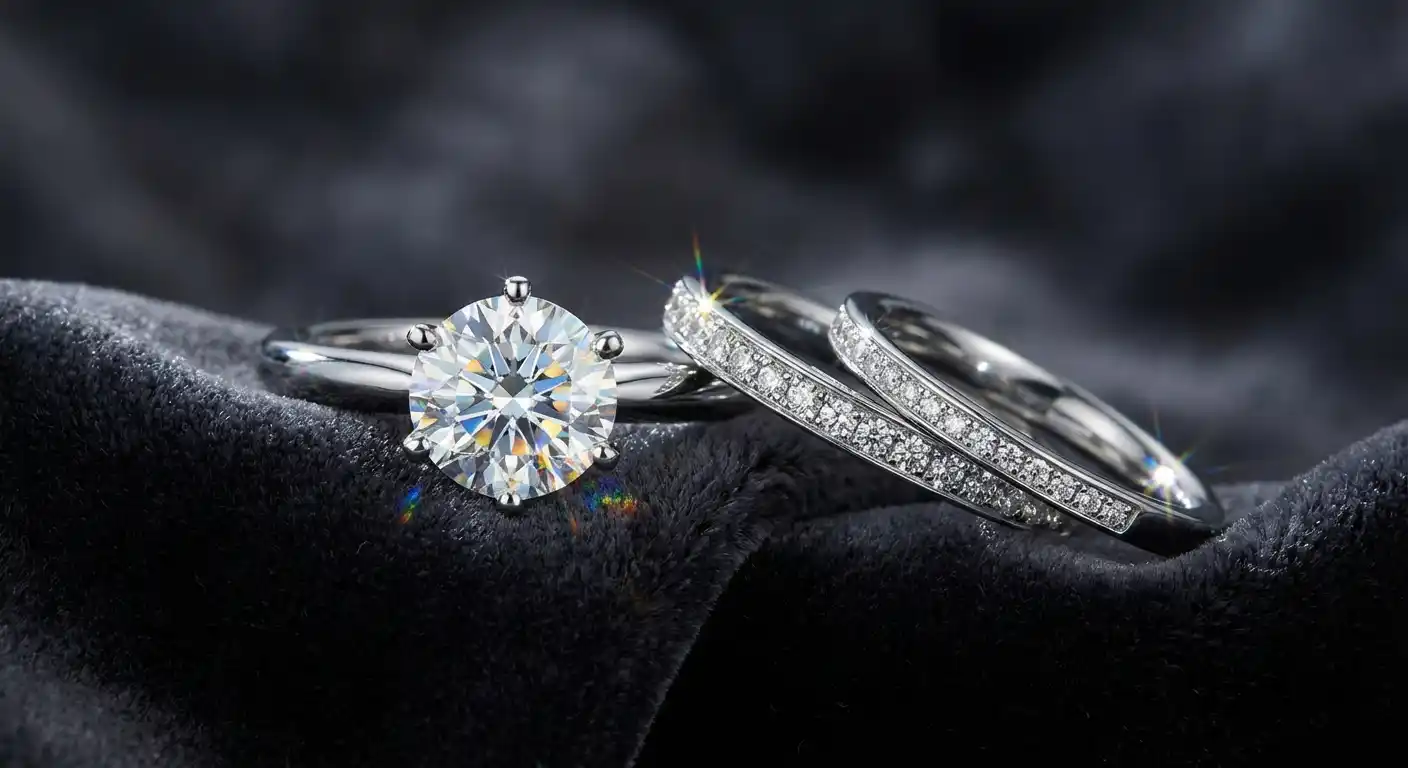
The iconic Tiffany setting, introduced in 1886, uses six prongs to elevate the diamond above the band, maximizing light exposure and creating the quintessential engagement ring silhouette.
Halo Setting
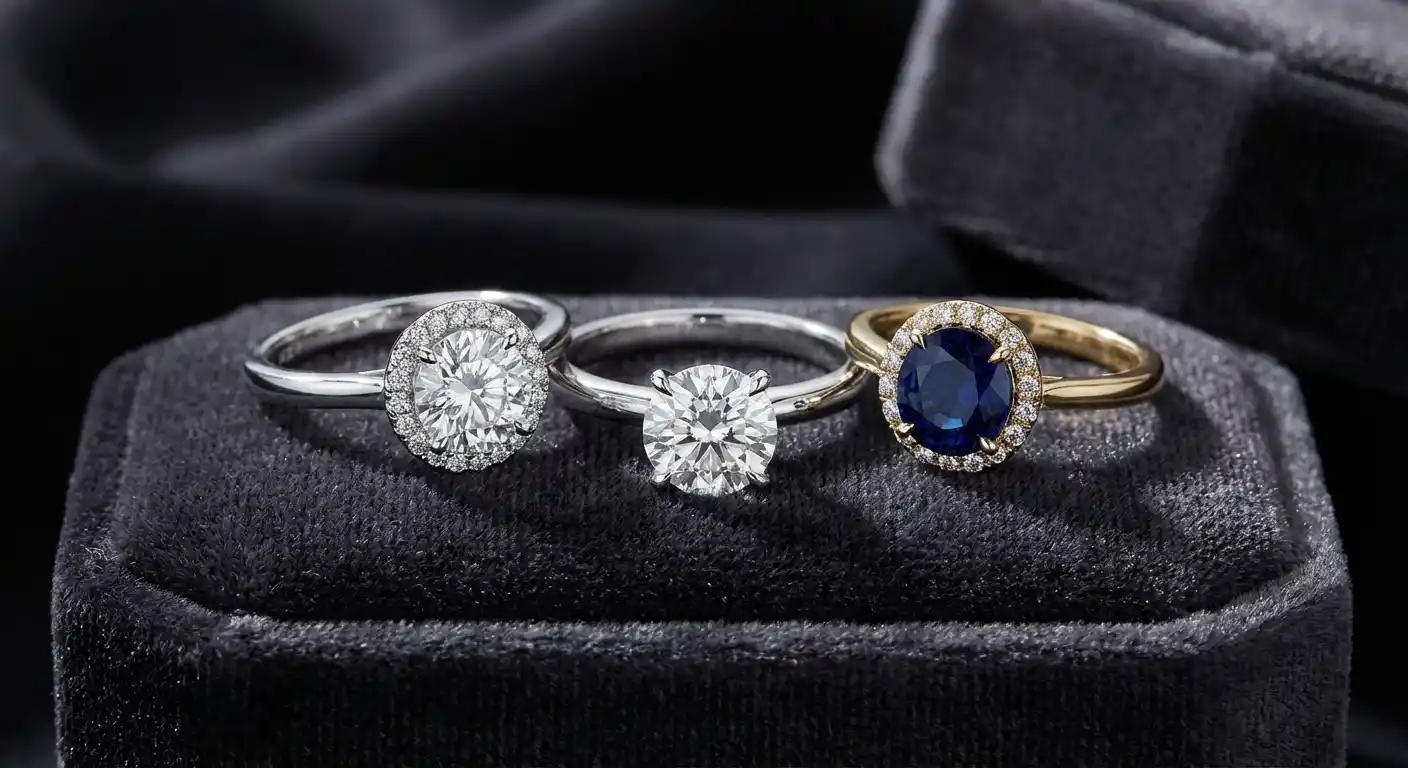
The halo setting surrounds the center stone with a ring of smaller diamonds, creating a larger, more brilliant appearance. This style accounts for approximately 19-20% of engagement ring choices.
Pros:
- Makes center stone appear up to 50% larger
- Adds significant sparkle
- Offers vintage-inspired elegance
- Allows for a smaller (less expensive) center stone
Cons:
- More intricate = more maintenance
- Can overwhelm very petite fingers
- Higher cost than solitaire
Variations include double halos, cushion-shaped halos around round stones, and hidden halos placed beneath the center stone for subtle sparkle from the side.
Three-stone rings (also called trilogy or trinity rings) feature a larger center stone flanked by two smaller stones. This style carries meaningful symbolism—past, present, and future—making it popular for both engagement and anniversary rings.
Pros:
- Deep symbolic meaning
- Offers incredible sparkle
- Versatile styling options (matching or mixed shapes)
- Can include colored gemstones
Cons:
- Higher cost due to multiple stones
- More settings require more maintenance
Modern variations mix diamond shapes—pairing an oval center with pear-shaped side stones, or a round center with half-moon accents.
Other Popular Settings
Bezel Setting: A rim of metal surrounds the diamond entirely, offering excellent protection for active lifestyles. The sleek, modern look is gaining popularity.
Pavé Setting: Tiny diamonds line the band, held by minimal metal for a continuous sparkle effect. Creates a dazzling appearance but requires care to prevent stone loss.
Cathedral Setting: Arches of metal support the center stone, resembling the architectural lines of a cathedral. Adds height and elegance.
Tension Setting: The diamond appears to float between the ends of the band, held by pressure alone. Requires precise engineering and a high-quality band.
For an in-depth comparison of the most popular styles, see our engagement ring settings guide.
Diamond Shapes & Cuts
While "cut" refers to quality (excellent to poor), "shape" describes the diamond's outline. Each shape has distinct characteristics affecting sparkle, perceived size, and style.
Round Brilliant
The most popular shape, accounting for over 50% of diamond sales. Round brilliant diamonds are cut to maximize sparkle through 58 precisely angled facets. They're versatile, timeless, and graded on a standardized scale.
Best for: Traditional tastes, maximum brilliance
Oval
Trending strongly in 2025-2026, oval diamonds elongate the finger and appear larger than rounds of equal carat weight. Their brilliant faceting offers exceptional sparkle.
Best for: Modern elegance, perceived size
Cushion
With rounded corners and larger facets, cushion cuts offer a soft, romantic appearance. Available in square or rectangular proportions, they display excellent fire.
Best for: Vintage-inspired looks, warm brilliance
Emerald
Step-cut facets create a hall-of-mirrors effect rather than sparkle. Emerald cuts emphasize clarity and color, requiring higher quality grades for best appearance.
Best for: Art deco style, quiet luxury
Princess
A square shape with brilliant-style faceting, princess cuts offer contemporary edge with excellent sparkle. They're often less expensive per carat than rounds.
Best for: Modern tastes, value-conscious buyers
Marquise
An elongated shape with pointed ends, marquise diamonds create the illusion of longer, slimmer fingers. Their large surface area makes them appear larger than other shapes of equal weight.
Best for: Dramatic statement, finger-elongating effect
Pear
Combining round and marquise shapes, pear (teardrop) diamonds offer romantic elegance. They can be worn with the point toward or away from the fingertip.
Best for: Unique style, romantic aesthetic
Explore all shapes in detail in our diamond shapes guide.
Diamonds
One of the most significant developments in the engagement ring market is the rise of lab-grown diamonds. According to The Knot's 2025 Real Weddings Study, 52% of couples now choose lab-grown diamonds for their engagement rings—up from just 12% in 2019.
What Are Lab-Grown Diamonds?
Lab-grown diamonds are chemically, physically, and optically identical to mined diamonds. They're pure carbon crystals with the same hardness (10 on the Mohs scale), brilliance, and fire. Even gemologists need specialized equipment to distinguish them.
Two primary methods create lab-grown diamonds:
- HPHT (High Pressure High Temperature): Mimics natural diamond formation conditions
- CVD (Chemical Vapor Deposition): Grows diamonds from a carbon-rich gas in a vacuum chamber
Price Difference
The cost advantage of lab-grown diamonds is substantial. As of 2025:
- Average 1-carat lab-grown diamond: ~$1,000-1,500
- Average 1-carat natural diamond: ~$4,000-4,500
This 70-85% price difference means you can purchase a significantly larger or higher-quality lab-grown diamond for the same budget. The average lab-grown engagement ring costs about $4,900 compared to $7,600 for natural diamond rings, according to The Knot.
Key Considerations
Choose lab-grown if:
- Budget is a primary concern
- You want a larger or higher-quality stone
- Environmental and ethical sourcing matters to you
- You plan to upgrade in the future
Choose natural if:
- You value rarity and natural origin
- Resale value is important (lab-grown diamonds have minimal resale value)
- You prefer the tradition of natural diamonds
- You're purchasing as an heirloom investment
For a complete comparison, read our lab-grown vs natural diamonds guide.
Choosing the Right Metal
The metal you choose affects the ring's appearance, durability, price, and how well it complements the diamond and wearer's skin tone.
Platinum
Platinum is the most durable precious metal, naturally white and hypoallergenic. It doesn't fade or tarnish over time.
Pros:
- Extremely durable and scratch-resistant
- Naturally white—never needs replating
- Hypoallergenic
- Holds stones securely
Cons:
- Highest price point (typically $300-800 more than white gold)
- Heavier weight
- Develops a patina over time (some prefer this)
Best for: Those wanting the ultimate in durability and purity; active lifestyles; metal sensitivities.
White Gold
White gold is an alloy of yellow gold with white metals (palladium, nickel, or silver), plated with rhodium for a bright white finish.
Pros:
- More affordable than platinum
- Bright, modern appearance
- Widely available
- Lighter weight than platinum
Cons:
- Requires rhodium replating every 1-2 years
- May cause reactions in those with nickel allergies
- Less durable than platinum
Best for: Those wanting a platinum look at lower cost; traditional white metal aesthetic.
Yellow Gold
Yellow gold is experiencing a major resurgence in 2025-2026. Its warm, classic appearance complements warm-toned skin beautifully.
Pros:
- Timeless, classic appearance
- Complements warm skin tones
- Doesn't require replating
- Often more affordable than platinum
Cons:
- Shows scratches more easily than white metals
- May appear dated to some
- 14K is more durable than 18K (higher gold content = softer)
Best for: Classic style lovers; warm skin tones; vintage-inspired designs.
Rose Gold
Rose gold, an alloy of gold and copper, offers a romantic pink hue that flatters many skin tones.
Pros:
- Unique, romantic appearance
- Complements most skin tones
- More durable than yellow gold (copper adds strength)
- Distinctive and on-trend
Cons:
- May cause reactions in copper-sensitive individuals
- Not as traditional
- Can clash with certain wardrobe colors
Best for: Those seeking something unique; romantic aesthetic; warmer skin tones.
Compare metals in depth in our gold vs platinum engagement rings guide.
Ring Sizing Guide
Getting the right ring size is crucial—especially for surprise proposals. Here's how to find the perfect fit.
Average Ring Sizes
- Women: Average size 6 (range typically 4-8)
- Men: Average size 9 (range typically 8-12)
Methods to Determine Size
1. Borrow an existing ring: Take a ring they wear on their left ring finger and bring it to a jeweler, or trace the inside on paper and measure the diameter.
2. String/paper method: Wrap string or paper around the finger, mark where it meets, and measure the length against a ring size chart. Add ~2mm for comfort.
3. Ring sizer: Many jewelers offer free ring sizers, or you can purchase one online.
4. Professional sizing: Visit a jeweler for the most accurate measurement. This is ideal if you're shopping together.
Sizing Tips
- Measure multiple times: Finger size fluctuates throughout the day. Measure in the afternoon when fingers are largest.
- Consider temperature: Fingers shrink in cold weather and swell in heat.
- Account for band width: Wider bands (4mm+) fit tighter—size up half a size.
- When in doubt, go larger: Rings can be sized down more easily than up.
- Dominant hand is larger: The fingers on your dominant hand are slightly larger.
For detailed instructions, see our how to measure ring size guide.
Wedding Bands
Wedding bands symbolize the continuous circle of commitment. Here's what to consider when selecting bands for both partners.
Men's Wedding Bands
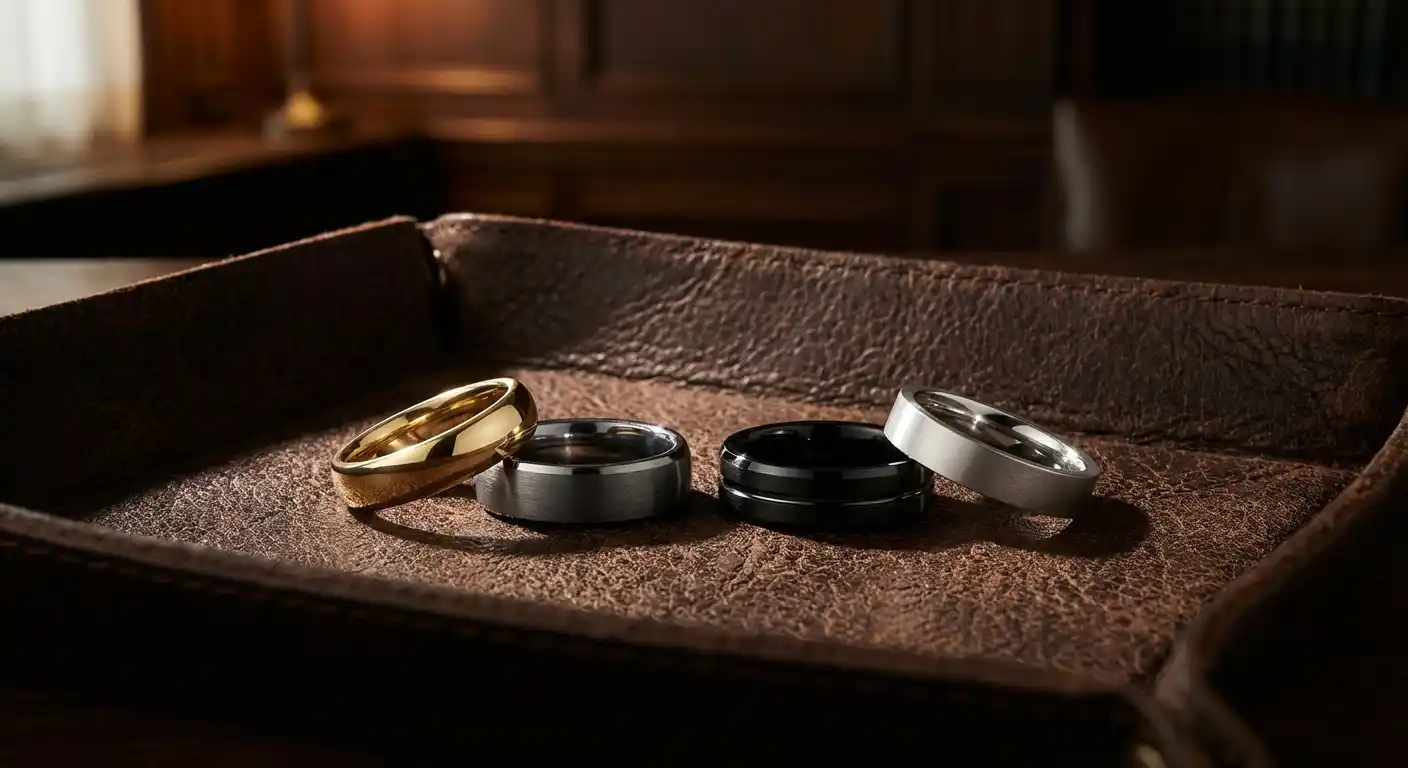
Men's wedding bands have evolved beyond simple gold bands. Today's options include:
Materials:
- Tungsten: Extremely scratch-resistant and affordable
- Titanium: Lightweight and hypoallergenic
- Gold (yellow, white, rose): Classic and traditional
- Platinum: Premium durability
- Alternative materials: Wood inlays, carbon fiber, meteorite
Trending styles for 2025-2026:
- Matte and brushed finishes
- Mixed materials (wood and metal)
- Diamond accents
- Wider bands (6mm+)
For more options, see our guide to best men's wedding bands and our existing article on men's wedding bands.
Women's Wedding Bands
Women's wedding bands range from simple to elaborate:
Styles:
- Plain bands: Classic, pairs with any engagement ring
- Eternity bands: Diamonds circling the entire band
- Half-eternity bands: Diamonds on the visible portion
- Curved/contour bands: Shaped to fit against engagement ring
- Stackable bands: Multiple thin bands worn together
Considerations:
- Should it match the engagement ring metal?
- Will it sit flush against the engagement ring?
- Do you prefer matched set or contrasting styles?
Explore options in our best women's wedding bands guide.
Matching vs. Coordinating
Couples don't need matching bands. What matters is that each ring reflects personal style while symbolizing your shared commitment. Some couples choose:
- Same metal, different styles
- Same style, different metals
- Completely different rings
- Custom-designed complementary designs
Budget Considerations
The notion that you should spend three months' salary on an engagement ring is a marketing invention—not a rule. De Beers began suggesting "one month's salary" in the late 1930s; this increased to two months in the 1980s and three months by the 1990s. Here's practical guidance for any budget.
What Rings Actually Cost
According to The Knot's 2024 survey:
- Average engagement ring spend: ~$5,200
- Median spend: ~$4,500
- Wide range: $500 to $50,000+
Your budget should be based on what you can comfortably afford, not arbitrary formulas.
Maximizing Value
1. Prioritize cut: A well-cut diamond sparkles more than a larger, poorly cut one. Never compromise on cut.
2. Find the sweet spots:
- Color: G-J appears colorless, saves over D-F
- Clarity: VS1-SI1 has no visible inclusions, saves over VVS
3. Consider "shy" weights: A 0.9-carat diamond costs less than 1.0 carat but looks nearly identical.
4. Choose alternative stones:
- Lab-grown diamonds: Same look, 70-85% less cost
- Moissanite: Nearly as hard, more brilliance, fraction of price
- Sapphires, morganite: Unique and beautiful
5. Simple settings cost less: Solitaires require no accent stones.
Budget-Friendly Options
We've created detailed guides for every budget:
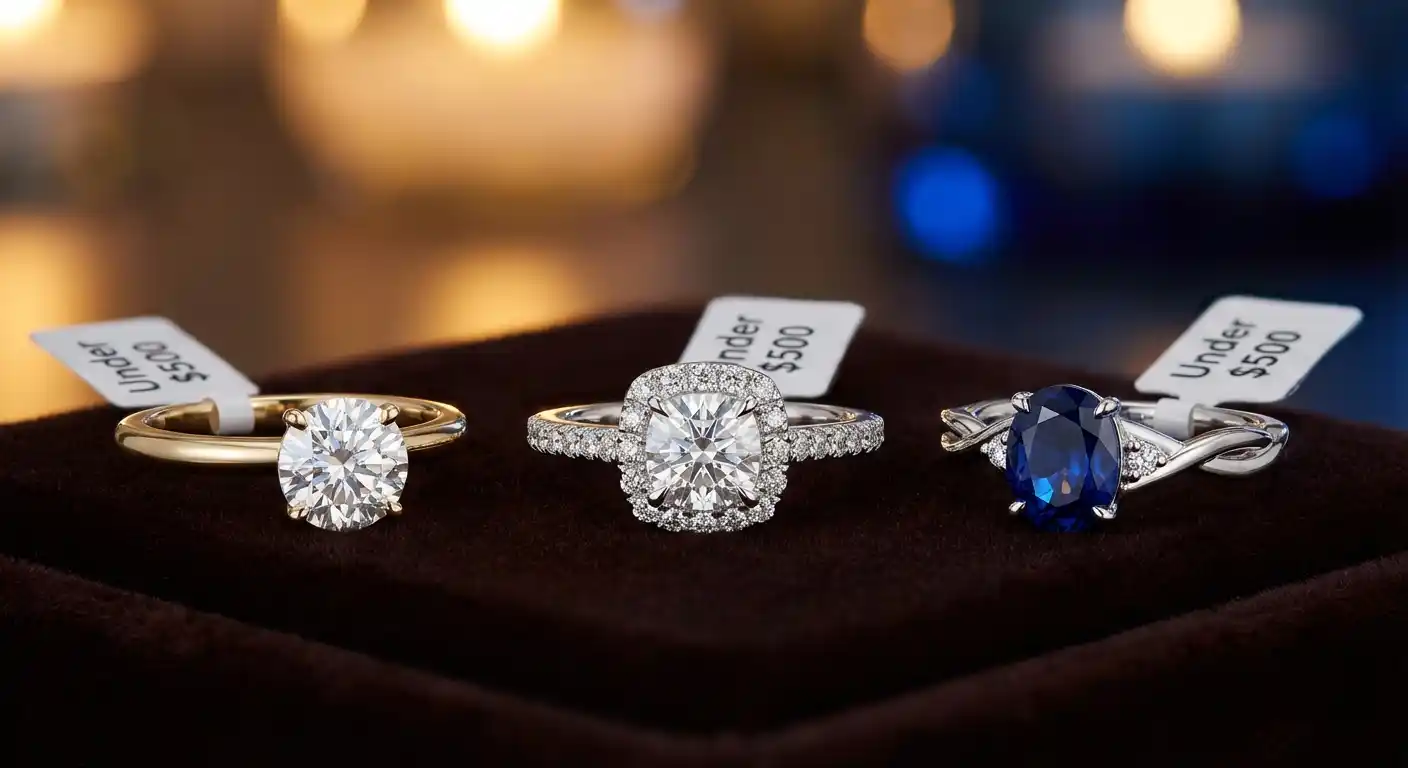
- Best engagement rings under $500
- Best engagement rings under $1000
- Moissanite vs diamond comparison
- Vintage engagement rings (often offer more value)
2025-2026
Stay current with the styles defining engagement rings this year.
Trending Shapes
- Oval: The dominant trend, offering finger-elongating elegance and perceived larger size
- Marquise: Making a dramatic comeback after the Old Mine cut gained celebrity attention
- Cushion: Soft, romantic, vintage-inspired
- Emerald: Clean lines for the quiet luxury aesthetic
Trending Settings
- East-West settings: Center stone turned horizontally for modern appeal
- Bezel settings: Sleek, protective, contemporary
- Toi et moi: Two stones together, symbolizing partnership
- Hidden halos: Sparkle visible only from the side
Trending Metals
- Yellow gold: Leading designer collections after years of white metal dominance
- Mixed metals: Combining gold tones for depth and interest
- Chunky bands: Moving away from ultra-thin for substantial presence
Trending Approaches
- Lab-grown diamonds: Now chosen by over half of couples
- Vintage and antique: Sustainable, unique, storied pieces
- Customization: Personalized engravings, meaningful details
- Colored gemstones: Sapphires, emeralds, and morganite as alternatives
For a complete breakdown, see our 2026 engagement ring trends guide.
How to Shop Smart
Navigate the engagement ring buying process with confidence.
Finding a Reputable Jeweler
- Read reviews and check ratings (Google, Yelp, BBB)
- Ask about certifications (GIA, AGS trained staff)
- Ensure diamonds come with grading reports (GIA, IGI, AGS)
- Understand return policies (30+ days is standard)
- Ask about sizing, cleaning, and maintenance services
Surprise vs. Shopping Together
More couples are shopping together—and that's okay. Benefits include:
- Ensuring she loves the style
- Accurate ring sizing
- Shared decision-making
- No pressure to guess preferences
If surprising, gather intel: observe jewelry she wears, ask friends/family, create a shared Pinterest board, or propose with a placeholder ring.
Red Flags to Avoid
- No certification or vague grading claims
- Pressure to buy immediately
- Unwillingness to explain pricing
- No return policy
- "Too good to be true" pricing on natural diamonds
Insurance and Maintenance
Insurance: Coverage typically costs 1-2% of the ring's value annually. Options include:
- Adding to homeowner's/renter's insurance
- Standalone jewelry insurance (Jewelers Mutual, Lavalier)
Maintenance:
- Professional cleaning: Every 6-12 months
- Prong inspection: Annually
- Replating (white gold): Every 1-2 years
Frequently Asked Questions
What's the average cost of an engagement ring?
The average engagement ring costs around $5,200, but couples spend anywhere from a few hundred to tens of thousands. Buy what you can afford—the meaning matters more than the price tag.
How far in advance should I buy an engagement ring?
Allow at least 2-4 weeks for standard purchases, 6-8 weeks for custom designs, and 8-12 weeks for complex custom work. For surprise proposals, factor in potential sizing adjustments.
Can you tell lab-grown diamonds from natural diamonds?
Not with the naked eye or standard jewelry loupes. Even gemologists require specialized equipment. Lab-grown diamonds are chemically identical to natural diamonds—the difference is origin, not appearance.
Should I prioritize cut or carat?
Cut, always. A well-cut 0.8-carat diamond will sparkle more brilliantly than a poorly cut 1-carat diamond. Cut directly affects how much the diamond sparkles—the quality most people notice first.
Do I need a GIA certificate?
A grading report from GIA, AGS, or IGI provides independent verification of diamond quality. It's strongly recommended for diamonds over 0.5 carats. Without certification, you're trusting the seller's assessment.
Can engagement rings be resized?
Most rings can be resized within 1-2 sizes. Rings with full eternity bands, tension settings, or certain alternative metals may be difficult or impossible to resize. Discuss with your jeweler before purchase.
Start Your Search
Finding the perfect engagement ring combines understanding technical quality factors with recognizing what resonates emotionally. Whether you prioritize a show-stopping carat weight, an ethically-sourced lab-grown diamond, or a unique vintage piece, the "right" ring is the one that makes you both happy.
Explore our complete engagement ring content library:
- Best Engagement Rings Under $1000
- Best Engagement Rings Under $500
- Lab-Grown vs Natural Diamonds
- Engagement Ring Settings Guide
- Diamond Shapes Guide
- How to Measure Ring Size
- Best Men's Wedding Bands
- Best Women's Wedding Bands
- Gold vs Platinum
- Moissanite vs Diamond
- Vintage Engagement Rings
- 2026 Engagement Ring Trends
About the Author
Alfreda Borror
Alfreda Borror is the founding editor of Opulent Opal, writing research-based buying guides on diamonds, birthstones, and fine jewelry.