Types of Bracelets: Every Style Explained

This post may contain affiliate links. Read our affiliate policy
A listing says "18k gold plated, 7.5 inches, 5mm." It does not tell you whether the clasp will pop open against the edge of a desk, whether the plating will wear through at the wrist bone first, or whether a jeweler can shorten the thing by half an inch. Bracelets take more abuse than any other jewelry, because a wrist rests on hard surfaces and gets knocked through doorways all day.
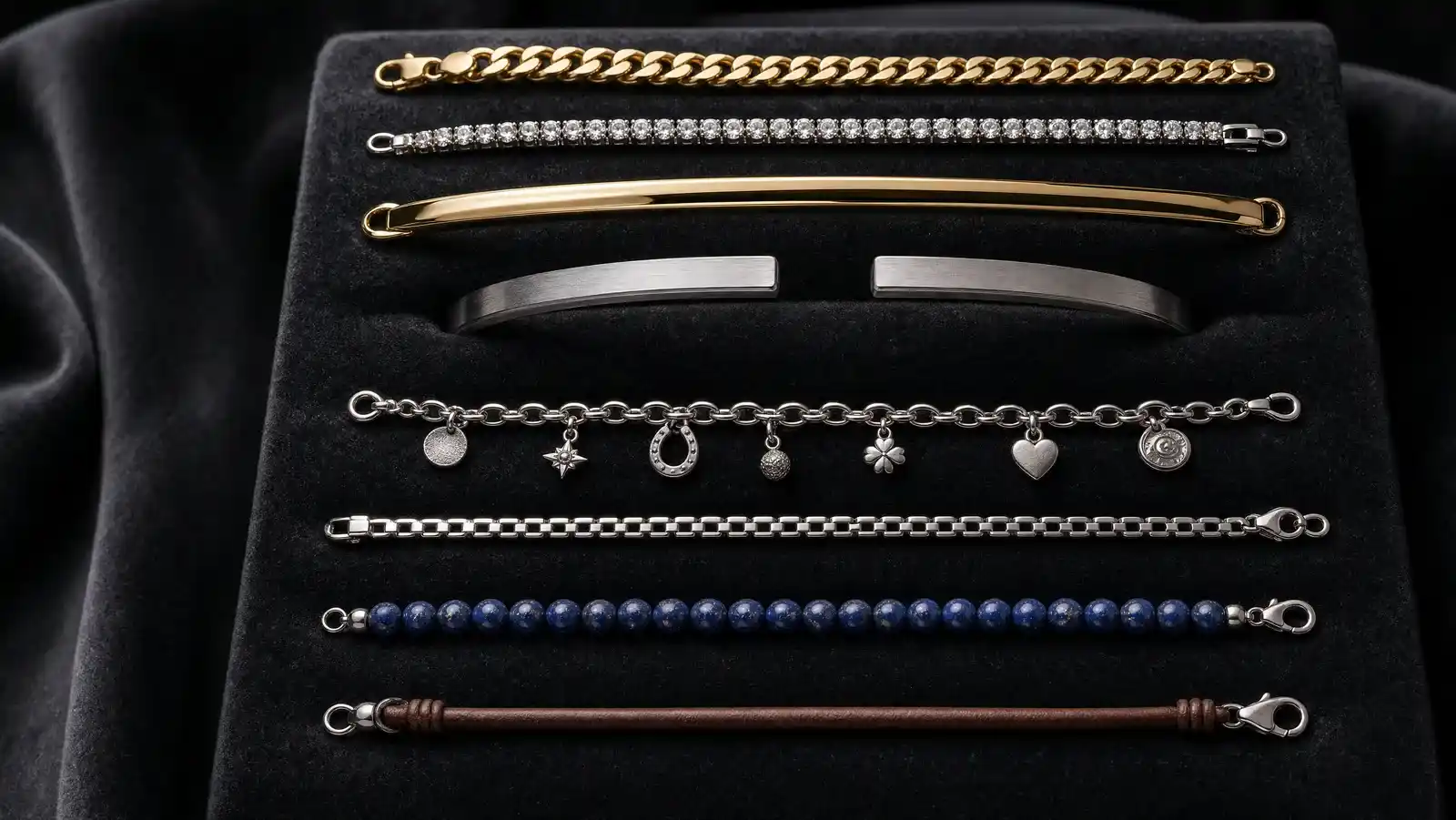
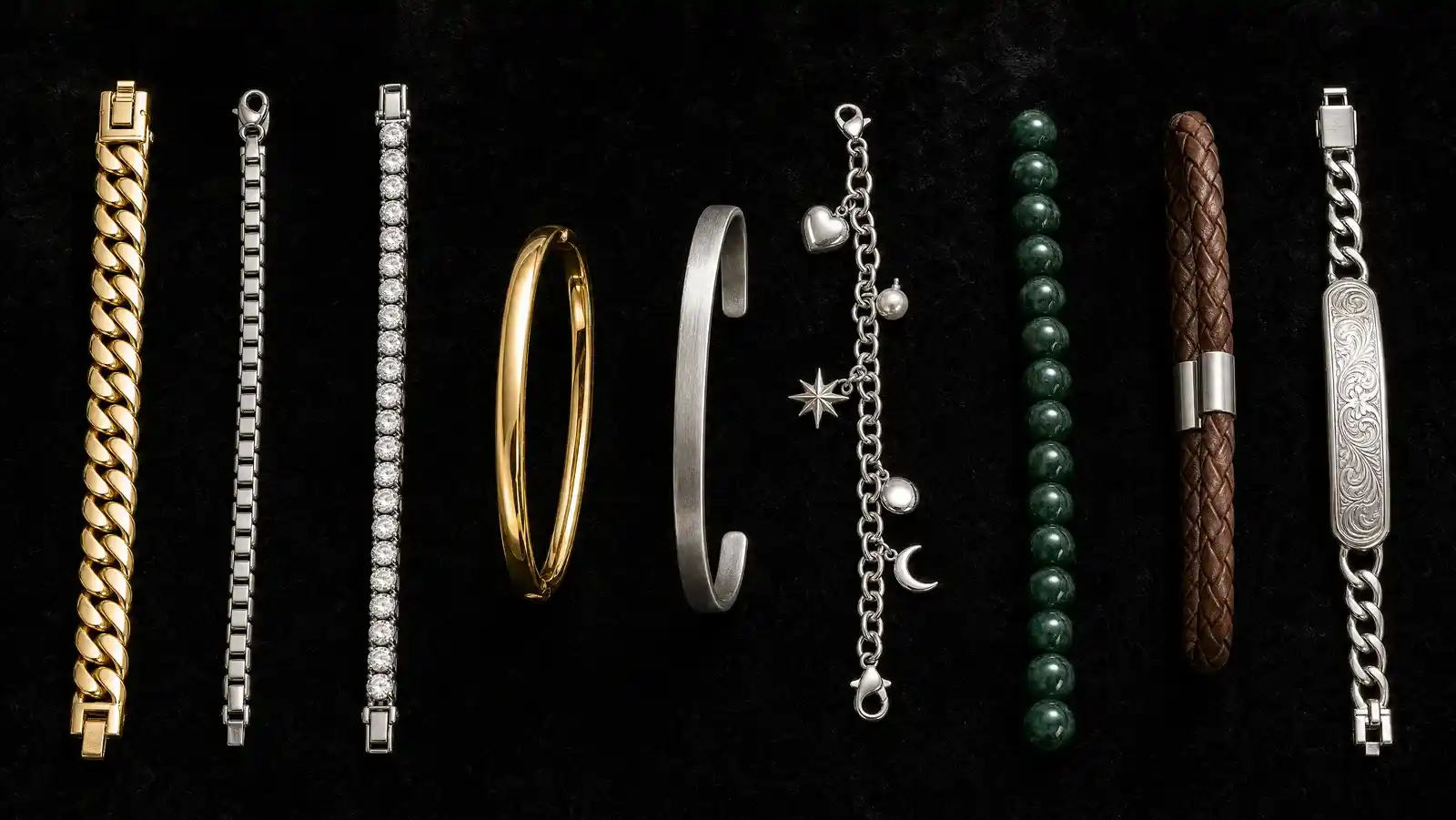
The types of bracelets sold today come down to about nine constructions. Each sizes differently, fails differently, and costs a different amount to fix. This is the translation key: what each style is, how it is built, how it breaks, and who it suits. For sizing charts, clasp comparisons and the categories side by side, start with our bracelet guide.
Table of Contents
- Link and Chain Bracelets
- Tennis and Line Bracelets
- Bangles
- Cuffs
- Charm Bracelets
- Beaded and Elastic Stretch Bracelets
- Leather and Cord Bracelets
- ID Bracelets
- Wrap and Multi-Strand Bracelets
- Types of Bracelets Compared
- How to Read a Bracelet Listing
- Choosing Among the Types of Bracelets
- FAQ
Link and Chain Bracelets
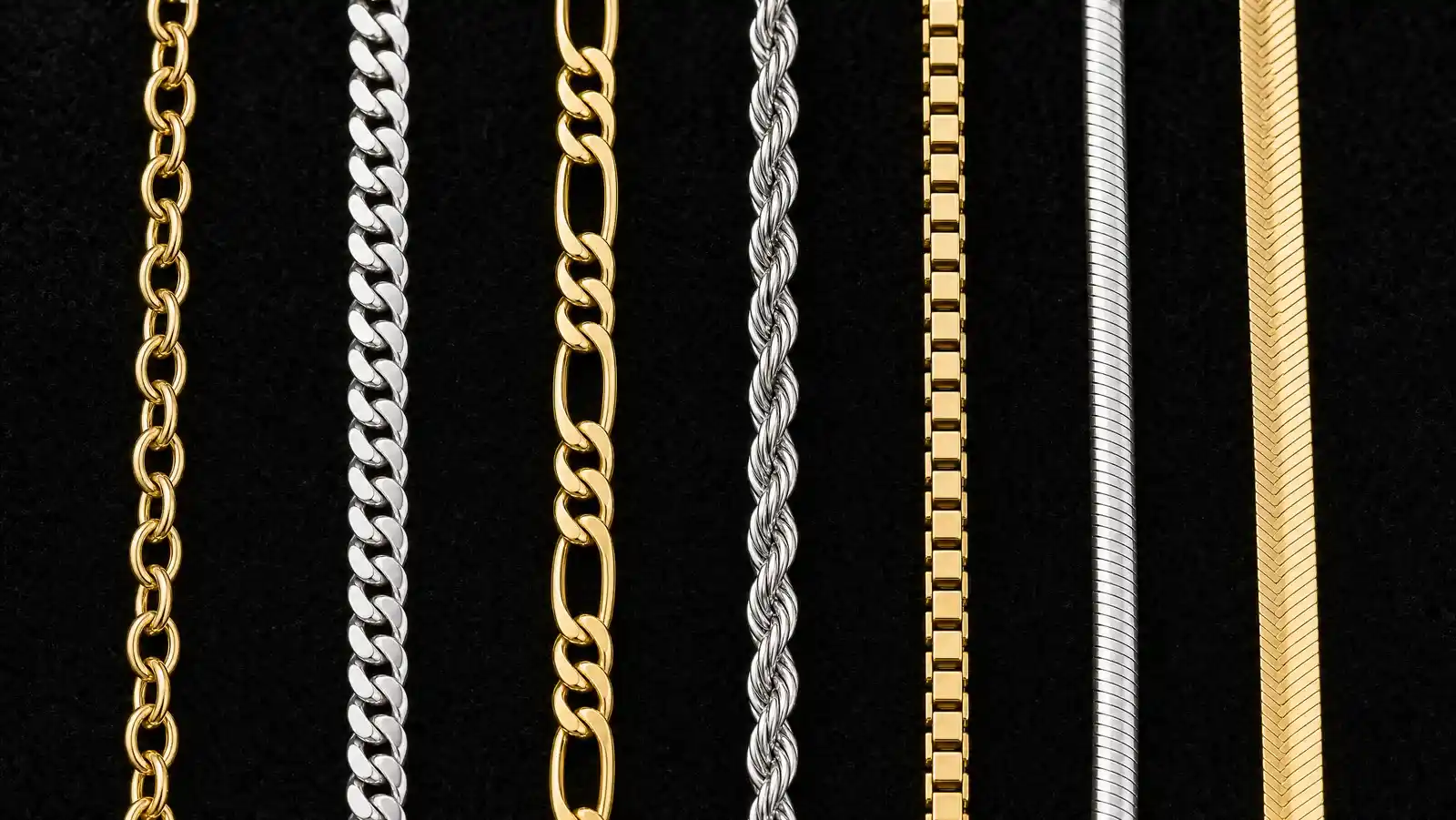
A link bracelet is a necklace chain shortened to wrist length and given a clasp. The vocabulary is identical — cable, curb and Cuban, figaro, rope, box, herringbone, paperclip, mariner — and our guide to types of necklace chains covers how each construction behaves.
Two things change at wrist scale. Bracelet versions run wider, commonly 3mm for a fine cable up to 12mm and beyond for a Cuban. And the underside is a contact surface, grinding against desks in a way a necklace never does.
How it fails. Hollow links crush rather than break, and a crushed tube cannot be reflowed cleanly. Flat woven constructions are worse. Van Adams Jewelers describes herringbone as "flat, tightly packed links" that are "known to be unforgiving when bent," and notes that once kinked "it can be challenging to repair without leaving a weak spot," with severe kinks sometimes requiring that a section, or the whole chain, be replaced. The other common failure is the clasp rather than the chain; our guide to necklace clasp types covers the same parts used on bracelets.
Best for: daily wear in solid cable, curb, box or rolo links, all of which solder cheaply. We would avoid wide hollow links and flat woven chains for a bracelet worn every day.
Tennis and Line Bracelets
A tennis bracelet is a continuous line of matched stones, each in its own small setting, with the settings linked so the strip flexes around the wrist. Sotheby's describes the form as "a flexible, serpentine design of diamonds" and notes that before it took its sporting name it was sold as an eternity bracelet, popular in the 1920s.
The name came from a broken one. Sotheby's places the incident at the 1987 US Open, when Chris Evert's bracelet snapped mid-rally and play was halted while it was recovered. Mental Floss instead dates it to 1978, the first year the tournament was played at Flushing Meadows, citing Evert's publicist Tami Starr: "Chrissie recalls that she was wearing a diamond and gold bracelet, and it broke and fell onto the court in an early round of the Open." The accounts disagree on the year; both agree the bracelet came off during play.
How it fails. Every setting is a link, so the piece has dozens of joints instead of one. Stones are lost when a prong wears or a link opens, and because they are matched, replacing one is a matching exercise rather than a repair. Any tennis bracelet worn regularly needs a working safety catch as well as its main clasp. We cover what a tennis bracelet is in a dedicated article, including how total carat weight is quoted.
Best for: formal wear, and daily wear if you are disciplined about the safety catch.
Bangles
A bangle is a rigid closed circle with no clasp. It does not open; it passes over the hand. The constraint is therefore not your wrist but the widest part of your hand with the thumb tucked across the palm.
Bangles are quoted by inner diameter rather than length. The Jewellery Room's bangle chart maps a 5 to 5.5 inch wrist to a 48 to 51mm internal diameter, a 5.5 to 7 inch wrist to 54 to 57mm, a 7 to 8 inch wrist to 60 to 64mm, and an 8.5 to 9 inch wrist to about 67mm. It gives the conversion outright: internal diameter equals circumference divided by 3.14, measured around the knuckles including the thumb knuckle. Our Bracelet Size Guide: How to Measure Your Wrist walks through both measurements.
How it fails. Undersized, a bangle will not go on. Oversized, it clears the hand in the wrong direction and is lost without you noticing. Thin hollow bangles dent from one knock against a door frame, and dents in a closed tube are hard to push out. Hinged bangles add two failure points a solid one does not have: the hinge pin and the box clasp.
Best for: stacking, and anyone who dislikes fastening a clasp one-handed.
Cuffs
A cuff is a rigid open circle with a gap at the back that slides on sideways at the narrowest part of the wrist. The bangle versus cuff question is just this: closed circle or open one, and whether you want the piece to be adjustable.
Cuffs are adjustable, but carefully and only a few times. Sterling silver, gold and copper tolerate gentle flexing at the gap; work-hardened brass, steel and thin stamped metal do not. Open or close a cuff gradually along its whole curve rather than levering the ends apart — bending repeatedly at one point is what cracks it. Widths run from a 4mm wire cuff to 40mm and up.
How it fails. Metal fatigue at the gap, from being opened and closed as a habit rather than as a one-time fitting. Plated cuffs also wear through first on the underside.
Best for: wrists between standard sizes, and anyone who wants a bracelet with no clasp to fasten.
Charm Bracelets
A charm bracelet is a base chain plus removable dangling ornaments attached with jump rings, lobster clips or threaded stations. The category is old: Fewer Finer dates the earliest charm bracelets to the Assyrians, Babylonians, Persians and Hittites, "from 600 - 400 BC," and records that Tiffany and Co. launched its first charm bracelet in 1889 at the Paris Exposition.
Mechanically, the base chain is the whole decision. Rolo, belcher and curb links have wide, thick-walled loops a charm cannot pry open, which is why they dominate the category. A fine cable chain hung with eight charms concentrates load on whichever link carries the heaviest one.
How it fails. Open jump rings, almost always. A ring that is split rather than soldered will work itself open against a sleeve and the charm is gone. Ask whether the jump rings are soldered before you buy, and have new charms fitted with closed rings.
Best for: gifting over time, and anyone who wants a piece that changes rather than one finished the day it is bought.
Beaded and Elastic Stretch Bracelets
Two constructions get sold under the same photographs, and the difference decides how long the piece lasts.
A strung beaded bracelet threads beads onto silk, nylon or fine steel cable, finished with crimps or knots and a clasp. Bead diameters cluster at 4mm, 6mm, 8mm and 10mm. Knotting between beads, standard on pearls, stops beads rubbing each other and limits the loss to one bead if the thread parts.
An elastic stretch bracelet threads the same beads onto a loop of clear elastic cord with no clasp at all. It is cheaper to make and needs no sizing, which is why it dominates the low end of the bead market.
How it fails. Strung bracelets fail at the thread, usually where it flexes against a crimp or the clasp; restringing is routine maintenance rather than a repair, and pearls in particular are expected to be restrung periodically. Stretch cord is a consumable: it stretches permanently, absorbs lotion and shower water, and eventually parts without warning. Rolling a stretch bracelet over the hand rather than stretching it open extends its life, and our jewelry storage guide covers dry, anti-tarnish storage for everything kept alongside it.
Best for: color and texture at low cost. Buy strung and clasped if you want the beads to still exist in five years.
Leather and Cord Bracelets
Braided leather, waxed cotton, nylon paracord and macramé cord, closed with a button and loop, a sliding knot, a magnetic barrel or a lobster clasp fitted into metal end caps. Widths run from a 2mm single cord to a 20mm braided band. The sliding-knot version is genuinely adjustable, which no clasped metal bracelet is.
How it fails. Leather dries, stiffens and cracks, and sweat and hand sanitizer accelerate it. Cord frays where it enters an end cap, and caps are frequently glued rather than soldered, so the cord pulls free from a cap that is still intact. Magnetic closures are the least secure option here; they release when the bracelet snags.
Best for: casual daily wear at a price where replacement is expected rather than repair.
ID Bracelets
An ID bracelet is a flat engraved plate carried between two lengths of chain, usually curb or Cuban. Plates commonly run 6 to 12mm wide on lighter pieces and considerably wider on men's styles.
How it fails. The design concentrates stress at the two joints where the plate meets the chain, and that is where a cheap ID bracelet separates. Engraving is the other weak point: on a plated bracelet it cuts through the plating into the base metal, so the letters discolor before the rest does. If the bracelet is a medical ID, legibility is the entire product, and we would buy deep engraving in solid stainless steel, sterling or gold rather than laser marking on a plated blank.
Best for: engraving, gifts meant to be kept, and medical identification worn continuously.
Wrap and Multi-Strand Bracelets
A wrap bracelet is one long strand that circles the wrist two to five times and fastens with a button or a row of loops, giving it a built-in size range. A multi-strand bracelet runs several parallel strands into shared end caps and a single clasp.
How it fails. On a wrap, the strand is continuous, so a single break releases every turn at once. On a multi-strand, strands cut to slightly different lengths do not share load evenly, and the shortest parts first. In both cases inspect the end caps: glued caps let go, crimped and soldered caps do not.
Best for: casual volume, layering, and wrists that fall between standard bracelet lengths.
Types of Bracelets Compared
| Bracelet type | Construction | Typical width | Durability | Repairable? | Best for |
|---|---|---|---|---|---|
| Link / chain | Interlocking metal links, clasped | 3-12mm+ | High solid, low hollow | Easily, if solid | Daily wear |
| Tennis / line | Matched stones in linked settings | 2-6mm | Moderate, many joints | Yes, at cost | Formal wear, gifts |
| Bangle | Rigid closed circle, no clasp | 2-15mm | High solid, dents hollow | Sometimes | Stacking |
| Cuff | Rigid open circle with a gap | 4-40mm+ | High, fatigues at gap | Yes, reshaping | In-between sizes |
| Charm | Base chain plus hung ornaments | 3-8mm base | Depends on jump rings | Easily | Collecting over time |
| Beaded (strung) | Beads on thread or cable, clasped | 4-12mm beads | Moderate, thread wears | Restringing is routine | Pearls, gemstones |
| Stretch / elastic | Beads on elastic cord, no clasp | 4-12mm beads | Low, cord is consumable | Re-cord only | Cheap, no sizing |
| Leather / cord | Braided or knotted cord, end caps | 2-20mm | Moderate, material ages | Rarely worth it | Casual, adjustable |
| ID | Engraved plate between chain runs | 6-20mm plate | High, stress at two joints | Yes | Engraving, medical ID |
| Wrap / multi-strand | One long or several parallel strands | Varies | Moderate, one failure point | Depends on caps | Volume without weight |
How to Read a Bracelet Listing
Length versus inner circumference. A clasped bracelet is quoted as total length end to end, including the clasp. A bangle is quoted as inner diameter. They are not comparable numbers. REEDS Jewelers gives the industry standard as 7 inches for women and 8 inches for men, and advises measuring your wrist and adding three quarters of an inch to one inch "to allow for movement and flexibility." For bangles, The Jewellery Room's conversion applies: internal diameter equals circumference divided by 3.14.
Width in millimeters. Width is measured across the face. On link bracelets it tracks weight and durability; on cuffs it is a styling choice; on beaded pieces it is the bead diameter, not the band.
Clasp type. Lobster and spring ring are the defaults, spring rings being weaker at small sizes. Box clasps with a figure-eight safety catch are standard on tennis bracelets for a reason. Toggles are easy one-handed and the easiest to work loose. Magnetic clasps are the least secure common option.
Metal stamp. A number tells you more than a color name. The FTC's Jewelry Guides at 16 CFR 23.3 note that, under the National Stamping Act, karat gold articles containing no solder carry a permissible tolerance of "three parts per thousand," rising to seven parts per thousand when the tested part contains solder. The same section allows "gold filled" for a mechanically applied layer of at least 10 karat fineness making up at least one twentieth of the weight of metal in the entire article; at one fortieth, the article may be marked only with the weaker terms "gold plate," "gold overlay" or "rolled gold plate." "Gold electroplate" requires a minimum thickness equivalent to 0.175 microns of fine gold, "approximately 7/1,000,000ths of an inch," while "heavy gold electroplate" requires two and a half microns. Vermeil, defined one section later at 16 CFR 23.4, is a sterling silver base coated with at least 2.5 microns of gold of not less than 10 karat fineness. Our guide to gold chain necklaces unpacks the same stamps in more detail.
Choosing Among the Types of Bracelets
Work backward from how the bracelet will live, not from the photograph.
If it will be worn every day and rarely taken off, buy solid metal in a repairable construction: a solid cable, curb, box or rolo link, a solid bangle, or a well-made cuff. All can be sized, soldered and reshaped by a bench jeweler for less than the cost of replacement.
If it is an occasion piece, the fragile constructions become reasonable. A flat woven link, a fine multi-strand or a delicate stretch design is fine when it goes on for an evening and comes off into a box.
And if a listing will not say whether the links are solid or hollow, whether the jump rings are soldered, or whether the gold is filled, plated or solid, treat the silence as the answer.
For wrist measurement, clasp comparisons and the full set of trade-offs in one place, read our guide to how to choose a bracelet.
FAQ
What are the main types of bracelets?
Nine constructions cover almost everything sold: link and chain, tennis or line, bangle, cuff, charm, beaded, elastic stretch, leather and cord, and ID bracelets, with wrap and multi-strand designs as a variation on stringing. The distinction that matters most is rigid versus flexible, because it decides how a bracelet is sized and how it fails.
What is the difference between a bangle and a cuff?
A bangle is a closed rigid circle that must pass over your hand, so it is sized by inner diameter. A cuff is a rigid circle with a gap at the back, so it slides on at the wrist and can be flexed to fit. A cuff is adjustable; a bangle is not.
What size bracelet should I buy?
REEDS Jewelers gives 7 inches as the industry standard for women and 8 inches for men, and recommends measuring your wrist and adding three quarters of an inch to one inch for movement. Bangles differ: The Jewellery Room's chart maps a 5.5 to 7 inch wrist to a 54 to 57mm internal diameter, measured around the knuckles including the thumb knuckle.
Which type of bracelet is most durable for everyday wear?
A solid link bracelet in a chunky construction, or a solid bangle. Both have few joints and can be repaired. The weakest choices for constant wear are elastic stretch bracelets, whose cord is a consumable, and flat woven chains, which Van Adams Jewelers describes as "unforgiving when bent" and difficult to repair "without leaving a weak spot."
Can a bracelet be shortened or lengthened?
Most clasped link bracelets can be shortened by removing links and lengthened with an extender, both routine bench work. Tennis bracelets can usually have settings removed, though that changes the stated carat weight. Bangles cannot be resized; cuffs are adjusted by gentle flexing.
What does "18k gold plated" mean on a bracelet?
It describes the karat of the plating, not how much of it there is. Under the FTC's Jewelry Guides at 16 CFR 23.3, "gold electroplate" requires only a minimum thickness equivalent to 0.175 microns of fine gold, "approximately 7/1,000,000ths of an inch," while "heavy gold electroplate" requires two and a half microns. A plated bracelet wears through first on the underside, where it rests against desks.
About the Author
Alfreda Borror
Alfreda Borror is the founding editor of Opulent Opal, writing research-based buying guides on diamonds, birthstones, and fine jewelry.