Bracelet Clasp Types: Which Ones Actually Stay Closed

This post may contain affiliate links. Read our affiliate policy
A bracelet is the only piece of jewelry you fasten one-handed, with your weaker hand, without looking — then swing against desks, door handles and seatbelts all day.
The verdict first. Of the common bracelet clasp types, a box clasp with a working safety catch is the most secure. A lobster claw is the best all-round compromise. A toggle and a bare magnet come off.
For constructions, metals and wrist measurement, see our bracelet guide.
Table of Contents
- Why the Clasp Is the Part That Fails
- Clasp Security, Ranked
- Lobster Claw
- Spring Ring
- Box Clasp and the Safety Catch
- Fold-Over and Deployant Clasps
- Toggle: T-Bar and Ring
- Magnetic Closures
- Slide and Bolo Adjusters
- Hook-and-Eye and S-Hooks
- Screw and Barrel Clasps
- Push-Button Locks on Heavy Links
- Safety Chains and What They Buy You
- Fastening a Bracelet Single-Handed
- When a Clasp Keeps Coming Open
- Swapping a Clasp for a Better One
- What We'd Actually Do
- FAQ
Why the Clasp Is the Part That Fails
A necklace clasp sits at the nape under a steady pull, out of the way of everything. A bracelet clasp rides on the outside of the wrist and takes the knocks — which is why it fails in three ways, and only one of them is dramatic.
It opens. Something snags the gate, or it was never fully seated. You notice forty minutes late.
It wears out. Springs fatigue, hinge pins elongate and gate tips round off, so the clasp rests shut instead of latching. Jewelers Mutual advises regular jeweler inspections of clasps, prongs and loose stones for this reason.
It cannot be worked by the wearer. Gabriel & Co.'s clasp guide notes small spring rings "can be tricky to fasten by yourself." A clasp you cannot close lives in a drawer.
Clasp Security, Ranked
Ordered by how reliably each stays shut on a wrist.
| Clasp | Security | One-handed | Failure | Repairable |
|---|---|---|---|---|
| Box clasp + safety catch | Highest | Fair | Tongue slackens | Yes |
| Push-button + figure-eight | Highest | Good | Catch left open | Yes |
| Fold-over / deployant | High | Good | Hinge pin wear | Sometimes |
| Lobster claw | High | Good | Spring fatigue | Yes |
| Magnetic + catch | Moderate-high | Excellent | Catch not engaged | Yes |
| Screw / barrel | Moderate-high | Poor | Cross-threading | Rarely |
| Hook-and-eye / S-hook | Moderate | Good | Wire opens | Yes |
| Slide / bolo | Moderate | Excellent | Insert wears smooth | Insert only |
| Spring ring | Low-moderate | Poor | Spring fatigue | Replace |
| Toggle | Low | Good | Bar rotates out | By conversion |
| Bare magnetic | Lowest | Excellent | Sideways shear | No |
Lobster Claw
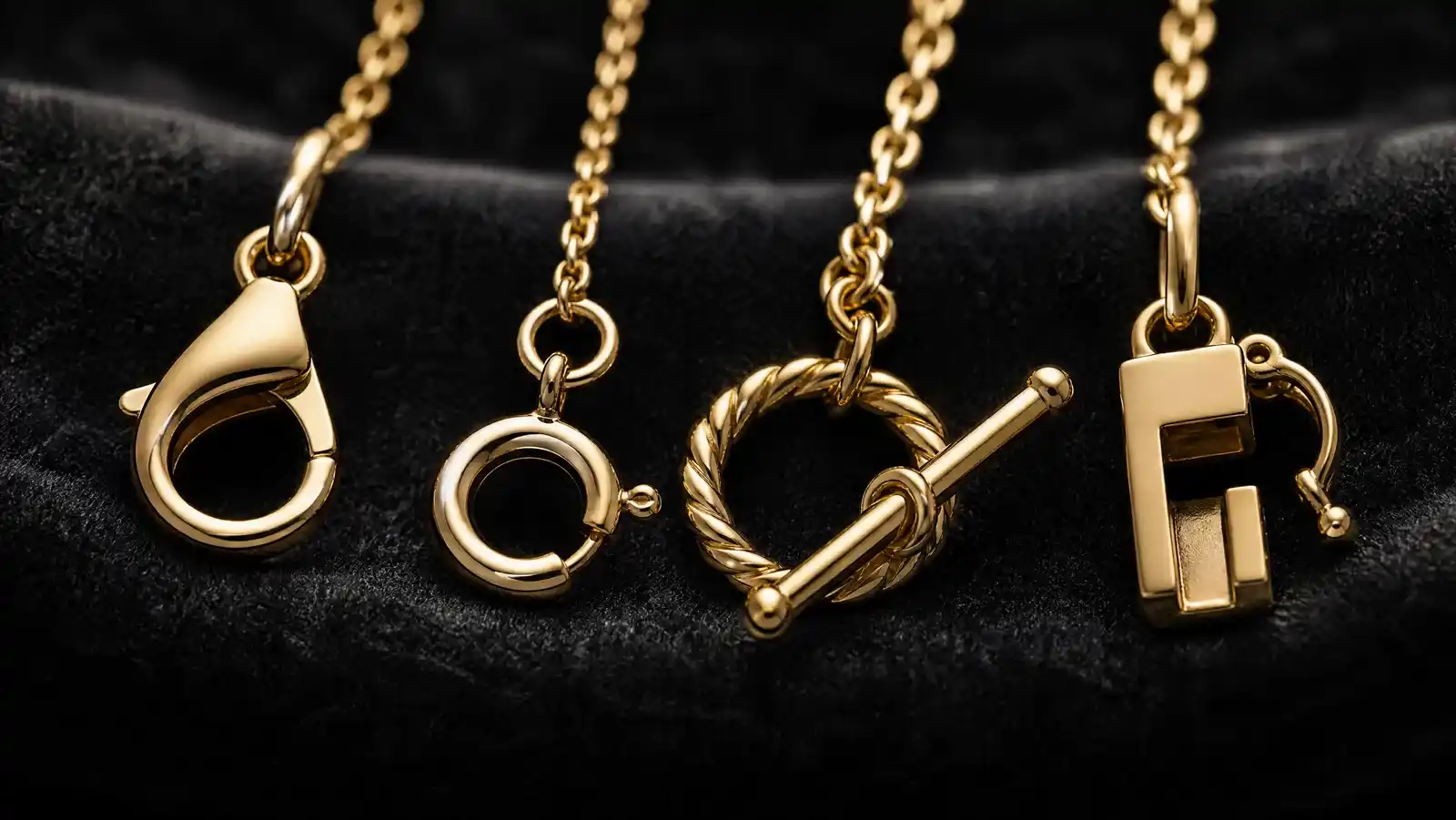
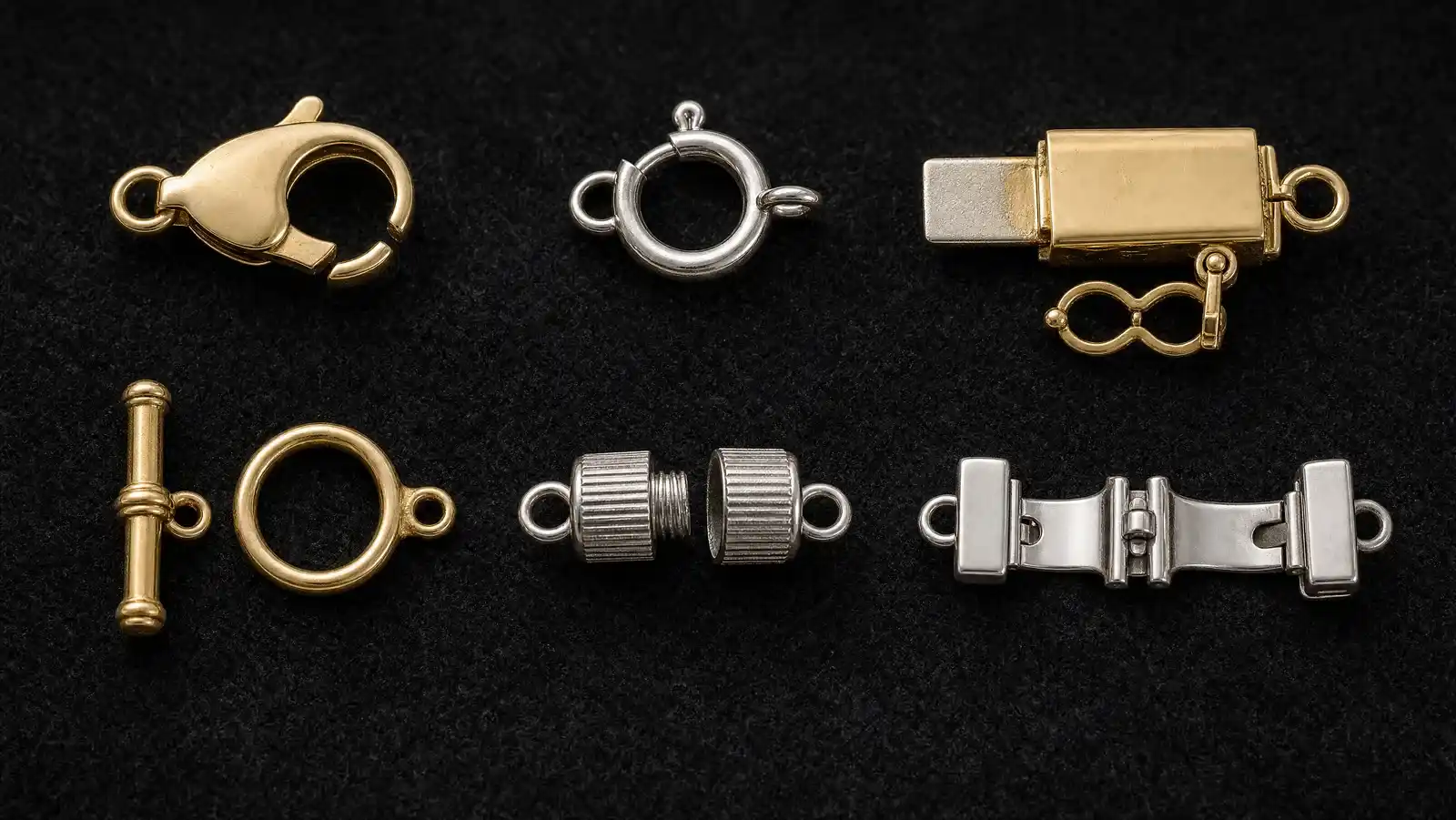
Sold as a lobster clasp, trigger or swivel: an oval body with a hinged gate on a side lever. Press, the gate opens; release, a spring drives it shut behind the ring.
Robinson's Jewelers calls the mechanism "robust and much less likely to fail spontaneously than a spring ring," and notes lobster claws are "generally easier to open and close one-handed." Size to mass, not link width: per CJ Beaders' clasp guide, 8mm to 10mm suits delicate chains, 10mm to 12mm is the everyday all-rounder, and 14mm to 16mm handles chunky chains and charm bracelets.
How it fails: the gate tip and its seat round off until the gate rests on the lip instead of dropping behind it. Hold it to a window; daylight means it is finished.
Spring Ring
A hollow tube with a slot. You drag a tab round against a coiled spring, hook the other end in, and let go.
This is the least secure sprung clasp in common use on a bracelet, and it survives because it is cheap. Robinson's Jewelers puts it starkly: "that tiny spring inside is the only thing standing between you and jewelry loss."
How it fails: the spring fatigues, and the tube packs with hand cream and skin oil until the tab stops travelling its arc. When you look into how to clean a bracelet, flush the tube, do not just polish links.
Box Clasp and the Safety Catch
A folded, springy tongue pushes into a hollow box; tension in the fold makes it click and hold. It is the fine-jewelry standard and the closure on many quality line bracelets — see what a tennis bracelet is for that construction.
The redundancy is the point. Over the tongue goes a secondary catch: a hinged figure-eight bar across the seam, or a fold-over blade snapping over the join. Gabriel & Co. notes box clasps come "often with additional safety latches on the sides"; Robinson's Jewelers calls that latch "the equivalent of a deadbolt." Two mechanisms must release before the bracelet can leave your wrist.
How it fails: the tongue loses tension and slides out under light pull — a bench re-tensioning job, not a replacement. The other failure is human: people stop flipping the catch shut.
Fold-Over and Deployant Clasps
Borrowed from watch bracelets. Hinged blades fold into each other and a top plate snaps over the stack, so the bracelet opens to a wide loop instead of parting — a mis-latch drops it onto your hand, not the pavement.
How it fails: hinge pins elongate until the blades develop side-to-side play, and the snap plate loses its spring. A clasp that no longer clicks crisply is telling you something.
Toggle: T-Bar and Ring
A toggle clasp is a T-shaped bar and an open ring: fold the bar in line, thread it through, let it swing crosswise. No springs, so almost nothing wears out — and almost nothing holds it shut.
The toggle stays closed on geometry and the bracelet's weight pulling the bar sideways. Gabriel & Co. concedes the dependency: it works best when the bracelet fits properly. On a wrist that is a problem — your arm swings, the bracelet goes slack a hundred times an hour, and each slack moment lets the bar slip back through.
How it fails: quietly, and you find out later. Jewelers commonly solder a bar across the ring to narrow it, or convert the piece to a lobster claw. We would avoid a toggle on anything you could not replace.
Magnetic Closures
Two housings, each holding a rare-earth magnet, snap together and self-align. For anyone with arthritis, tremor, low vision or one usable hand, nothing else comes close.
The weakness is direction. Magnets are rated on straight pull, face to face, which is not how a bracelet is loaded: a sleeve drags the halves sideways, and magnets are far weaker in shear. Gabriel & Co. states the limit plainly — magnetic clasps are "better suited to lighter bracelets, as magnets can separate under tension."
Which is why the good ones are hybrids. United States Patents 6,591,462 ("Magnetic jewelry clasp with safety catch") and 5,197,168 ("Magnetic jewelry closures with wire safety clasp") both cover it: the magnet aligns, a catch holds. A bare magnet on a bracelet you value is not a closure, it is a preference.
A note, not advice: magnet supplier K&J Magnetics, summarizing pacemaker manufacturer guidance including Boston Scientific's, reports that fields above roughly 10 gauss can alter an implanted device's function. Anyone with an implant should ask their clinician.
Slide and Bolo Adjusters
Not a clasp but a friction stop: two chain ends run through a bead gripped by a rubber insert, and you pull the bracelet tight. How it fails: the insert is a wear part — it polishes smooth, grit speeds that up, and the slider stops holding position.
Hook-and-Eye and S-Hooks
Shaped wire, often decorative enough to wear as the front of the piece. Security is entirely wire gauge and how tightly the hook is closed: a heavy-gauge hook under tension is reliable, a thin one straightens the first time the bracelet catches a bag strap. How it fails: it opens rather than breaks, so a jeweler can re-form it in minutes.
Screw and Barrel Clasps
Two threaded halves twist into a smooth barrel: secure, and nearly invisible. Then you try it one-handed. Gabriel & Co. is blunt that barrel clasps "require a bit more time and dexterity to fasten," and a wrist gives you one.
How it fails: cross-threading, which strips soft gold threads for good. We would avoid it as a daily closure.
Push-Button Locks on Heavy Links
Curb, Miami Cuban and other heavy link bracelets use a box lock with a spring-loaded thumb button, usually with one or two figure-eight safeties folded over the top. The button is big enough to find without looking — the most convenient secure closure here.
These are specified by chain width so the clasp body matches the link profile — aftermarket replacements are stocked by width, commonly 6mm to 14mm. How it fails: the button spring weakens or, far more often, the safeties never get folded down.
Safety Chains and What They Buy You
The sentence most articles skip: a safety chain does not stop the clasp opening. It buys the seconds in which you notice.
Martin Busch Jewelers defines it as "a secondary closure, like a chain or latch, that acts as a backup if your main clasp comes undone." Fit is the trick: Sky Jems' reference describes very fine chains, often under a millimetre wide, set with minimal slack — enough for the clasp to work, not enough for the bracelet to clear your wrist.
Fastening a Bracelet Single-Handed
Jewelers Mutual, Gabriel & Co. and Robinson's Jewelers all publish guides to putting a bracelet on by yourself. They converge on the same list.
- Tape. A small piece over the fixed end, stuck to your wrist, holds the bracelet still while your other hand works.
- A bent paper clip. Hook it through the fixed end and trap the loop under your thumb to keep tension.
- A fastener tool. A clip on a handle that does the paper-clip job properly, on any clasp.
- Your non-dominant wrist, so your better hand does the fiddly part.
- Close the clasp first, then slide it on — only where the bracelet clears your knuckles. Never force it; that spreads the jump rings.
The other half is buying a closure you can operate. A 12mm lobster claw gets fastened; a 6mm spring ring does not.
When a Clasp Keeps Coming Open
Work through these in order. The cause is usually further down the list than people expect.
- Wrong length. Too loose and the bracelet rotates, so the clasp migrates to the top of the wrist where everything you touch drags across it. Our bracelet size guide covers the allowance to add over your measurement.
- A gate or tongue that has lost tension. Look for daylight at the closed seam.
- A safety catch nobody engages. If the piece has one, using it is not optional.
- A worn jump ring — the real culprit. The unsoldered ring joining clasp to bracelet fails more often than the clasp does: under steady pull it works into a gap and the end link walks out. If the clasp is still latched but the bracelet is gone, this was it.
- The wrong clasp for the weight. One sized for fine chain, on a heavy link bracelet, gets dragged open eventually.
A gold clasp should also match the karat it closes: a 10k clasp on an 18k bracelet is typically the harder alloy and can wear into the softer metal. The same logic runs across types of bracelets — construction and closure have to be chosen together.
Swapping a Clasp for a Better One
Almost any clasp can be changed: a bench jeweler cuts the old one off, fits the new one and solders fresh rings — close enough to a necklace chain repair that shops price them together.
Robinson's Jewelers' published 2025 repair price guide lists "replacing a broken clasp: $30 - $150+", with a lobster claw at the low end and a branded safety clasp higher, plus jump ring soldering at $35 to $80. Those are one shop's posted figures, not a national average. Jewelers Mutual also lists clasp replacement among the wear-and-tear repairs its coverage can include.
Replace the jump rings at the same time, match the karat, and do not glue anything. Skip the upgrade when the clasp costs a large share of the bracelet's value, or when the links beside it are already thinned. Hanging a bracelet by its clasp also loads it continuously, so jewelry storage flat and clasped is the cheapest maintenance there is.
What We'd Actually Do
Worn every day: a 10mm to 12mm lobster claw on soldered rings. A line bracelet or heirloom: a box clasp with a working safety catch, plus a safety chain. Limited dexterity on a valuable piece: a magnetic closure with a mechanical catch, never a bare magnet.
The same mechanisms behave differently around a neck, where load is steady rather than shocked — our guide to necklace clasp types covers what changes. And our guide to choosing a bracelet works back from the closure to construction, metal and fit.
FAQ
Which bracelet clasp is the most secure?
A box clasp with an engaged secondary safety. Two independent mechanisms must release before the bracelet can come off: the tongue is the lock, the catch is the deadbolt.
Why does my bracelet clasp keep opening?
Check length first, mechanism second, jump rings third. A loose bracelet rotates until the clasp rides on top of the wrist and catches on everything. If length is right, look for daylight at the closed gate. If both look fine, it is the unsoldered ring beside the clasp.
Are magnetic bracelet clasps safe to use?
They are easy to fasten and weak in shear, which is how a bracelet gets pulled. Gabriel & Co. says magnetic clasps suit lighter bracelets because magnets can separate under tension, so choose one with a mechanical backup catch. K&J Magnetics, citing pacemaker manufacturer guidance, notes fields above roughly 10 gauss may affect implanted devices — ask your clinician.
Can a jeweler put a different clasp on my bracelet?
Yes, on almost any bracelet. Robinson's Jewelers' published guide puts clasp replacement at $30 to $150 and up, with a new lobster clasp at the low end and a specialty or branded safety clasp costing more. Have the attachment rings soldered in the same visit.
About the Author
Alfreda Borror
Alfreda Borror is the founding editor of Opulent Opal, writing research-based buying guides on diamonds, birthstones, and fine jewelry.