Necklace Clasp Types: Which Ones Actually Stay Closed

This post may contain affiliate links. Read our affiliate policy
Chains almost never fail in the middle. They fail at the clasp, at the small open ring beside it, or inside the spring that holds the gate shut. Learning these clasp types is really about learning four failure modes and matching the right closure to the load it carries.
Below is every common closure, what it holds, how it breaks, and whether you can work it one-handed. If you are still choosing the necklace itself, start with how to choose a necklace chain.
Table of Contents
- Necklace Clasp Types at a Glance
- Spring Ring
- Lobster Claw, Trigger, and Swivel
- Box Clasp and the Safety Catch
- Toggle Clasp
- Magnetic Clasp
- S-Hook and Hook-and-Eye
- Barrel and Screw Clasps
- Fishhook Clasp
- Slide-Lock Clasp
- Bolo and Adjustable Sliders
- The Jump Ring Is Half the Problem
- Matching Necklace Clasp Types to Your Chain
- Clasps for Limited Dexterity
- Upgrading or Replacing a Clasp
- What We'd Actually Do
- FAQ
Necklace Clasp Types at a Glance
| Clasp | Security | One-handed use | Best for |
|---|---|---|---|
| Spring ring | Low to moderate | Poor | Fine chains |
| Lobster claw | Moderate to high | Fair | Everyday chains |
| Box with safety catch | High | Fair | Strands, heirlooms |
| Toggle | Moderate | Good | Heavy statement chains |
| Magnetic | Low | Excellent | Limited dexterity |
| S-hook / hook-and-eye | Low to moderate | Good | Layering |
| Barrel / screw | Moderate | Poor | Vintage looks |
| Fishhook | High | Poor | Strand necklaces |
| Slide-lock | Moderate to high | Good | Multi-strand |
| Bolo slider | Moderate | Excellent | Adjustable lengths |
Spring Ring
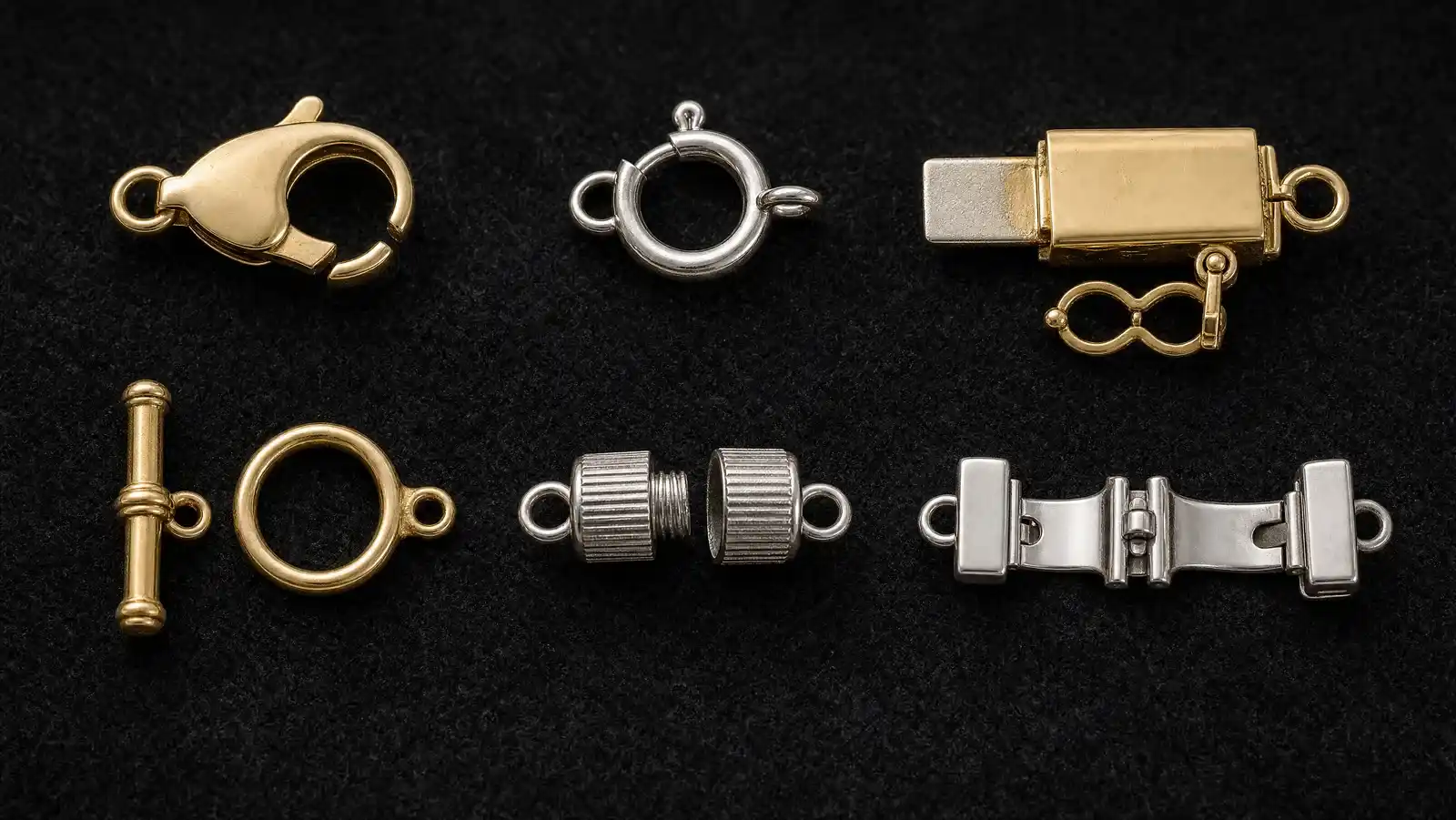
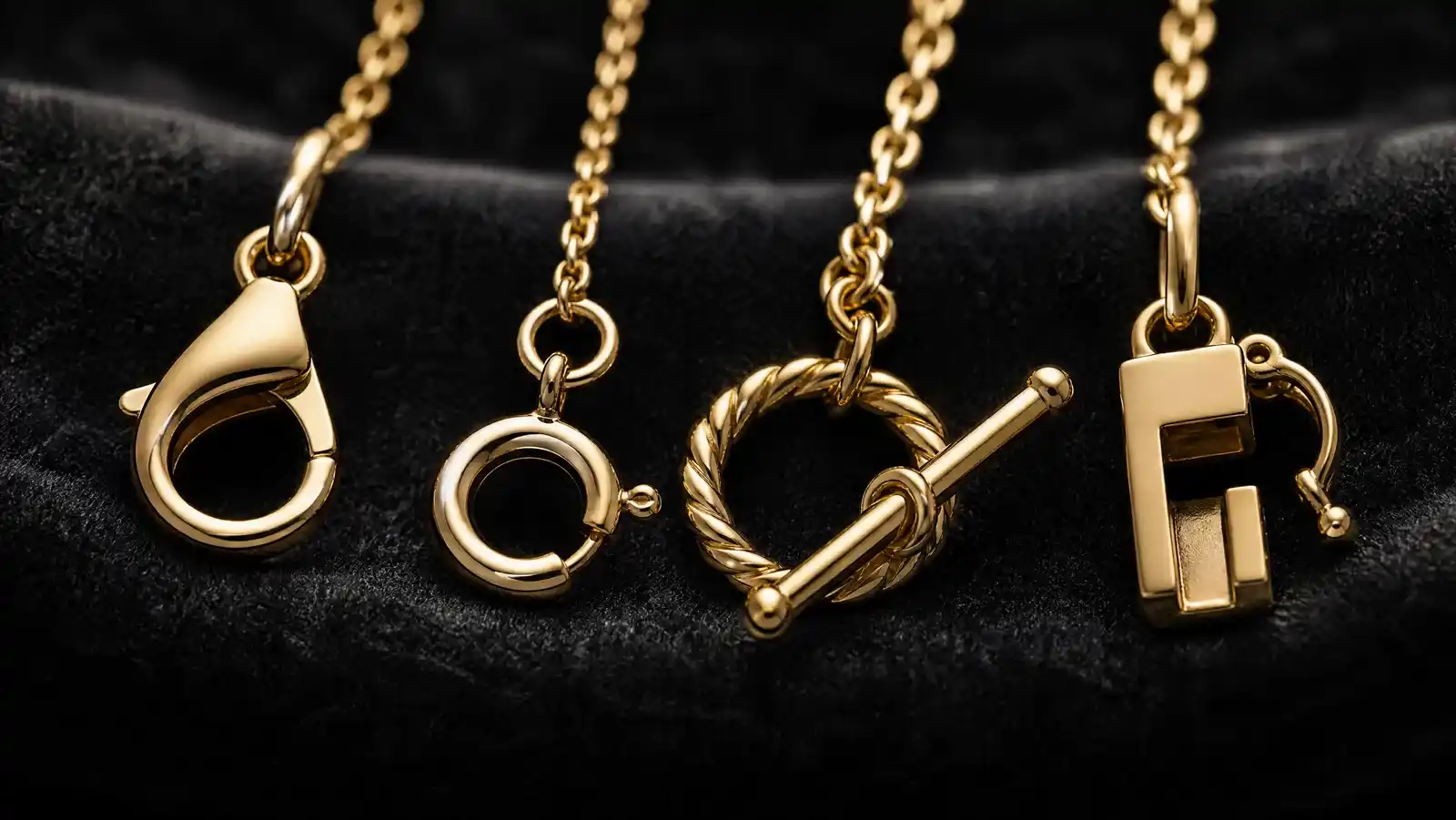
A hollow tube with a gate cut into it. A tiny tab rides in a slot; you drag it around against a coiled spring, hook the chain in, and let go. Findings catalogs stock spring rings from roughly 5mm to 14mm across, with 5mm to 7mm usual on fine chain.
The lightest-duty clasp in common use, it fails through spring fatigue plus contamination: lotion and skin oil pack the tube, tension drops, the gate stops seating. According to Arden Jewelers, "spring rings tend to wear faster over time because they are made to be lightweight."
One-handed use is poor: the tab must be held back while you thread. Right for fine cable and box chains where a heavier clasp would look wrong.
Lobster Claw, Trigger, and Swivel
An oval body with a hinged gate driven by a side lever, the trigger. As Arden Jewelers puts it, "when the trigger is pushed down, the clasp opens"; release it and "the spring tension closes the clasp again."
Sizing is what most people get wrong. According to CJ Beaders' clasp guide, 8mm to 10mm suits very delicate chains, 10mm to 12mm is the all-round everyday size, and 14mm to 16mm suits chunky chains and heavier gemstone designs. Fire Mountain Gems still describes lobster claws as "suitable mostly for lightweight to medium-weight designs," with only "some larger styles" taking heavier pieces.
A swivel version adds a rotating post so a pendant can untwist. Gate wear tends to arrive before spring failure: the tip and its seat round off until the gate rests on the lip instead of dropping behind it. Daylight at a closed gate means the clasp is finished.
Box Clasp and the Safety Catch
A folded, springy metal tongue pushes into a hollow box. Arden Jewelers explains that "the tension on the fold in the metal causes it to click into place."
The version worth paying for adds a safety catch — a hinged figure-eight bar or flip-over latch across the seam. Fire Mountain Gems notes some box styles include "safety latches or safety chains." Without one, there is no backup.
The failure is predictable: Arden Jewelers notes "the tongue (insert) can become loose over time." A bench jeweler can re-tension it, so a loose box clasp is usually a repair, not a replacement. Fire Mountain rates the style "best used for lightweight necklaces" — its security comes from the catch, not brute strength.
Toggle Clasp
A T-shaped bar and a ring. Arden Jewelers describes the motion exactly: the bar "is folded in line with the chain to thread it through the circle and then allowed to swing out." With no springs, Arden notes there is "very little that can actually wear out."
Nothing latches. A toggle is held shut by geometry and by the necklace's weight pulling the bar crosswise, so proportion decides everything. On one 12mm stainless toggle set listed by Beadaholique, the ring measures 17mm by 12mm while the bar is 16mm across.
It fails on light necklaces with slack: if the chain bunches as you pull a sweater on, the bar rotates back through. We'd avoid a toggle on anything featherweight, or anything you cannot replace.
Magnetic Clasp
Two housings, each holding a rare-earth magnet, snap together and self-align. Nothing is easier to fasten, and the numbers show the trade-off. Magnet supplier First4Magnets rates one 3/16 in. by 3/16 in. gold jewelry clasp magnet at 1.45 lbs of pull, noting it "can support a steel weight of up to 0.66kg (1.46lbs) vertically from the magnetic face when in flush contact with a mild steel surface of equal thickness" — a best case, flat and pulled straight apart.
Necklaces get dragged sideways across a coat collar instead, which is shear, and magnets are far weaker in shear — magnet suppliers typically put sideways holding force at roughly 15% to 30% of the rated straight pull. Fire Mountain Gems' own handling note gives it away: "slide the two ends apart rather than pulling to prevent pulling the magnets out." Arden Jewelers adds that magnets can separate from their housings when the adhesive fails, and Sky Jems does not recommend them for high-value jewelry.
Safety note: Sky Jems advises buyers with cardiac pacemakers, implanted defibrillators or other electronic implants to consult their cardiologist before wearing strong magnetic-clasp jewelry, particularly where the clasp sits near the device. Ask your own physician first.
S-Hook and Hook-and-Eye
Shaped wire with a ring at each end. Fire Mountain Gems describes S-hooks as "double-ended clasps, shaped like an 'S.' Pinching the arm of the 'S' secures the clasp," and recommends the related hook-and-eye for necklaces and chain belts.
Arden Jewelers is blunt about the weakness: the clasp "holds together by virtue of the strength of the wire to hold its curved shape alone," and can open if "the chain is pushed or caught in the wrong way." Gauge — the wire's thickness, where a lower gauge number means thicker wire — is the whole story: a thin S-hook straightens, a substantial one does not. Right for layering, where a flat closure sits better than a bulky claw.
Barrel and Screw Clasps
Two threaded halves. Fire Mountain Gems calls them "threaded clasps, which twist to open and close" that "provide a clean line to jewelry designs"; Arden Jewelers notes "one side of the clasp is simply screwed into the other."
Secure once closed, but genuinely two-handed, and Arden warns about cross-threading: soft gold threads can strip for good if the halves start misaligned. The other failure is slow unscrewing as the chain turns against a collar. We'd avoid it for anyone who fastens jewelry behind their neck.
Fishhook Clasp
A flattened, hooked tongue slides into a decorative oval box and catches on an internal bar. Fire Mountain Gems describes a "fishhook-shaped hook which is inserted into a box," where "the hook has notches to help secure jewelry."
That redundancy is why the style survives on fine strand necklaces: according to Arden Jewelers, "if the tension in the clasp fails, the hook design should catch and prevent the clasp from opening fully." Fire Mountain rates it "ideal for lightweight necklaces." It is fiddly behind the head, so these clasps are usually worn to one side.
Slide-Lock Clasp
Fire Mountain Gems describes a slide-lock as a "set of tubes, one of which slides inside the other and locks into place," and calls the style "perfect for multi-strand designs." Each tube carries a row of loops, one per strand, so strands stay parallel instead of twisting into a rope.
It needs no fingernails and no precise pinch, just one push. Its weak points are the detent holding the tubes together, which wears, and the tube itself, long enough to bend if crushed in a bag.
Bolo and Adjustable Sliders
A bolo is not really a clasp but a friction stop. Two chain ends run through a decorative bead gripped by a rubber or silicone insert; Quick Jewelry Repairs describes two interior channels carrying the chain ends with "a rubber stopper" that keeps them from slipping out.
That makes it a wear part: the insert polishes smooth, and grit speeds it up. Quick Jewelry Repairs warns that pulling the slide incorrectly can cause it to malfunction and that tugging too hard can break the chain. We'd avoid it under a heavy pendant, which drags the slider open.
The Jump Ring Is Half the Problem
You can buy the best clasp made and still lose the necklace, because it is usually attached with a jump ring — a circle of wire whose ends simply butt together. Under steady pull, a butted ring works into a gap and the chain walks out.
- Open (unsoldered): butted wire, no join. Cheapest, and the part that fails.
- Soldered or closed: the seam is fused, so no single point can spread.
- Split: wire wound in two full turns, like a keyring, spreading load across a doubled section.
The jewelry-making resource Wire Jewelry recommends sterling silver split rings here, calling them "perfect for attaching clasps" because they resist opening in normal wear but release "if enough force is applied." That last clause matters: the same source argues for keeping one deliberate "break-away" ring, "full-hard 18 gauge or heavier," so a necklace caught in a car door lets go instead of cutting.
Storage counts too, since a necklace hung on a hook loads its clasp continuously. Storing pieces flat or on a padded tray takes that tension off the weakest link.
Matching Necklace Clasp Types to Your Chain
Clasp choice should be proportionate to the chain's construction and weight, not just its look. A hollow rope and a solid curb of the same width behave very differently under load, which is why it helps to know types of necklace chains first.
- Match mass, not diameter. A heavy solid link deserves a larger lobster or a box clasp with a catch, however slim it looks.
- Count the wear hours. Pieces showered in and slept in punish springs fastest — the logic behind our thinking on chains for everyday wear.
- Never let the clasp outweigh the chain. An oversized claw on fine chain concentrates stress at the jump ring.
Clasps for Limited Dexterity
Ranked by how little fine motor control they demand:
- Bolo or over-the-head styles — nothing to fasten at all.
- Magnetic — self-aligning, no fingernails, no mirror. Easiest to close, easiest to lose.
- Slide-lock — one push, no pinch, no nails.
- Toggle — fastened in front, then rotated around; needs sight, not grip.
- A large lobster, 12mm or more — the honest compromise when security is non-negotiable.
Hybrid clasps pair a magnet with a secondary lobster or safety loop: the magnet aligns, the latch holds. That is what we'd choose for a valuable piece, answering the shear weakness.
A necklace chain extender or magnetic converter clips onto the existing clasp so you can fasten in an easier position, but it moves where the necklace sits — check a chain length guide before adding two inches to a 16-inch necklace.
Upgrading or Replacing a Clasp
Swapping a tired spring ring for a properly sized lobster claw is, in our view, the highest-value change you can make to a necklace you already own.
As of July 2026, Quick Jewelry Repairs' published price guide still lists repair of an existing clasp starting at $30 to $40, a jump ring needing only soldering starting around $29, and chain repair or soldering from $30, with "$5-10 per additional area of solder." Those are one shop's posted figures rather than a national average, and the replacement clasp is priced separately by metal. A necklace chain repair is one of the few jewelry services where labor, not material, is most of the bill.
Two things we'd insist on. Have the ring replaced or soldered at the same time, because a new clasp on an old open jump ring solves nothing. And do not glue anything. Many jewelers advise against home soldering kits and adhesives on fine jewelry: poor technique can discolor metal, weaken the joint or damage stones, and cured adhesive contaminates the seam. Robinson's Jewelers describes laser welding as a precise alternative for thin chains — exactly the work a glued joint ruins.
What We'd Actually Do
For a chain worn every day: a 10mm to 12mm lobster claw on a soldered or split ring. For a strand or heirloom: a box clasp with a working safety catch. For limited dexterity on a valuable piece: a magnetic clasp with a backup latch, never a bare magnet. For anything irreplaceable: no toggles, no bare S-hooks, no glue.
Then check the ring beside the clasp once a year, the way you'd check a prong. Pair that habit with Opulent Opal's necklace chain guide.
FAQ
Why does my clasp keep opening?
Usually one of three: a spring ring whose coil has lost tension, a lobster whose gate has worn round at the tip, or an open jump ring that has spread into a gap. Visible daylight at the gate or seam is your answer.
Is a lobster clasp really stronger than a spring ring?
At the same nominal size, yes. Arden Jewelers notes spring rings "wear faster over time because they are made to be lightweight," while the lobster's trigger-and-spring design gives a positive latch. Fire Mountain Gems still classes lobster claws as suited "mostly for lightweight to medium-weight designs" — an upgrade, not unlimited strength.
Are magnetic necklace clasps safe?
They suit light chains and help stiff hands, but they fail in shear, and Sky Jems does not recommend them for high-value jewelry. Sky Jems also advises anyone with a pacemaker, implanted defibrillator or other electronic implant to consult their cardiologist first.
What size lobster clasp do I need?
According to CJ Beaders, 8mm to 10mm suits very delicate chains, 10mm to 12mm covers most everyday necklaces, and 14mm to 16mm handles chunky chains. Between sizes, size to the weight of the piece, not the width of the chain.
Can a chain extender weaken a necklace?
It adds two connection points, and each is a potential opening. A soldered or split-ring extender in matching metal is a minor risk; a thin open ring in mismatched base metal is a real one. Check its rings as carefully as the clasp's.
About the Author
Alfreda Borror
Alfreda Borror is the founding editor of Opulent Opal, writing research-based buying guides on diamonds, birthstones, and fine jewelry.