Types of Necklace Chains: Every Link Style Explained

This post may contain affiliate links. Read our affiliate policy
A listing says "2.3mm figaro, diamond-cut." It does not tell you whether the chain will kink, whether a jeweler can repair it, or whether it will hold the pendant already in your drawer. The types of necklace chains sold today come down to about a dozen link constructions, and each behaves differently on the neck.
This is the translation key: what each link looks like, common widths, how it fails, and whether it can be fixed. For length charts, clasps, and metal weights, start with our necklace chain guide.
Table of Contents
- How to Read a Chain Listing
- Cable Chain
- Curb Chain and Cuban Link
- Figaro Chain
- Rope Chain
- Box Chain
- Snake Chain
- Herringbone Chain
- Wheat and Spiga Chain
- Singapore Chain
- Rolo and Belcher Chain
- Bead and Ball Chain
- Paperclip Chain
- Mariner and Anchor Chain
- How Link Style Interacts With Length
- Types of Necklace Chains Compared
- Care, Repair, and Storage
- Choosing Among the Types of Necklace Chains
- FAQ
How to Read a Chain Listing
Width, quoted in millimeters, measures the chain across its face. Robinson's Jewelers suggests 1 to 2mm for a tiny solitaire pendant, 3 to 5mm for a medium cross or locket, and 6mm or wider for large medallions, with the rule that "your chain should be at least 1.5 times thicker than the bail opening to look balanced, but thin enough to actually slide through." The bail is the loop on the back of a pendant that the chain passes through. We go deeper in our guides to chain thickness and gauge and choosing a chain for a pendant.
Solid or hollow matters more than shoppers expect. Uverly puts the gap in grams: a 6mm 14k gold 24-inch solid Miami Cuban chain weighs roughly 68.0 grams, the hollow version about 25.3 grams. Hollow walls dent more easily than solid links.
Metal sets how forgiving a link is at a given width; the trade-offs between gold karats, platinum, and silver are in our guide to jewelry metals. If the chain you are pricing is gold, the construction word in the listing matters as much as the link style — we break down solid, filled, vermeil and plated in our guide to gold chain necklaces.
Diamond-cut is the label most often misread. According to ItsHot, it does not mean diamonds are set into the chain. It is a faceting technique that cuts a pattern into the surface of the metal so it throws off more light. ItsHot says the finish turns up on box, curb, and rope chains among others, and that diamond-cut chains "may be slightly less durable than plain-cut chains due to the extra processing involved."
Cable Chain
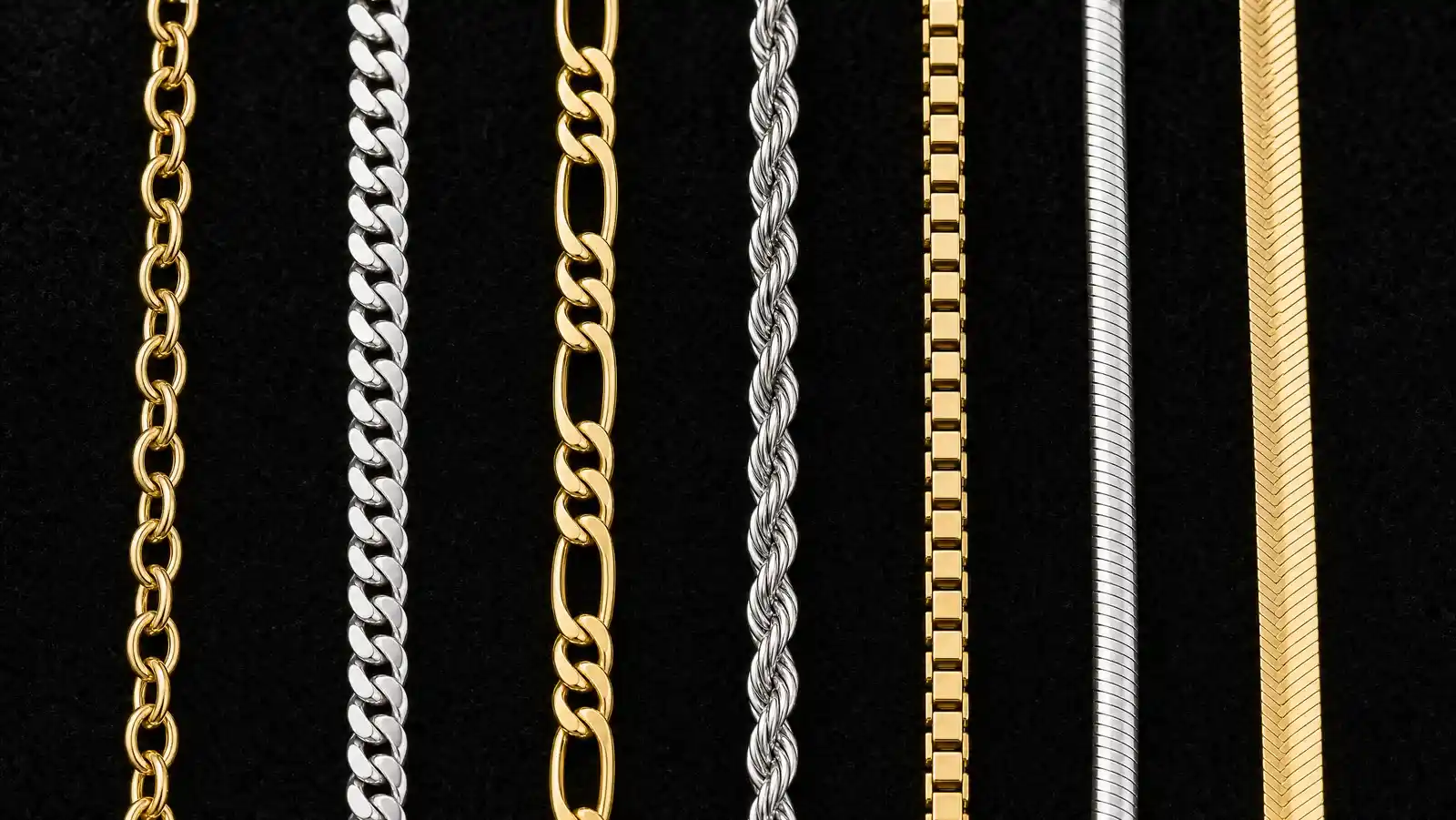
The default: uniform oval links, each set at a right angle to the last and soldered closed. Commonly 1mm to 5mm.
Cable is the easiest style here to repair. Quick Jewelry Repairs calls basic cable chains "the easiest kind of chain to repair," because every link is a discrete closed loop a jeweler can open, rejoin, and solder with almost no visible scar. ItsHot calls it "one of the most recommended gold chains for durability," and its failure mode is contained: one link parts, and the rest of the chain is undamaged.
Best for: pendants of any size and daily wear, at low repair cost.
Curb Chain and Cuban Link
Curb takes cable's ovals and twists and flattens them so they interlock and lie flush. That flattening is the whole trick: the chain sits still instead of rolling.
Cuban is a curb variation, not a separate species, and the terms get used loosely online. Frost NYC puts it precisely: "Curb chains have oval links with a slightly flattened face while the links on Cuban chains have rounder, thicker walls." Its example has a 10k gold 10mm 26-inch Cuban chain at around 7 ounces against 2.4 ounces for curb at the same specs. ItsHot calls Cuban "the strongest of all because of its thickness" within the curb family.
Curb runs from about 2mm up, and Cuban is usually sold in the wider, heavier sizes, though both are made at the same widths, which is how Frost NYC can compare a 10mm curb with a 10mm Cuban.
Best for: wearing alone and heavy pendants. A solid Cuban is among the toughest chains you can own; a hollow one at the same width is not.
Figaro Chain
Curb with a rhythm: one elongated link followed by two or three short ones, repeating. Commonly 2mm to 7mm, and flattened like curb, so it lies flat.
ItsHot rates figaro "as strong as cable chains or Cuban link chains." Each link is still an individual closed loop, so breaks are a straightforward solder repair. The long link carries the most unsupported span.
Best for: standalone texture and medium pendants.
Rope Chain
Many small links twisted around a central axis so the chain reads as a spiraling cord. Usually diamond-cut, which is why rope looks so bright. Widths run from about 1.5mm past 6mm.
The catch is repair. Quick Jewelry Repairs notes that on many rope chains "the design of the chain is empty on the inside of the links," so the repair site ends up crushed and weak. Solid rope is genuinely tough; ItsHot lists it among the strongest styles and "one of the best gold chains for pendants."
Best for: pendants and standalone wear, if you buy solid. We would avoid a wide hollow rope for everyday wear.
Box Chain
Square links joined face to face into a smooth, angular cord with visible right angles. The most geometric of the common types of necklace chains, usually 0.8mm to 4mm.
Box is stiffer than cable, which is why it hangs cleanly and resists knotting in a drawer. ItsHot describes it as having a "sturdy structure, despite smooth appearance," and repairs are among the simplest here, since the links are discrete.
Best for: pendants that must hang dead straight.
Snake Chain
Tightly fitted plates that curve and lock into a smooth, flexible tube with no visible gaps. Common widths sit between about 1mm and 4mm.
It is also structurally unforgiving. The plates ride in a continuous track, so a sharp bend leaves a permanent crimp. Repairs are possible, but Quick Jewelry Repairs is clear that on patterned chains including snake, herringbone, and rope, "there will always be a slightly noticeable location of repair." Tellingly, ItsHot's ranking of the ten strongest gold chains excludes snake and herringbone entirely.
Best for: occasion wear and slide pendants with a wide bail.
Herringbone Chain
A flat ribbon of short, slanted parallel plates, essentially a flattened snake. It sits flush to the skin and mirrors light. Bayam Jewelry lists widths from 3mm up to 18mm, the wide end functioning as a collar.
This is the most fragile construction in common circulation, and it is worth being blunt about why. Quick Jewelry Repairs explains that herringbone is made of "thin slices of metal, and once they're bent it's near-impossible to hammer them back," and that a snag "'unravels' the entire structure." A kink is usually permanent, and even a good repair leaves a weak point that folds again. Bayam is direct: "We recommend you avoid pendants as the pendants tend to twist and turn, and may kink the chain."
Best for: a bare-neck statement, worn alone, stored flat. Not for pendants.
Wheat and Spiga Chain
Also sold as spiga: strands of twisted oval links interwoven into a braided, wheat-stalk texture with almost no slack. Widely available from about 1mm to 4mm.
The weave is the strength. ItsHot calls wheat "one of the strongest chains" and describes it as kink-free, which reduces the risk of breaking. When it fails, reassembling the weave is fiddly, and Quick Jewelry Repairs notes that chains needing more labor and material cost more to fix than a plain cable link.
Best for: heavier pendants and daily wear, without the bulk of Cuban.
Singapore Chain
A twisted hybrid between curb and rope: flattened links given a spiral twist, usually diamond-cut, so the chain shimmers as it moves. Almost always fine, roughly 1mm to 2.5mm.
Despite the delicate look, ItsHot ranks Singapore among the ten strongest chain types and calls its structure "remarkably strong." The realistic annoyance is twisting rather than breakage.
Best for: small pendants, layering, and dressier wear.
Rolo and Belcher Chain
Rolo, called belcher in the UK, uses symmetrical round or D-shaped links of even width, each at a right angle to the next. Common from about 1.5mm to 5mm.
Chunky closed loops with thick walls take abuse well and solder easily. The open, roomy geometry is also the vulnerability: a thin rolo can be pried open by a heavy charm pulling at one point.
Best for: charm necklaces and chunky pendants.
Bead and Ball Chain
A row of small metal spheres joined by short lengths of wire, best known from military dog tags. Commonly 1mm to 4mm across the bead.
Load rides entirely on the thin wire between beads, so quality varies enormously. ItsHot rates a well-made dog tag or ball chain as "a very strong type of chain," while lightweight hollow-bead versions are among the flimsier things sold. Quick Jewelry Repairs groups ball chains with cable and box chains as "fairly simple to fix."
Best for: casual pendants and dog tags in solid metal.
Paperclip Chain
Elongated rectangular links with rounded ends, spaced widely enough to see through. Usually 2mm to 8mm across the link.
Large, individually accessible links make paperclip easy to solder. Its weakness is geometry rather than construction: a long, thin link has a wide unsupported span, so it bends out of shape more readily than a short cable link of the same gauge.
Best for: modern styling and layering against finer chains.
Mariner and Anchor Chain
Oval links with a bar across the middle of each, copying a ship's anchor chain. The bar is not decoration; ItsHot credits it with keeping the links from twisting and the chain tangle-free. Sold from about 2mm into double digits, in flat and puffed versions.
ItsHot lists mariner as "one of the strongest gold chain types," crediting that heavy-duty design. The center bar gives a jeweler more geometry to match at the repair site, but the style is robust.
Best for: heavy pendants and standalone wear with more structure than plain curb.
How Link Style Interacts With Length
Link style and length are not independent choices. A stiff chain like box or wheat holds a deliberate curve at 16 to 18 inches. The same length in herringbone becomes a collar that has to sit exactly right or it buckles.
At 24 inches and beyond, a fine cable or Singapore chain swings more, catches more, and puts more leverage on a pendant bail. Denser links hang straighter at length, which is why long chains skew toward curb, Cuban, rope, and mariner. Our necklace chain length guide covers the standard lengths and where each falls.
For layering, mix constructions instead of repeating one: two fine cable chains at similar lengths braid together quickly, while a flat curb and a box chain two inches longer tend not to.
Types of Necklace Chains Compared
| Chain style | Common width | Durability | Repairable? | Best use |
|---|---|---|---|---|
| Cable | 1–5mm | High | Easily | Pendants, daily |
| Curb | 2–8mm | High | Easily | Standalone, pendants |
| Cuban | 6mm+ | Highest when solid | Yes | Bold, heavy pendants |
| Figaro | 2–7mm | High | Easily | Textured standalone |
| Rope | 1.5–6mm+ | High solid, lower hollow | Costs more | Pendants, sparkle |
| Box | 0.8–4mm | High | Easily | Straight-hanging pendants |
| Snake | 1–4mm | Low, kinks | Repair shows | Occasion, no pendant |
| Herringbone | 3–18mm | Lowest, kinks permanently | Often not | Bare-neck statement |
| Wheat/Spiga | 1–4mm | High | Yes, fiddly | Heavier pendants, daily |
| Singapore | 1–2.5mm | Good for its weight | Yes | Small pendants, layering |
| Rolo/Belcher | 1.5–5mm | High | Easily | Charms, chunky pendants |
| Bead/Ball | 1–4mm | Varies with build | Fairly simple | Dog tags, casual |
| Paperclip | 2–8mm | Moderate, links bend | Easily | Modern layering |
| Mariner/Anchor | 2mm+ | High | Yes | Heavy pendants, standalone |
Durability follows ItsHot's ranking, which places cable, Cuban, mariner, rope, wheat, figaro, box, and Singapore among the ten strongest gold chains and omits snake and herringbone.
Care, Repair, and Storage
Take it off before it gets pulled. Snags from sweaters, seat belts, hair ties, and gym equipment are a common cause of chain failure, and that goes double for herringbone, snake, and fine paperclip links. Quick Jewelry Repairs notes that a snagged herringbone "unravels" the entire structure.
Clean gently, dry completely. Residue trapped between tightly packed links is what makes an old chain look gray. Our guide to cleaning gold, platinum, and silver at home covers what is safe on each metal.
Store flat or hanging, never in a pile. Herringbone and snake should lie flat, never folded. Fine cable and rope want individual compartments, since fine chains tangle with each other readily. Our jewelry storage and travel guide covers cases and tangle prevention.
Ask whether a chain is hollow before you buy: Quick Jewelry Repairs notes that hollow rope repairs get crushed at the work site and may not withstand daily wear.
Choosing Among the Types of Necklace Chains
Work backward from how the chain will live.
If it holds a pendant and gets worn constantly, buy cable, box, wheat, or a solid curb sized to the bail. All four are strong, solder cleanly, and do not compete with the pendant.
If the chain is the jewelry, look at Cuban, mariner, figaro, or paperclip. These read as complete pieces on bare skin and hold shape at wider widths.
If you want the liquid-metal look of herringbone or snake, buy it knowing what it is: an occasion piece that punishes one sharp bend. And if a listing will not say whether the links are solid or hollow, treat that as the answer.
For length charts, clasp comparisons, and metal weights in one place, read our complete guide to necklace chains.
FAQ
What is the strongest type of necklace chain?
ItsHot ranks cable, Cuban link, mariner, rope, and wheat at the top of its list of the strongest gold chains, and calls Cuban "the strongest of all because of its thickness" within the curb family. Width and solid construction matter as much as the style name.
Can a kinked herringbone chain be fixed?
Rarely to original condition. Quick Jewelry Repairs describes herringbone as "thin slices of metal, and once they're bent it's near-impossible to hammer them back." A straightened kink leaves a weak point that folds again in the same spot.
What is the difference between a curb chain and a Cuban link?
Cuban is a heavier variant of curb, not a separate construction. Frost NYC describes curb as having "oval links with a slightly flattened face" while Cuban links have "rounder, thicker walls." Its example puts a 10mm 26-inch Cuban chain at around 7 ounces against 2.4 ounces for curb.
Is a hollow chain ever worth buying?
For a wide statement chain worn occasionally, hollow buys the look for far less gold. Uverly puts a 6mm 14k 24-inch solid Miami Cuban at roughly 68.0 grams against about 25.3 grams hollow. For daily wear or a heavy pendant, spend the difference on solid links.
What chain width should I pair with a pendant?
Robinson's Jewelers suggests 1 to 2mm for a tiny solitaire, 3 to 5mm for a medium cross or locket, and 6mm or wider for large medallions, with the chain at least 1.5 times thicker than the bail opening while still sliding through it.
About the Author
Alfreda Borror
Alfreda Borror is the founding editor of Opulent Opal, writing research-based buying guides on diamonds, birthstones, and fine jewelry.