Best Tennis Bracelets: Picks by Carat and Budget

This post may contain affiliate links. Read our affiliate policy
- PAVOI CZ Classic Tennis Bracelet for Women, 14K Gold Plated, Yellow Gold
- KRKC Tennis Bracelet for Women 14K White Gold Plated, AAAAA+ Classic Cubic Zirconia Bracelet with 2mm-5mm Width, Durable Gold Bracelets Jewelry Christmas Gift, Size 6.5-8 Inches Hypoallergenic
- 925 Sterling Silver Moissanite Tennis Bracelet for Women, 5.3 Carat Total Weight, D Color VVS1 Brilliant Moissanite Stones, 3mm Classic Tennis Bracelet, GRA Certified, Available in 6.5 7 and 7.5 Inch Sizes
- Lab Grown Diamond Bracelets for Women, 3/5 Carat 14K Gold Over S925 Sterling Silver Bar Tennis Bracelet, D Color VS1 Clarity Diamond Adjustable Link Dainty Bracelets For Birthday Valentines Gifts
- NATALIA DRAKE 1/4 Cttw Diamond Tennis Bracelet, Wave Link
- Privosa - 10 Ct Lab Grown Diamond Tennis Bracelet for Women, 14K White Gold
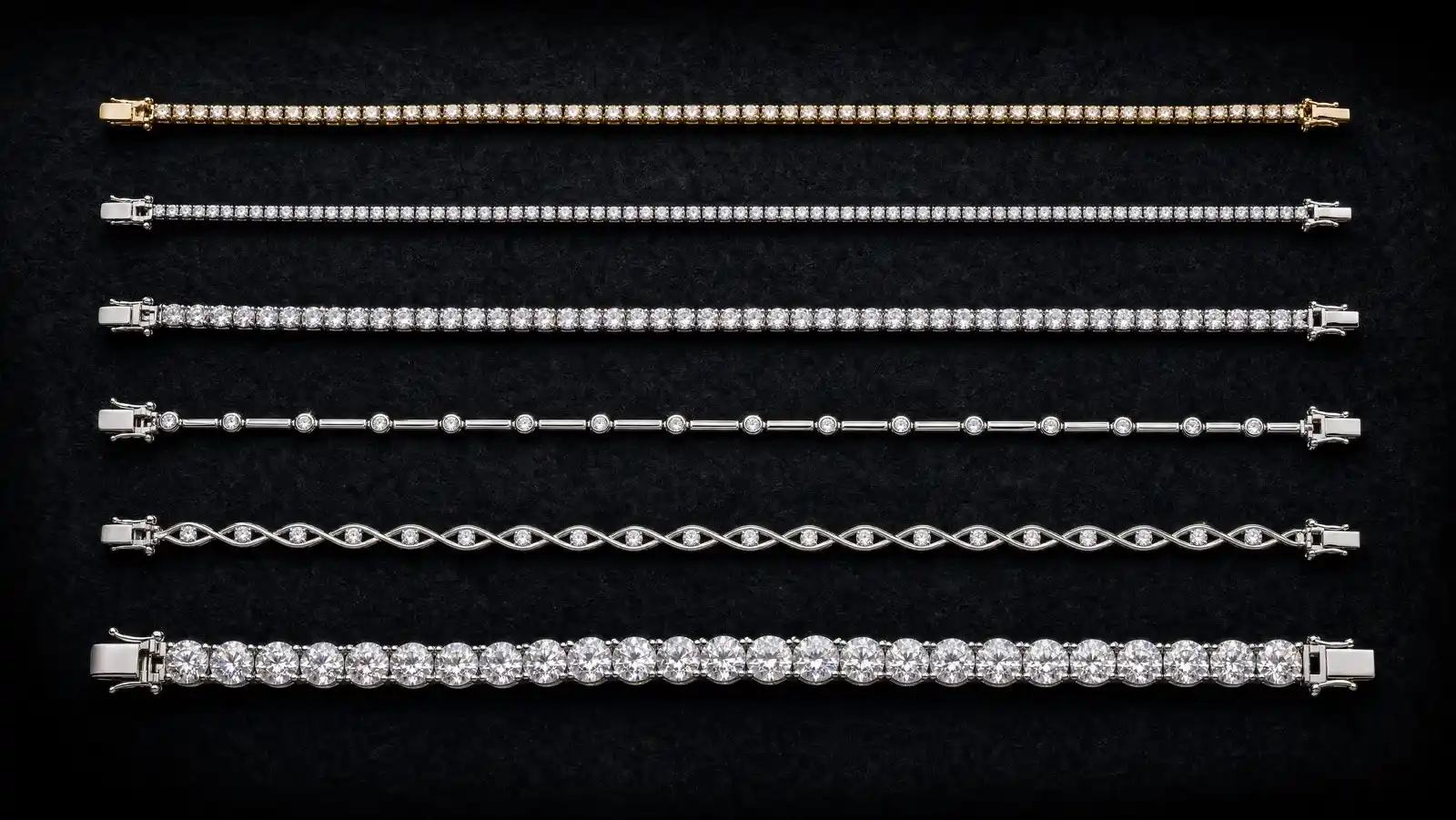
Search for the best tennis bracelet and the first page of results hands you a $16 piece and a $40,000 piece under the same three words. The phrase describes a shape — a continuous line of stones running the whole circumference of the wrist — and tells you nothing about what those stones are, what holds them in, or whether the metal is solid or a few microns of plating over brass.
This article contains affiliate links. We may earn a commission if you make a purchase through our links, at no extra cost to you.
Our six picks run from $16.45 to $2,649 as of September 2026. The thesis underneath all of them: price is set by the stone material first, carat weight second, and the setting metal third — and the expensive mistake is paying for a name on the stone instead of for the construction that keeps the stone attached. If you have not bought one before, what a tennis bracelet is covers the definition, fit and clasp basics, and our guide to bracelets puts the style next to its alternatives.
Table of Contents
- Where the Money Actually Goes
- Not Everything Sold Under This Name Is One
- Our Picks, Cheapest First
- The $189.99 Question: 0.6 ct Lab-Grown vs 0.25 ct Natural
- Prongs, Bezels and the Closure That Matters
- What a Certificate Card Actually Proves
- The Six at a Glance
- Choosing by Budget
- FAQ
Where the Money Actually Goes
Four stone materials account for almost the whole price spread, and they are not interchangeable.
Cubic zirconia costs a few dollars a carat. Gem-trade references commonly put it at roughly 8 to 8.5 on the Mohs hardness scale with a refractive index near 2.16. It is bright out of the box, but a bracelet spends its life dragging along desks and doorframes, and at that hardness the facet junctions abrade and the stones go milky. Budget $15 to $60 and treat it as a consumable rather than an heirloom.
Moissanite is silicon carbide — a distinct material, not a cheaper grade of diamond. The same references give it 9.25 on the Mohs scale and a refractive index around 2.65, higher than diamond's, which is why it throws more coloured flash. Our comparison of moissanite vs diamond covers where the two visibly diverge. Expect $100 to $400 for a full line.
Lab-grown diamond is the same material as mined diamond, grown in weeks. It is why a 10-carat line is now a four-figure purchase — see lab grown vs natural diamonds for how far the prices have separated.
Natural diamond carries a provenance premium and nothing else optically. At the budget end that premium gets paid for in quality: $190 buys a quarter carat of heavily included mined stones, or more than twice the weight in cleaner lab-grown.
Carat weight comes second, and total carat weight — not the width in millimetres listings prefer to advertise — is the number that moves price inside any one material.
Metal comes third, and this is where listings mislead most. "14K gold plated" describes a coating, not a bracelet. According to the Federal Trade Commission's Guides for the Jewelry, Precious Metals, and Pewter Industries at 16 CFR Part 23, "gold plate" must be immediately preceded by the karat fineness of the alloy, and the threshold for calling an electrolytic coating "gold electroplate" is a minimum thickness throughout equivalent to 0.175 microns — about seven millionths of an inch — of fine gold, deposited as gold or gold alloy of at least 10 karat fineness. Seven millionths of an inch is a colour, not a metal.
Not Everything Sold Under This Name Is One
Sotheby's calls the style a continuous-strand diamond bracelet — one flexible row of matched stones — and traces the modern name to Chris Evert, who stopped play at the U.S. Open after her bracelet broke and fell on court. Mental Floss notes the year is usually reported as 1987, but that Evert's own recollection, relayed through her publicist, places it in 1978.
The operative word is line. Three designs get sold under the same search term and are not the same object:
- Bar accents — one short row of stones on an otherwise plain chain.
- Station bracelets — individual stones spaced along a chain with gaps between them.
- Wave, cluster and fancy links — stones set into a shaped link rather than a straight run.
None of those are defects. They are cheaper to make, because a real line needs dozens of matched stones in dozens of individually built settings hinged together so the whole thing drapes.
Two of our own six picks fall into this group, and we would rather say so than let the box tell you. The GemmGalore is described by its own maker as a bar accent on an adjustable chain. The Natalia Drake is a wave link. Both are good buys for what they are; neither is a continuous line. If you want metal rather than stones, our roundup of the best gold bracelets is the better page.
Our Picks, Cheapest First
Six bracelets in rising price order, at prices as of September 2026.
Best Under $20: PAVOI 2mm CZ, 14k Gold Plated
At $16.45 the PAVOI is a genuine continuous line of 2mm round cubic zirconia, each stone in a four-prong basket setting, finished in 14K yellow gold plating over base metal. PAVOI states AAAAA-grade stones, compliance with US and EU nickel, lead and cadmium limits, and a 60-day satisfaction promise.
The gotcha is length. This is 6.5 inches finished and not adjustable. Our bracelet size guide cites REEDS Jewelers' industry standard of 7 inches for women, with 6.5 inches suiting a wrist near 6 to 6.25 inches once you allow the quarter to half inch of slack a bracelet needs to rotate. On an average adult wrist this will not close comfortably.
Best Bezel-Set Option: KRKC&CO Bezel-Set CZ
$49.99, and the reason to pay three times the PAVOI is the setting. These stones sit in bezels — a collar of metal around each stone's girdle — rather than under prongs, and prongs are what fail on the one piece of jewelry dragged across hard surfaces all day. KRKC&CO states a nickel-free copper and zinc alloy, rhodium plated with a 14K white gold coating it calls ten times thicker than standard.
Be careful with the specification. The title says 2mm-5mm widths and 6.5-8 inch sizes; its own bullet says 3mm-5mm and 6.0-8.5 inches, and another bullet calls the product "these earrings". Confirm the variation with the seller before ordering, and read the plating claim as marketing, since no micron figure is given.
Best Moissanite: Ironsaints 5.3 ctw in Sterling Silver
$129.99 buys 5.3 carats total weight of moissanite in a 3mm line on 925 sterling silver, in 6.5, 7 and 7.5 inch lengths. Ironsaints states D colour and VVS1 clarity and supplies a GRA card. Per carat of visible stone nothing here comes close — 5.3 carats of lab-grown diamond at comparable stated grades costs several times this.
Two caveats. Sterling tarnishes, because both the silver and the copper in the alloy react with sulfur compounds in the air, and the more copper an alloy carries the faster it goes, so "tarnish resistant" is a claim about the polish rather than the metal. And the GRA card is not what most buyers assume — see the certificates section below.
Best Budget Lab-Grown: GemmGalore 0.6 ct Bar Accent
$189.99 and the cheapest real lab-grown diamonds here: 0.6 carat total weight, stated by the maker as IGI-certified D colour and VS1 clarity, on 925 sterling silver plated in 14K white or yellow gold, with an adjustable link.
Read the maker's own words first. This is a bar accent — one run of stones on an adjustable chain — not a continuous line. The adjustable link is a real advantage in a category where a fixed length is a common reason for a return, and 0.6 ct of D/VS1 material at this price is honest value. It just is not the silhouette the search term implies.
Best Natural Diamonds: NATALIA DRAKE 0.25 ctw Wave Link
Also $189.99, and a completely different proposition: a quarter carat total weight of natural, Kimberley Process compliant diamonds, stated I-J colour and I2-I3 clarity, in rhodium-plated sterling silver. It measures 7.15 by 0.28 by 0.14 inches and is listed as fitting 6 to 8 inch wrists.
The best thing here is not the stones. It is the clasp: a safety catch that must be flipped open before the release button does anything. Two-action closures are why bracelets stay on wrists.
Best Solid 14k Gold: Privosa 10 ctw Lab-Grown in White Gold
$2,649, and the only piece here where the metal is the metal: solid 14K white gold, no plating, holding 42 round brilliant lab-grown diamonds totalling 10 carats in four-prong settings on a 7-inch bracelet, closed with a box clasp and safety catch. Privosa states D-E colour and VVS1-VVS2 clarity.
Do the arithmetic. Ten carats across 42 stones is about 0.24 carat per stone, sitting shoulder to shoulder over 7 inches — a substantial continuous band, not a delicate line. Privosa also discloses that total weight may vary by plus or minus 5 percent, which it calls standard for the industry; at 10 ctw that is half a carat either way, so read 10 ct as nominal.
The $189.99 Question: 0.6 ct Lab-Grown vs 0.25 ct Natural
Two picks cost exactly the same, $189.99 as of September 2026, and they are the clearest illustration in the category of what your money buys.
| GemmGalore | NATALIA DRAKE | |
|---|---|---|
| Stone origin | Lab-grown | Natural (mined) |
| Total carat weight | 0.6 ct | 0.25 ct |
| Stated colour | D | I-J |
| Stated clarity | VS1 | I2-I3 |
| Setting metal | 14K gold over sterling | Rhodium-plated sterling |
| Design | Bar accent, adjustable | Wave link, safety clasp |
What I2-I3 means. These are the bottom grades on the clarity scale published by the Gemological Institute of America. The American Gem Society describes the Included range as diamonds whose inclusions are obvious and may affect transparency and brilliance, and jeweler education pages are consistent that at I2 and I3 those inclusions are visible without magnification; at I3 they can be extensive enough to raise durability questions. Our explainer on diamond clarity walks the whole scale. In tiny melee stones this matters less than in a solitaire — a 0.01 ct stone has less room to hide a feather — but I2-I3 melee may read slightly grey rather than white.
What I-J means. GIA's D-to-Z scale groups G, H, I and J as near colourless, with I and J at the bottom of that group: face-up they read as colourless to most people, with a faint warm tint that shows against a white background or under bright light. Our diamond color chart shows where the perceptible steps fall. I-J is not a bad colour; it is where most buyers land when they want mined stones on a budget.
So which one. We will not decide this for you, because the deciding factor is not technical.
- If you want the biggest, whitest, cleanest stones $189.99 buys, the lab-grown piece wins on every measurable axis: more than twice the carat weight, top-of-scale stated colour, and a clarity grade where inclusions need magnification.
- If mined origin matters to you specifically, the natural piece is the only one of the two that satisfies it — and its safety clasp is a genuine engineering advantage over an adjustable chain.
What you should not do is buy the natural one believing it is the higher-quality object. At these grades it is not. It is the more traditionally sourced object, which is a different thing.
Prongs, Bezels and the Closure That Matters
This style has one failure mode that matters: it comes off and you do not notice. Read every construction detail against that.
Four-prong settings are the classic. Each stone sits in a small basket with four fingers bent over the crown, showing the most stone and letting light in from the sides. They are also what catches on knitwear, and a bent prong nobody notices is how a stone leaves.
Bezels trade a little brilliance for a lot of security: a continuous rim of metal, nothing to snag. On the piece of jewelry that takes the most incidental abuse, that is a defensible trade.
The clasp outranks both. A box clasp is a tongue that snaps into a housing; add a hinged safety catch and two independent actions must fail before it opens. A lobster claw is one spring-loaded gate — fine on a necklace, where a failure drops the piece down your front. A bracelet fails at arm's length, in a parking lot. That is why the Privosa's box clasp with safety closure matters more on a $2,649 piece than any grading document. On the plated picks no clasp type is stated at all, and that absence is itself information.
What a Certificate Card Actually Proves
A GRA card is a moissanite-trade record, not a laboratory grading report. By the Gemological Research Association's own account it provides archiving and data-recording services for moissanite, and its certificates function as data archive vouchers listing a sample's dimensions, cut, colour and clarity. GRA also states plainly that it has no affiliation, authorisation or cooperation with GIA or other gemstone authentication institutions. So it is a spec sheet from the moissanite trade about a moissanite — not an independent opinion, and emphatically not a diamond report.
GIA no longer issues 4Cs grades for lab-grown stones. GIA announced that from 1 October 2025 it stopped applying the nomenclature created for natural diamonds to laboratory-grown ones, replacing colour and clarity grades with a Laboratory-Grown Diamond Quality Assessment that sorts qualifying stones into two descriptive tiers, Premium and Standard, with the assessment number laser-inscribed on the girdle. GIA's stated rationale was that lab-grown production clusters tightly at the top of the old scale.
The practical consequence: a lab-grown listing quoting "D colour, VS1 clarity" in 2026 is quoting a grade from IGI or another laboratory, not from GIA. That is exactly what GemmGalore states, and it is legitimate — IGI grades most lab-grown goods. Just do not read "D/VS1" as a GIA number. And note that no certificate of any kind addresses prong thickness, clasp type or plating microns, which are the things that decide whether the bracelet survives.
The Six at a Glance
| Pick | Stone | Carat weight | Metal | Clasp | Price (Sep 2026) |
|---|---|---|---|---|---|
| PAVOI 2mm CZ | Cubic zirconia, 2mm | Not stated | 14K gold plated base metal | Not stated | $16.45 |
| KRKC&CO Bezel-Set CZ | Cubic zirconia, bezel set | Not stated | Rhodium and 14K white gold over copper-zinc alloy | Not stated | $49.99 |
| Ironsaints Moissanite | Moissanite, 3mm | 5.3 ctw | 925 sterling silver | Not stated | $129.99 |
| GemmGalore Bar Accent | Lab-grown diamond, D/VS1 stated | 0.6 ct | 14K gold over 925 sterling | Adjustable link | $189.99 |
| NATALIA DRAKE Wave Link | Natural diamond, I-J / I2-I3 stated | 0.25 ct | Rhodium-plated sterling silver | Button release with safety catch | $189.99 |
| Privosa 10 ctw | Lab-grown diamond, D-E / VVS1-VVS2 stated | 10 ct, plus or minus 5% | Solid 14K white gold | Box clasp with safety closure | $2,649 |
Choosing by Budget
Under $50. Buy cubic zirconia knowingly. The PAVOI at $16.45 is a genuine continuous line and the cheapest way to learn whether you like wearing one — if your wrist takes 6.5 inches. Otherwise the KRKC&CO at $49.99 gives you a bezel setting and a size range, once you have pinned the seller down on which one.
Around $130. The Ironsaints is the value pick of the list. Nothing else gets 5.3 carats of hard, high-refraction stone into a real 3mm line for $129.99.
Around $190. Decide whether origin or quality is what you are buying. Lab-grown gets you more than twice the carat weight at better stated grades; natural gets you mined stones and the better clasp.
$2,000 and up. The Privosa is the only piece here with solid metal and a two-action closure — the combination that makes a bracelet worth repairing in twenty years rather than replacing in two.
One last thing that applies at every price: measure your wrist and add your allowance before you shop, not after the box arrives. Many jewelers will tell you fit sends more bracelets back than stone quality ever does. For how this style sits against cuffs, bangles, chains and charm designs, Opulent Opal's bracelet guide is the next page to read.
FAQ
What carat weight should I look for?
There is no correct answer, only a look. Under 1 ctw reads as a delicate accent; 3 to 5 ctw reads as a classic line; 10 ctw is a statement band. Total carat weight matters more than the width quoted in millimetres, because width says nothing about how deep the stones are.
Are cubic zirconia bracelets worth buying?
For a specific job, yes: a look you are trying out, or travel jewelry you would rather lose than worry about. At roughly 8 to 8.5 on the Mohs scale it is soft enough that daily wear commonly dulls the facet edges over time, and gold plating wears through at the clasp and underside sooner. Buy it as a consumable.
Is a lab-grown stone actually a diamond?
Yes — same material, same hardness, same optics, grown rather than mined. What changed is the paperwork: GIA stopped issuing natural-diamond colour and clarity grades for lab-grown stones on 1 October 2025 in favour of a two-tier Premium or Standard quality assessment, so the D/VS1-style grades in listings now come from IGI or another laboratory.
How do I know it will fit before I order?
Measure at the wrist bone with a flexible tape, add your allowance — roughly a quarter inch for snug, half an inch for everyday comfort — and order that total as the finished length. Watch for listings quoting a wrist range instead of a finished length; "fits 6 to 8 inch wrists" and "7.15 inches long" are different specifications, and one of our picks quotes both.
Does a GRA card mean the same thing as a GIA report?
No. GRA describes itself as providing archiving and data-recording services for moissanite and states it has no affiliation with GIA or other gemstone authentication institutions. Treat it as the seller's spec sheet for a moissanite, not an independent gemological opinion.
Which clasp should I insist on?
Anything needing two actions to open: a box clasp with a hinged safety catch, or a push-button release protected by a flip-over catch. A bare lobster claw is fine on a necklace and marginal on a wrist. If a listing does not say what the clasp is, assume it is the cheapest option that fits the price.
PAVOI CZ Classic Tennis Bracelet for Women, 14K Gold Plated, Yellow Gold

PAVOI CZ Classic Tennis Bracelet for Women 14K Gold Plated Yellow Gold
A continuous line of 2mm round cubic zirconia, each stone held in a four-prong basket setting, on a bracelet that measures 6.
A continuous line of 2mm round cubic zirconia, each stone held in a four-prong basket setting, on a bracelet that measures 6.5 inches. The finish is 14K yellow gold plating over a base metal, and PAVOI states AAAAA-grade cubic zirconia that is hypoallergenic, nickel-safe, lead-safe and cadmium-compliant to US and EU standards. Per the listing it arrives in a gift box, carries a 60-day satisfaction promise, and is made from 100% recycled materials in 99% recycled packaging.
"The cheapest honest test of whether the silhouette suits you, and the four-prong basket is the classic construction rather than a shortcut. The trade-off is length: 6.5 inches is a finished measurement at the small end of the women's range, so on an average wrist it will not close comfortably, and plating is a finish rather than a metal thickness, so it wears through first at the clasp and the underside.
KRKC Tennis Bracelet for Women 14K White Gold Plated, AAAAA+ Classic Cubic Zirconia Bracelet with 2mm-5mm Width, Durable Gold Bracelets Jewelry Christmas Gift, Size 6.5-8 Inches Hypoallergenic

KRKC Tennis Bracelet for Women 14K White Gold Plated AAAAA Classic Cubic Zirconia Bracelet with 2mm 5mm Width Durable Gold Bracelets Jewelry Christmas Gift Size 6 5 8 Inches Hypoallergenic
Round-cut cubic zirconia held in bezel settings rather than prongs, on a nickel-free copper and zinc alloy that the maker states is rhodium plated and given a 14K white gold coating it describes as ten times thicker than standard plating.
Round-cut cubic zirconia held in bezel settings rather than prongs, on a nickel-free copper and zinc alloy that the maker states is rhodium plated and given a 14K white gold coating it describes as ten times thicker than standard plating. The listing contradicts itself on both dimensions: the title gives 2mm-5mm widths and 6.5-8 inch sizes while its own bullet gives 3mm-5mm and 6.0-8.5 inches, and one bullet refers to the item as 'these earrings', so the copy is recycled from another product. KRKC&CO states 30-day returns and a one-year warranty.
"Worth the step up for daily wear because a bezel wraps metal around each stone's girdle instead of trusting four thin prongs, which is the more forgiving construction on a piece that lives at the point of the wrist. The trade-off is the listing itself: it disagrees with its own bullets on both width and length and describes the item as earrings in one line, so confirm the exact variation with the seller before you order rather than after.
925 Sterling Silver Moissanite Tennis Bracelet for Women, 5.3 Carat Total Weight, D Color VVS1 Brilliant Moissanite Stones, 3mm Classic Tennis Bracelet, GRA Certified, Available in 6.5 7 and 7.5 Inch Sizes

925 Sterling Silver Moissanite Tennis Bracelet for Women 5 3 Carat Total Weight D Color VVS1 Brilliant Moissanite Stones 3mm Classic Tennis Bracelet GRA Certified Available in 6 5 7 and 7 5 Inch Sizes
A classic 3mm line carrying 5.
A classic 3mm line carrying 5.3 carats total weight of moissanite in a 925 sterling silver setting, offered in 6.5, 7 and 7.5 inch lengths. The maker states D colour and VVS1 clarity for the stones and includes a GRA certification card, and describes the silver as hypoallergenic, durable and tarnish resistant with a polished high-shine finish.
"By a wide margin the most stone per dollar here, and moissanite is hard enough to survive the knocks a bracelet takes that a ring never does. Two honest trade-offs: sterling silver does tarnish, so read 'tarnish resistant' as a claim about a polish rather than a property of the alloy, and the GRA card is a moissanite-trade archive document rather than an independent gemological laboratory report of the kind GIA issues.
Lab Grown Diamond Bracelets for Women, 3/5 Carat 14K Gold Over S925 Sterling Silver Bar Tennis Bracelet, D Color VS1 Clarity Diamond Adjustable Link Dainty Bracelets For Birthday Valentines Gifts

Lab Grown Diamond Bracelets for Women 3 5 Carat 14K Gold Over S925 Sterling Silver Bar Tennis Bracelet D Color VS1 Clarity Diamond Adjustable Link Dainty Bracelets For Birthday Valentines Gifts
Three-fifths of a carat, or 0.
Three-fifths of a carat, or 0.6 ct, of lab-grown diamonds that the maker states are IGI-certified at D colour and VS1 clarity, set on 925 sterling silver plated in 14K white or yellow gold and stated to be nickel, lead and cadmium free. The maker's own description is a bar accent on an adjustable link chain, called minimalist and dainty, rather than a continuous line of matched stones. It ships in a velvet-lined satin gift box with a care kit.
"The least expensive route to real lab-grown diamonds on this list, and the adjustable link quietly solves the sizing problem that every fixed-length bracelet creates. The trade-off is a big one and the maker states it openly: this is a bar accent on a chain, not a continuous line of stones, so if the unbroken circle of light is the thing you want, this is not the piece that delivers it.
NATALIA DRAKE 1/4 Cttw Diamond Tennis Bracelet, Wave Link

NATALIA DRAKE 1 4 Cttw Diamond Tennis Bracelet Wave Link
A quarter carat total weight of natural diamonds, stated at I-J colour and I2-I3 clarity, set in rhodium-plated sterling silver in a wave-link pattern rather than a straight line.
A quarter carat total weight of natural diamonds, stated at I-J colour and I2-I3 clarity, set in rhodium-plated sterling silver in a wave-link pattern rather than a straight line. It measures 7.15 inches long by 0.28 inches wide by 0.14 inches thick and is listed as fitting wrists from 6 to 8 inches, and the clasp carries a safety catch that must be flipped open before the release button will work. The maker states compliance with the Kimberley Process for conflict-free diamonds.
"The pick for a buyer who specifically wants mined stones and would rather spend the budget on the closure than on carat weight, since a safety catch over a push-button release is the single most useful feature on this whole list. Two trade-offs: I2-I3 is the bottom of the clarity scale, where inclusions are visible without magnification, and the wave link means this is a diamond bracelet rather than a true continuous tennis line.
Privosa - 10 Ct Lab Grown Diamond Tennis Bracelet for Women, 14K White Gold

Privosa 10 Ct Lab Grown Diamond Tennis Bracelet for Women 14K White Gold
Forty-two round brilliant lab-grown diamonds totalling 10 carats, four-prong set along a 7-inch bracelet in solid 14K white gold with no plating, closed by a box clasp with a safety closure.
Forty-two round brilliant lab-grown diamonds totalling 10 carats, four-prong set along a 7-inch bracelet in solid 14K white gold with no plating, closed by a box clasp with a safety closure. The maker states D-E colour and VVS1-VVS2 clarity, offers other total-carat-weight options, and discloses that total diamond weight may vary by up to plus or minus 5 percent, which it describes as standard across the fine jewelry industry.
"The only piece here built the way a bracelet you intend to keep should be built: solid metal rather than a plated layer, and a box clasp with a safety catch rather than a lobster claw. The trade-offs are the plus or minus 5 percent carat tolerance, which at 10 ctw is half a carat in either direction, and a fixed 7-inch length that leaves you no adjustment if your measurement lands between sizes.
Review of Our Favorite 3
PAVOI CZ Classic Tennis Bracelet for Women 14K Gold Plated Yellow Gold
A continuous line of 2mm round cubic zirconia, each stone held in a four-prong basket setting, on a bracelet that measures 6.
KRKC Tennis Bracelet for Women 14K White Gold Plated AAAAA Classic Cubic Zirconia Bracelet with 2mm 5mm Width Durable Gold Bracelets Jewelry Christmas Gift Size 6 5 8 Inches Hypoallergenic
Round-cut cubic zirconia held in bezel settings rather than prongs, on a nickel-free copper and zinc alloy that the maker states is rhodium plated and given a 14K white gold coating it describes as ten times thicker than standard plating.
925 Sterling Silver Moissanite Tennis Bracelet for Women 5 3 Carat Total Weight D Color VVS1 Brilliant Moissanite Stones 3mm Classic Tennis Bracelet GRA Certified Available in 6 5 7 and 7 5 Inch Sizes
A classic 3mm line carrying 5.
About the Author
Alfreda Borror
Alfreda Borror is the founding editor of Opulent Opal, writing research-based buying guides on diamonds, birthstones, and fine jewelry.