Diamond Color Chart: D vs E vs F vs G vs H Grades Explained

This post may contain affiliate links. Read our affiliate policy
This article contains affiliate links. We may earn a commission if you make a purchase through our links, at no extra cost to you.
A D-color diamond can cost 30-50% more than a G-color diamond of identical size and quality. Yet when both stones sit in a ring on someone's finger, most people cannot tell them apart.
This price difference represents one of the biggest opportunities in diamond buying—and one of the biggest traps for uninformed shoppers. Understanding what diamond color grades actually mean, and more importantly, what they look like in real-world conditions, helps you make decisions that prioritize visible beauty over expensive documentation.
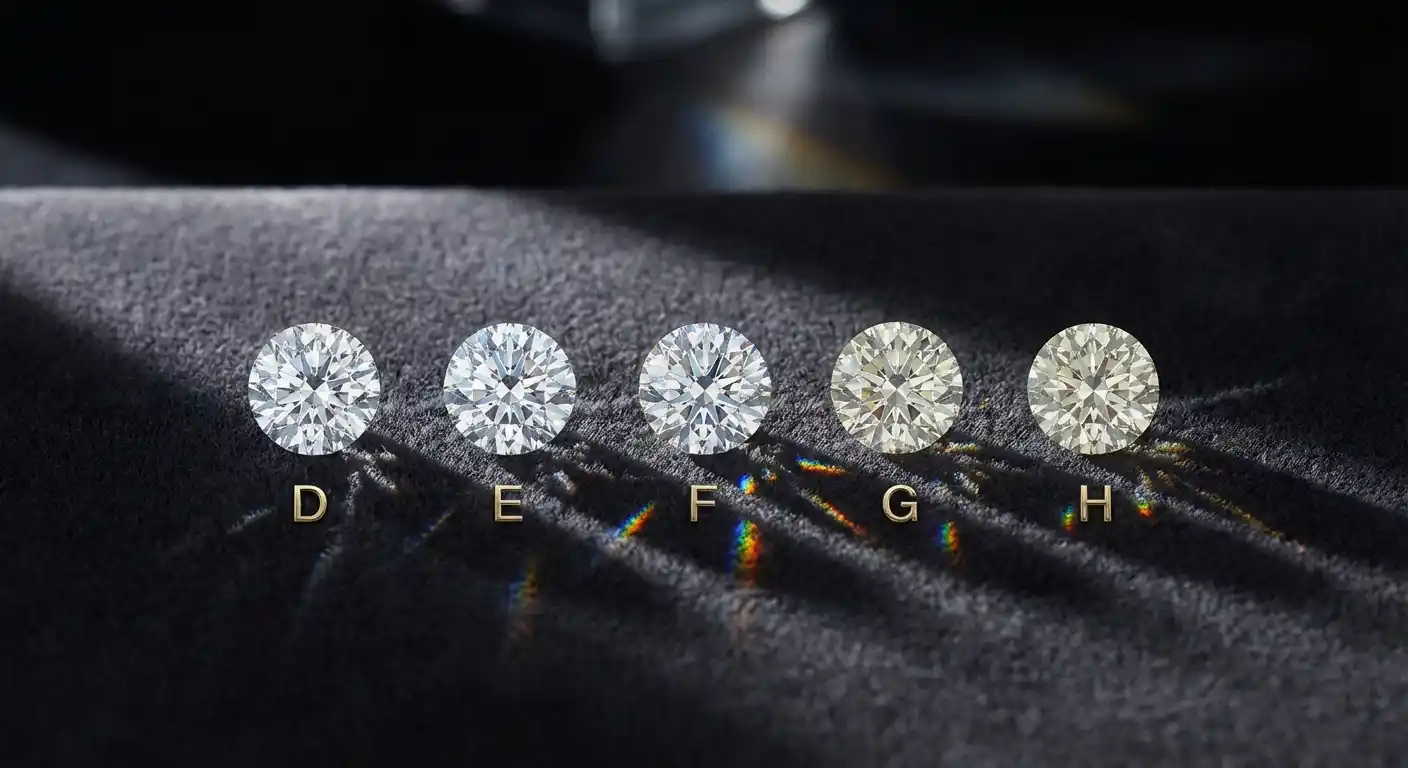
The GIA color grading scale runs from D (completely colorless) to Z (light yellow or brown). This guide focuses on grades D through H, which encompass the colorless and near-colorless categories that represent the sweet spot for engagement rings and fine jewelry.
For a complete overview of all diamond quality factors, see our comprehensive diamond buying guide.
Table of Contents
- The GIA Diamond Color Scale
- Colorless Diamonds: D, E, and F
- Near-Colorless Diamonds: G and H
- Visual Comparison: What You Actually See
- Color and Metal Settings
- Color and Diamond Shape
- Price Impact by Grade
- Making Your Decision
- Color in Natural vs. Lab-Grown Diamonds
- Using the Diamond Screener
- Common Color Mistakes
- Frequently Asked Questions
The GIA Diamond Color Scale
GIA developed the D-to-Z color grading system as the universal standard for evaluating diamond color. The scale measures the absence of color, with D representing absolutely no detectable color and each subsequent letter indicating increasing tint.
| Grade | Category | Description | Price Impact |
|---|---|---|---|
| D | Colorless | Absolutely no color | Highest premium |
| E | Colorless | Minute traces, lab-detectable only | High premium |
| F | Colorless | Slight color, visible only to experts | Moderate premium |
| G | Near-Colorless | Faint color, invisible in most settings | Best value |
| H | Near-Colorless | Slight warmth, invisible when set | Excellent value |
Why does the scale start at D? Before GIA standardized diamond grading, various systems used A, B, C, numbers, and other inconsistent scales. Starting at D avoided confusion with any prior grading systems.
Colorless Diamonds: D, E, and F
The colorless category represents the pinnacle of diamond color—stones with no detectable hue when examined by trained gemologists under controlled conditions. These grades are rare, prestigious, and priced accordingly.
D Color: Ultimate Colorless
D-color diamonds are completely colorless. When evaluated against a pure white background under standardized lighting, they show absolutely no trace of yellow, brown, or gray tint. They're the rarest color grade and carry the highest premiums.
Who should consider D color:
- Collectors seeking the absolute finest
- Buyers for whom documentation of perfection matters
- Those with unlimited budgets who won't sacrifice elsewhere
Reality check: D-color diamonds look identical to E and F grades to the naked eye, and virtually identical to G grades once set in jewelry. The premium pays for rarity and prestige, not visible superiority.
E Color: Near-Identical to D
E-color diamonds contain minute traces of color that only trained gemologists can detect under laboratory conditions using comparison stones. In any practical viewing situation, they're indistinguishable from D color.
Price difference: E-color diamonds typically cost 10-15% less than D-color stones of equivalent specifications.
F Color: The Colorless Threshold
F represents the lowest grade in the colorless category. These diamonds show very slight color that experts can identify under magnification in controlled lighting. Outside laboratory conditions, F-color diamonds appear completely colorless.
Price difference: F-color diamonds cost approximately 15-20% less than D-color and 5-10% less than E-color equivalents.
Near-Colorless Diamonds: G and H
The near-colorless category (G through J) represents where smart money meets excellent quality. These diamonds show faint color that's essentially invisible once set in jewelry, yet cost significantly less than colorless grades.
G Color: The Sweet Spot
G-color diamonds are the most recommended grade among diamond professionals and value-conscious buyers. They show slight warmth that's imperceptible in normal viewing conditions and virtually undetectable once mounted in a ring.
Why G color is optimal:
- Looks identical to D-F when set in jewelry
- Saves 25-35% compared to D color
- Provides "colorless" appearance at accessible prices
- Works perfectly with white gold and platinum settings
Price example: A 1-carat D-color diamond might cost $9,500, while an equivalent G-color stone costs approximately $6,750—the same diamond appearance for 30% less.
H Color: Excellent Value
H-color diamonds have slightly more warmth than G, visible under close inspection in ideal lighting but invisible in everyday wear. For buyers prioritizing value, H offers outstanding quality at even lower prices.
Best uses for H color:
- White gold and platinum settings (metal masks any warmth)
- Yellow and rose gold settings (warm metal complements the diamond)
- Maximizing carat weight within budget
- Brilliant cuts that disperse light and mask color
Price difference: H-color diamonds typically cost 5-10% less than G-color equivalents.
Visual Comparison: What You Actually See
Understanding color grades in theory differs from understanding what you'll actually observe. Here's the practical reality:
In a Jewelry Store
Under the bright, cool lighting of jewelry displays, differences between D and H become more apparent to trained eyes. However, most customers cannot reliably distinguish adjacent grades (D from E, or G from H) without side-by-side comparison.
On Someone's Hand
Once a diamond is set and worn in natural lighting, color differences become even harder to detect. Movement, sparkle, and the setting's reflection all mask subtle warmth. A G or H diamond in a platinum ring appears completely white to casual observers.
Under Different Lighting
Color appearance shifts with lighting conditions:
| Lighting | Effect on Diamond Color |
|---|---|
| Cool fluorescent | Diamonds appear whiter |
| Warm incandescent | Slight warmth becomes more visible |
| Natural daylight | Most accurate color representation |
| Candlelight | All diamonds look warmer |
The dynamic nature of real-world lighting means the controlled conditions used for grading rarely match how you'll actually see your diamond.
Color and Metal Settings
Your choice of metal significantly impacts how diamond color appears. Strategic pairing can make lower color grades look just as white as premium grades.
White Gold and Platinum
Cool-toned metals create contrast that makes diamonds appear whiter. Even I or J color diamonds can look ice-white in platinum settings. For G and H colors, the effect is dramatic—these stones appear essentially colorless.
Recommendation: G or H color in white metals offers the best value with no visible compromise.
Yellow gold's warm tones actually complement and camouflage slight warmth in diamonds. The metal's color makes it difficult to perceive faint yellow in the stone, meaning you can go 1-2 color grades lower without visible impact.
Recommendation: H, I, or even J color works beautifully with yellow gold, saving significant money.
Rose Gold
Rose gold's pink tones similarly mask diamond warmth. The romantic hue of the metal draws attention away from any slight color in the center stone.
Recommendation: G, H, or I color pairs excellently with rose gold.
Color and
Different diamond shapes show color differently based on their faceting patterns and light performance.
Brilliant Cuts: More Forgiving
Round brilliant, princess, cushion, oval, and pear shapes feature complex faceting that creates intense sparkle. This light performance masks body color effectively.
Color recommendation for brilliant cuts:
- Budget-conscious: H or I
- Balanced value: G
- Premium: F
Step Cuts: More Revealing
Emerald and Asscher cuts have large, flat facets that act like windows, allowing color to be more visible than in brilliant cuts.
Color recommendation for step cuts:
- Budget-conscious: G
- Balanced value: F
- Premium: E or D
Price Impact by Grade
Understanding the price relationships between color grades helps you make informed trade-offs.
Relative Pricing
Using D color as the baseline (100%), here's typical pricing across grades:
| Grade | Relative Price | Savings vs. D |
|---|---|---|
| D | 100% | — |
| E | 88-92% | 8-12% |
| F | 82-87% | 13-18% |
| G | 68-75% | 25-32% |
| H | 62-70% | 30-38% |
Real-World Example
For a 1.00ct round brilliant with Excellent cut and VS2 clarity:
| Grade | Approximate Price | vs. D Color |
|---|---|---|
| D | $7,500 | — |
| E | $6,800 | Save $700 |
| F | $6,200 | Save $1,300 |
| G | $5,400 | Save $2,100 |
| H | $5,000 | Save $2,500 |
The savings from choosing G or H color can fund a larger diamond, better cut, or upgraded setting.
Making Your Decision
Choose D-F if:
- Documentation of colorlessness matters to you
- Budget allows without sacrificing cut quality
- You're purchasing a step-cut diamond
- You're buying for investment or collecting
- You want the "best" grade regardless of visibility
Choose G if:
- You want colorless appearance at significant savings
- You're buying a brilliant-cut diamond
- You're setting in white gold or platinum
- You prioritize maximizing other factors (cut, carat) within budget
- You trust that "looks colorless" matters more than "graded colorless"
Choose H if:
- Maximum value is your priority
- You're setting in yellow or rose gold
- You're buying a brilliant-cut diamond
- You'd rather put savings toward larger carat weight
- You understand slight warmth is invisible in most conditions
Color in Natural vs. Lab-Grown Diamonds
Whether natural or lab-grown, diamonds are graded on the same D-to-Z color scale. Lab-grown diamonds can achieve any color grade, with D-F colorless stones readily available.
The color recommendations above apply equally to both natural and lab-grown diamonds. Lab-grown options simply offer the same color grades at significantly lower prices.
Using the Diamond Screener
Our Diamond Screener helps you compare diamonds across color grades from multiple retailers:
- Set your specifications for carat, cut, and clarity
- Filter by color to see D, E, F, G, or H options
- Compare pricing to understand how color affects cost
- Identify best values on the efficiency frontier
- Click through to retailer sites for detailed imagery
The screener shows exactly how much you can save by selecting G or H color while maintaining excellent visual quality.
Compare color grades: Use our Diamond Screener to see real pricing differences between D and G color diamonds and find the best value for your budget.
Common Color Mistakes
Overpaying for D-F in brilliant cuts: The complex faceting of round, cushion, and oval diamonds masks color so effectively that D-F premiums rarely translate to visible benefit.
Ignoring metal impact: A D-color diamond in yellow gold won't look any whiter than a G-color in the same setting. Match color grade to metal for maximum efficiency.
Comparing isolated diamonds: Diamonds always look slightly more colored when compared side-by-side to higher grades. Your diamond will be worn alone—judge it that way.
Forgetting about lighting: Store lighting makes color differences appear more dramatic than they'll look in normal wear. Consider real-world conditions.
Sacrificing cut for color: A well-cut G-color diamond sparkles more than a poorly cut D-color. Cut quality trumps color grade for visible beauty.
Frequently Asked Questions
Can you see the difference between D and G color diamonds?
When examined side-by-side under ideal lighting, trained eyes can distinguish them. When set in jewelry and worn normally, most people cannot tell any difference.
What is the best color grade for an engagement ring?
G color offers the best balance of colorless appearance and value for most engagement rings. H works excellently for yellow gold settings or when maximizing carat weight.
Does diamond shape affect which color to choose?
Yes. Step-cut shapes (emerald, Asscher) show color more readily than brilliant cuts. Choose one grade higher for step cuts.
Is G color really colorless?
G is technically "near-colorless," but the color is invisible to the naked eye in most viewing conditions. For practical purposes, G-color diamonds appear colorless when worn.
Should I pay more for D color?
Only if documentation of absolute colorlessness matters to you personally, or if budget is unlimited. For visible beauty, G and H colors perform identically to D-F grades.
The Bottom Line
The difference between a D-color diamond and a G-color diamond is essentially invisible once the stone is set in jewelry and worn in everyday conditions. Yet that invisible difference can cost 25-35% more.
For most diamond buyers, G color represents the optimal choice—colorless appearance at accessible prices. H color offers even greater value, particularly for yellow gold settings or brilliant-cut shapes.
Remember that color is just one factor in a diamond's overall beauty. A well-cut G-color diamond will look more brilliant than a poorly cut D-color stone. Prioritize cut quality first, then optimize color within your budget.
Ready to find your perfect diamond? Our Diamond Screener lets you compare color grades across thousands of certified diamonds and see exactly how much you can save by choosing wisely.
For more diamond education, explore our complete diamond buying guide, learn about clarity grades, or discover how cut quality affects sparkle.
About the Author
Alfreda Borror
Alfreda Borror is the founding editor of Opulent Opal, writing research-based buying guides on diamonds, birthstones, and fine jewelry.