Ring Prong Inspection Guide: Preventing Stone Loss

This post may contain affiliate links. Read our affiliate policy
Prong failure is the leading cause of lost center stones in engagement rings. Stone loss claims are among the most common jewelry insurance claims, with worn prongs almost always the culprit. The good news: prong problems develop gradually, giving you time to catch issues before disaster strikes.
Regular home inspection, combined with professional maintenance, keeps your precious stone secure for a lifetime.
Table of Contents
- How Prongs Work
- Signs of Prong Problems
- Home Inspection Technique
- Types of Prong Damage
- Prong Repair Options
- Repair Costs
- Prevention Tips
- FAQ
How Prongs Work
Prongs are small metal claws that grip your stone from above, holding it securely in the setting. They're the most stressed component of your ring, bearing the stone's weight while enduring daily impacts and friction.
Common Prong Configurations
4-prong setting:
- Most light enters stone (maximum sparkle)
- Less metal coverage shows more stone
- Each prong bears 25% of the load
- Most vulnerable to single-prong failure
6-prong setting:
- Better stone security
- Slightly more metal visible
- Each prong bears ~17% of load
- Can lose one prong without immediate stone loss
For more about setting types and their trade-offs, see our engagement ring settings guide.
- Complete metal rim surrounds stone
- Maximum protection
- Less light entry
- No traditional prongs to fail
Prong Metal Matters
Prongs are made from the same metal as the setting—typically gold or platinum. Each behaves differently:
Gold prongs:
- Softer; wear faster
- May need retipping every 5-10 years with regular wear
- 18K gold is softer than 14K (higher gold content = softer)
Platinum prongs:
- More durable over time
- Last longer before needing retipping
- Metal displaces rather than wears away (no metal loss)
Signs of Prong Problems
Learning to recognize early warning signs prevents stone loss.
Visual Warning Signs
What to look for:
- Visible gaps: Light showing between prong tip and stone edge
- Bent prongs: Prong pushed to the side rather than gripping straight down
- Flat or worn tips: Prong tips that look thin, flat, or pointed instead of rounded
- Discoloration: Different color at prong tips (exposed base metal)
- Missing prong pieces: Obvious chunk missing from prong
Physical Warning Signs
What you might feel or hear:
- Catching on fabric: Worn or lifted prongs snag on sweaters, towels, hair
- Loose stone sensation: Stone moves or rattles when ring is tapped
- Stone rotation: Center stone has shifted or turned in setting
- Unusual clicking: Sound when stone is touched with fingernail
The Newspaper Test
Can't tell if your diamond has shifted?
- Look at the stone's facet pattern from directly above
- Note the position of any visible inclusions or the cut pattern
- Check again in a week
If the position has changed, your stone is loose and rotating in the setting.
Home Inspection Technique
Monthly home inspection catches problems before they become emergencies.
What You Need
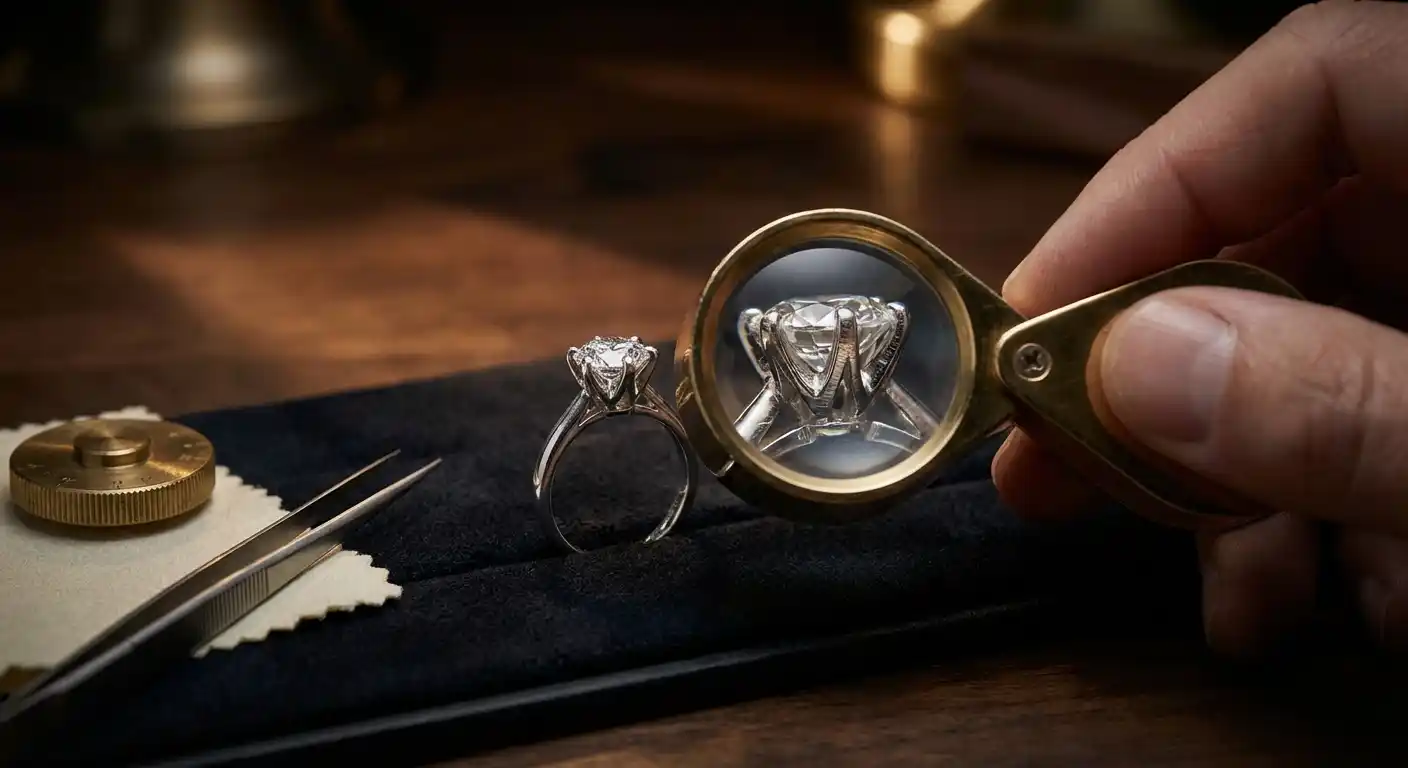
- 10x magnifying loupe (jeweler's standard)
- Good lighting (daylight or bright LED)
- Clean ring (inspect after weekly cleaning)
- Steady hands
Step-by-Step Inspection
1. Clean your ring first Dirt obscures prong condition. Do your regular weekly cleaning before inspecting.
2. Examine each prong individually Using your loupe:
- Look at each prong from multiple angles
- Check the tip where it contacts the stone
- Note the shape—should be rounded, not flat or pointed
- Look for gaps between prong and stone
3. Check prong symmetry
- All prongs should contact the stone evenly
- No prong should appear significantly different from others
- Spacing should be consistent around the stone
4. Test for looseness
- Gently try to rock the stone with your fingernail
- A secure stone should not move at all
- Any movement indicates loose setting—visit jeweler immediately
5. Listen test
- Hold ring close to your ear
- Tap ring band gently
- A secure stone is silent; a loose stone may rattle or click
Creating an Inspection Log
Keep a simple record:
- Date of inspection
- Condition notes for each prong
- Any concerns observed
- Date of last professional inspection
Tracking over time reveals gradual wear before it becomes critical.
Types of Prong Damage
Understanding different damage types helps you communicate with your jeweler.
Worn Prong Tips
Appearance: Prong tips appear flat, thin, or pointed rather than rounded Cause: Natural wear from daily contact and friction Risk level: Moderate—address within a few weeks Repair: Retipping (adding metal to worn tips)
Bent Prongs
Appearance: Prong pushed to the side, no longer gripping straight down Cause: Impact, catching on objects, aggressive handling Risk level: High—stone could fall out Repair: Straightening and possible retipping
Lifted Prongs
Appearance: Prong pulled away from stone, creating visible gap Cause: Catching and pulling, impact Risk level: Very high—stone at immediate risk Repair: Tightening; may need rebuild if damaged
Broken Prongs
Appearance: Missing portion of prong Cause: Metal fatigue, impact, manufacturing defect Risk level: Critical—protect stone, visit jeweler immediately Repair: Prong replacement or setting reconstruction. For guidance on repair decisions, see when to repair vs replace your ring.
Worn Prong Base
Appearance: Thinning where prong meets the setting Cause: Long-term wear, friction Risk level: High—entire prong can break off Repair: May require setting rebuild
Prong Repair Options
Several repair approaches address different levels of wear.
Prong Tightening
What it is: Gently pushing prongs back against the stone When appropriate: Slight looseness without visible damage Cost: Often included with professional cleaning Duration: Done while you wait
Prong Retipping
What it is: Adding new metal to worn prong tips When appropriate: Visible wear at tips; no structural damage Process:
- Jeweler cleans and examines prongs
- Adds matching metal to worn tips
- Shapes tips to grip stone properly
- Polishes for smooth finish
Cost: $25-$75 per prong Duration: Same day to 1-2 days
Prong Replacement
What it is: Removing and rebuilding individual prongs When appropriate: Broken prongs, severe damage Process:
- Stone is carefully removed
- Damaged prong is cut away
- New prong is fabricated and soldered
- Stone is reset
- Finishing and polishing
Cost: $75-$200 per prong Duration: 3-7 days typically
Complete Head Replacement
What it is: Replacing the entire prong assembly (head) When appropriate: Multiple damaged prongs, overall setting wear Process:
- Stone removed
- Old head removed from shank
- New head soldered on
- Stone reset
- Finishing
Cost: $150-$400+ depending on complexity Duration: 1-2 weeks
Repair Costs
Budget for prong maintenance as part of ongoing ring care.
Typical Price Ranges
| Service | Cost Range | Notes |
|---|---|---|
| Prong tightening | Free-$30 | Often included with cleaning |
| Retipping (per prong) | $25-$75 | Most common repair |
| Single prong rebuild | $75-$200 | More extensive than retipping |
| Multiple prong rebuild | $150-$400 | Depends on number and complexity |
| Complete head replacement | $150-$500+ | New setting fabrication |
| Emergency stone reset | $50-$150 | If stone falls out but is recovered |
Factors Affecting Cost
Metal type: Platinum repairs cost more than gold Ring complexity: Designer or intricate settings cost more Location: Urban jewelers may charge more Turnaround time: Rush service adds premium
Insurance Coverage
Many jewelry insurance policies cover prong repair as normal maintenance. Check your policy—you may be able to claim repair costs. This is another reason to have proper jewelry insurance.
Prevention Tips
Extend time between repairs with careful wear habits.
Daily Habits
- Remove during high-risk activities: Gym, gardening, cleaning, cooking
- Avoid impacts: Don't tap ring against hard surfaces
- Be careful with pockets and bags: Rings can catch and pull prongs
- Remove when applying lotions: Buildup accelerates wear
Regular Maintenance
- Weekly cleaning: Prevents abrasive buildup
- Monthly home inspection: Catch problems early
- Professional check every 6 months: Expert eyes and equipment
- Address issues promptly: Small repairs prevent big problems
Smart Choices
- Consider 6-prong settings: More security than 4-prong
- Choose platinum for prongs: Longer lasting than gold
- Bezel settings for active lifestyles: Maximum protection
- Quality jeweler matters: Well-made settings last longer
Protective Measures for High-Risk Times
- Pregnancy: Swelling can stress prongs—consider having ring checked
- Travel: Get inspection before trips
- Life changes: New job with manual work? Evaluate setting security
- Seasonal: Winter dryness causes skin cracking that catches prongs
Frequently Asked Questions
How often do prongs need retipping?
With regular wear, gold prongs typically need retipping every 5-10 years. Platinum lasts longer. Frequency depends on lifestyle—desk work is gentler than manual labor.
Can I tighten prongs myself?
No. Attempting to bend prongs without proper tools and training risks breaking them or cracking your stone. Even "gentle" adjustments can cause hidden damage. Always use a professional.
My jeweler found worn prongs, but my stone isn't loose. Do I need to fix it?
Yes. Worn prongs are a ticking clock. The stone may seem secure today but can fall out tomorrow with one caught thread. Address worn prongs within a few weeks of discovery.
Is 4-prong or 6-prong safer?
Six prongs offer more security—losing one prong still leaves five holding the stone. Four prongs show more stone but losing one is more critical. For valuable or sentimental stones, 6-prong is safer.
What happens if my stone falls out?
Search immediately—most lost stones are found nearby. Check drains, floors, clothing, and vacuum bags. If insured, file a claim. If you find the stone, take it to a jeweler for inspection before resetting—it may have damage from the fall.
Does retipping change my ring's appearance?
When done properly, no. The jeweler adds metal only to the worn tip and shapes it to match. The ring should look exactly as it did when new. Poorly done retipping can look lumpy—choose a reputable jeweler.
The Bottom Line
Stone loss is preventable with vigilant inspection and timely maintenance. A $50 retipping visit is infinitely better than losing a $5,000 diamond. Make prong inspection part of your regular routine, and your precious stone will stay exactly where it belongs.
Inspection Schedule Summary
| Timeframe | Action |
|---|---|
| Weekly | Clean ring; quick visual check |
| Monthly | Loupe inspection; looseness test |
| Every 6 months | Professional inspection |
| As needed | Immediate visit for any warning signs |
For complete ring care guidance, see our ring care maintenance guide.
Hastings Triplet Loupe 10X Jeweler's Loupe with 16mm Triplet Lens

Hastings Triplet Loupe 10X Jeweler s Loupe with 16mm Triplet Lens
10x magnification with a 16mm distortion-free triplet lens — the same power jewelers use for diamond grading and prong inspection.
10x magnification with a 16mm distortion-free triplet lens — the same power jewelers use for diamond grading and prong inspection.
"Crystal clear view of my prongs. I caught a worn tip that my jeweler confirmed needed retipping. This loupe paid for itself instantly.
JARLINK 30X 60X LED Lighted Magnifying Glass

JARLINK 30X 60X LED Lighted Magnifying Glass
Dual magnification with built-in LED lights.
Dual magnification with built-in LED lights. Great for beginners wanting to inspect jewelry at home.
"Perfect for monthly prong checks. The built-in light makes it easy to see any issues.
Review of What We Liked
Hastings Triplet Loupe 10X Jeweler s Loupe with 16mm Triplet Lens
10x magnification with a 16mm distortion-free triplet lens — the same power jewelers use for diamond grading and prong inspection.
JARLINK 30X 60X LED Lighted Magnifying Glass
Dual magnification with built-in LED lights.
About the Author
Alfreda Borror
Alfreda Borror is the founding editor of Opulent Opal, writing research-based buying guides on diamonds, birthstones, and fine jewelry.