Lab-Grown vs Natural Diamonds: Which Is Right for Your Engagement Ring?

This post may contain affiliate links. Read our affiliate policy
This article contains affiliate links. We may earn a commission if you make a purchase through our links, at no extra cost to you.
The engagement ring market has undergone a seismic shift. According to The Knot's 2025 Real Weddings Study, 52% of couples now choose lab-grown diamonds for their engagement rings—a dramatic increase from just 12% in 2019. But which option is right for you?
This comprehensive comparison examines the real differences between lab-grown and natural diamonds: their identical physical properties, dramatically different prices, environmental considerations, and the factors that matter most when making this significant purchase.
For a complete overview of buying an engagement ring, see our engagement ring guide.
The Fundamental Question: Are They the Same?
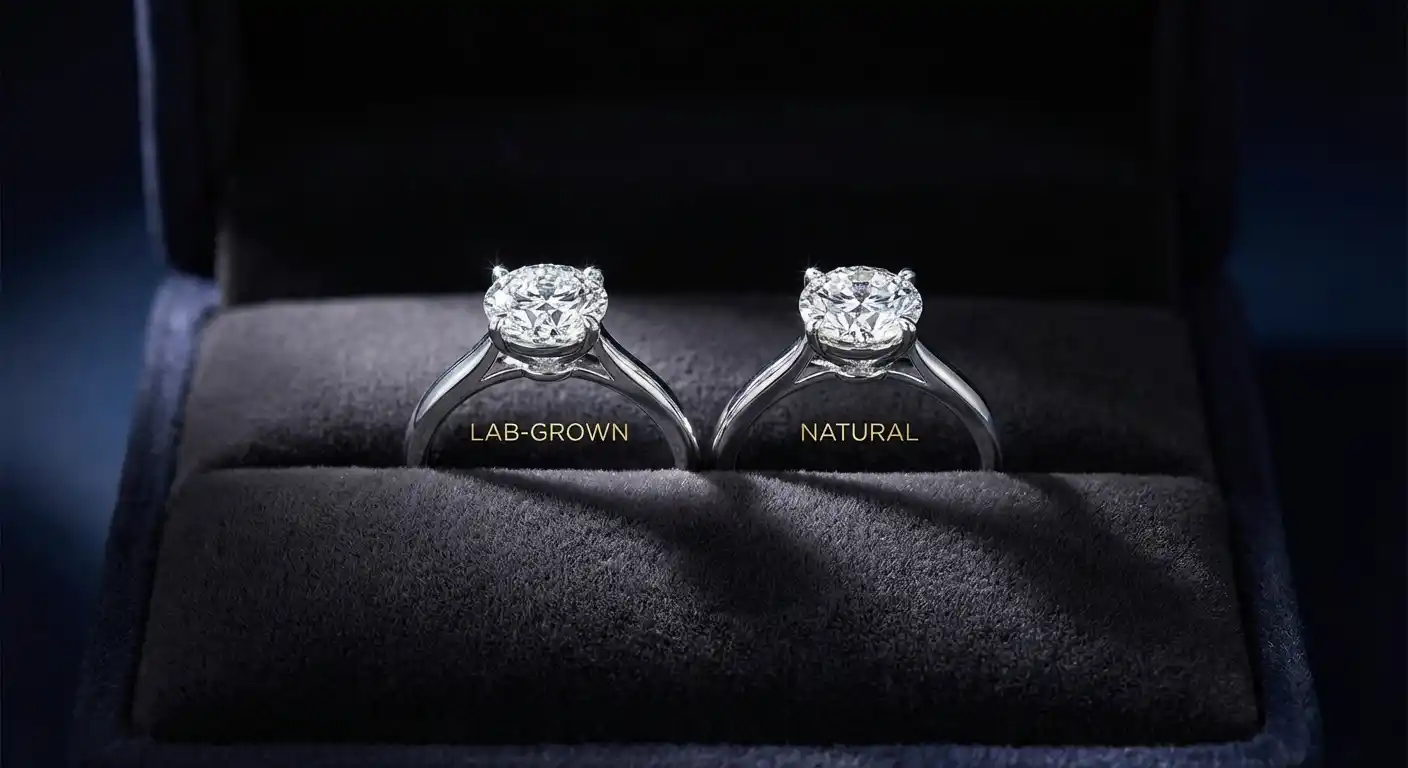
Chemically and physically, lab-grown and natural diamonds are identical. Both are pure carbon crystals with the same atomic structure, hardness (10 on the Mohs scale), refractive index, and optical properties. They sparkle the same, look the same, and even feel the same.
The only difference is origin—where and how they formed:
-
Natural diamonds: Formed 1-3 billion years ago, 90-120 miles below Earth's surface, under extreme heat and pressure. Brought to the surface by volcanic eruptions.
-
Lab-grown diamonds: Created in weeks using advanced technology that replicates natural conditions. Two primary methods exist:
- HPHT (High Pressure High Temperature): Mimics natural formation with extreme heat (2,000°C+) and pressure (1.5 million PSI)
- CVD (Chemical Vapor Deposition): Grows diamonds layer by layer from carbon-rich gas in a vacuum chamber
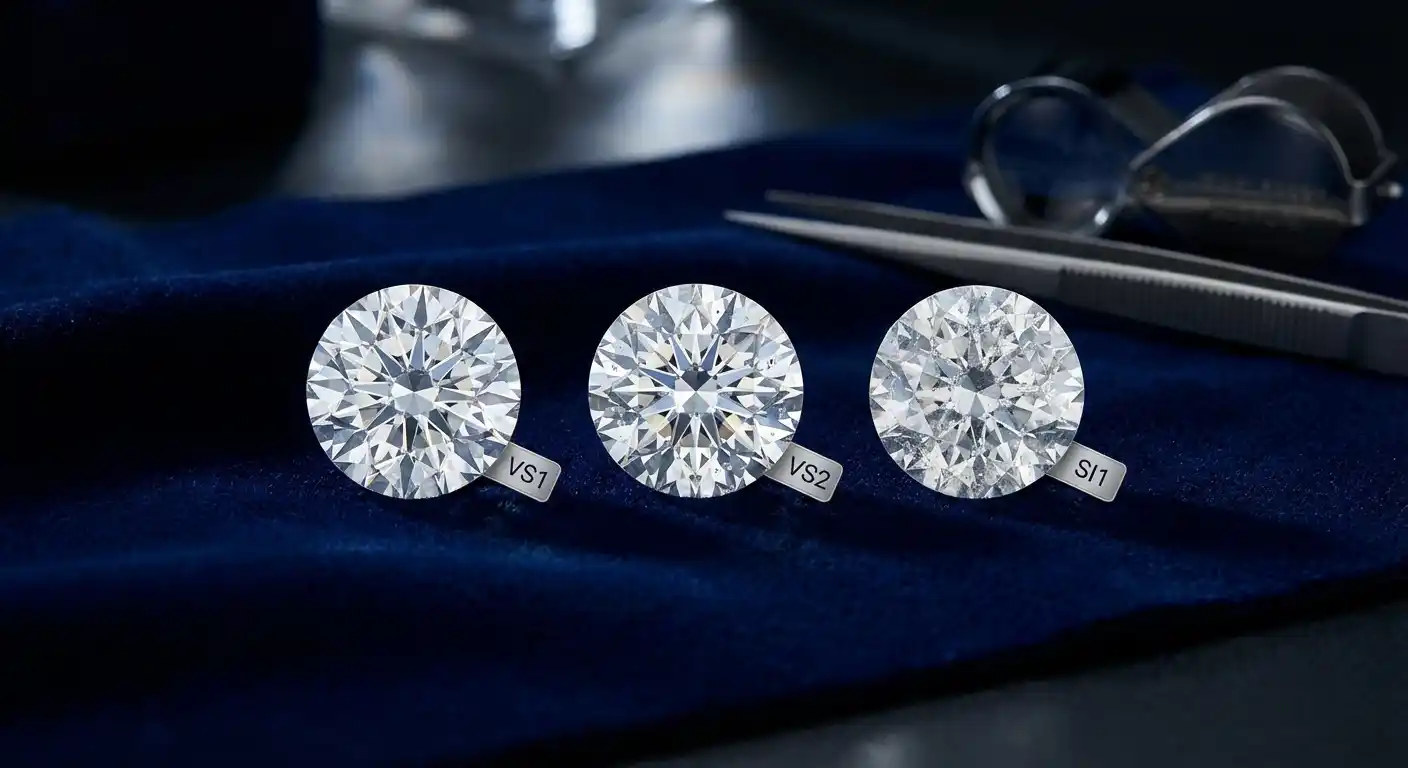
Can you tell them apart? Not with the naked eye. Not even with a standard jeweler's loupe. Gemologists require specialized equipment to distinguish lab-grown from natural diamonds. Both receive the same grading from certification labs like IGI and GIA, evaluated on the same 4Cs: cut, color, clarity, and carat weight.
It's important to understand that lab-grown diamonds are distinct from diamond simulants like cubic zirconia or moissanite. For a detailed explanation, see our guide on synthetic vs simulant gems.
Price Comparison: The Numbers Don't Lie
The cost difference between lab-grown and natural diamonds is substantial—and growing.
Current Market Prices (2025-2026)
Average prices for a 1-carat round diamond in 2025:
| Type | Average Price | % Difference |
|---|---|---|
| Natural Diamond | ~$4,000-4,500 | Baseline |
| Lab-Grown Diamond | ~$1,000-1,500 | 70-80% less |
What This Means for Your Budget
According to The Knot's 2024 survey, the average engagement ring costs approximately $5,200, with lab-grown options often costing 30-40% less than comparable natural diamond rings.
But the real value proposition becomes clear when you compare what each budget gets you:
| Budget | Natural Diamond | Lab-Grown Diamond |
|---|---|---|
| $2,000 | 0.40-0.50 ct, VS2, G color | 1.0-1.25 ct, VS2, G color |
| $4,000 | 0.70-0.85 ct, VS2, G color | 1.5-2.0 ct, VS1, F color |
| $6,000 | 1.0-1.15 ct, VS2, G color | 2.5-3.0 ct, VS1, E-F color |
The bottom line: For the same budget, you can purchase a significantly larger and/or higher-quality lab-grown diamond.
For budget-conscious options, see our guides to engagement rings under $1000 and under $500.
Why Lab-Grown Diamonds Cost Less
Several factors contribute to the price difference:
1. Supply and Production
Natural diamonds are finite—they can only be mined from existing deposits. Lab-grown diamonds can be produced consistently in controlled facilities, with production capacity increasing as technology improves and more facilities come online.
2. Supply Chain Simplicity
Natural diamonds pass through extensive supply chains: mining companies, rough diamond dealers, cutting facilities, wholesalers, and retailers—each adding margin. Lab-grown diamonds have shorter, more direct supply chains.
3. Technology Improvements
HPHT and CVD technology continues advancing, making production more efficient and cost-effective. Natural diamond mining costs remain relatively stable or increase as easily-accessible deposits deplete.
4. Market Competition
The lab-grown market is highly competitive, with multiple producers driving prices down. The natural diamond market is more consolidated.
Quality Comparison: Grading Standards
Both lab-grown and natural diamonds are graded using identical standards. The Gemological Institute of America (GIA), International Gemological Institute (IGI), and other labs evaluate both types on the same criteria:
The 4Cs Apply Equally
| Factor | Applies to Lab-Grown? | Notes |
|---|---|---|
| Cut | Yes | Same grading scale: Excellent to Poor |
| Color | Yes | Same D-Z scale |
| Clarity | Yes | Same FL to I3 scale |
| Carat | Yes | Same weight measurements |
Lab-grown diamonds can achieve the highest grades in all categories. In fact, because they're grown in controlled conditions, it's often easier to produce diamonds with fewer inclusions and better color.
Important: Always purchase certified diamonds from reputable labs (GIA, IGI, GCAL) regardless of origin. The certificate verifies quality and confirms whether the diamond is natural or lab-grown.
Appearance: Can Anyone Tell?
No. Lab-grown and natural diamonds are visually identical. Even trained gemologists cannot distinguish them without specialized equipment that detects trace elements and growth patterns invisible to the naked eye.
Light Performance
Both types display:
- Brilliance: Internal and external white light reflection
- Fire: Light dispersion into spectral colors
- Scintillation: Pattern of light and dark when the diamond moves
The identical crystalline structure means identical optical properties. A well-cut lab-grown diamond sparkles exactly like a well-cut natural diamond of equivalent quality.
The Only Visual Difference (If You Look for It)
Some lab-grown diamonds, particularly those grown by HPHT, may show subtle differences under magnification that trained gemologists can identify—but these are never visible to the naked eye or even standard jewelry loupes.
Ethical and Environmental Considerations
Natural Diamonds
Concerns:
- Conflict diamonds: While the Kimberley Process (2003) reduced conflict diamonds from ~15% to less than 1% of the market, concerns persist
- Environmental impact: Mining disrupts ecosystems, requires significant water usage, and produces CO2 emissions
- Labor conditions: Vary significantly by source country
Positives:
- Supports mining communities (10 million people globally)
- Modern mining increasingly implements environmental restoration
- Botswana, Canada, and Australia have strong labor protections
Lab-Grown Diamonds
Benefits:
- No mining-related environmental disruption
- Guaranteed conflict-free origin
- Controlled production conditions
- Growing use of renewable energy in production
Considerations:
- Energy-intensive production (offset when renewable energy used)
- Manufacturing environmental footprint (generally lower than mining)
- Newer industry, evolving standards
Neither option is perfect. Lab-grown diamonds eliminate mining concerns but require energy. Natural diamonds support mining communities but involve extraction. Your priorities determine which considerations matter most.
Resale Value: The Important Distinction
Here's where natural and lab-grown diamonds genuinely differ.
Natural Diamonds
- Retain 25-50% of purchase price if sold
- May appreciate for exceptional quality/rare stones
- Established resale market through jewelers, auction houses, consignment
- Have perceived heirloom value
Lab-Grown Diamonds
- Minimal resale value (often 10-20% or less)
- Prices continue declining as production increases
- Limited secondary market
- Value is in the wearing, not the investment
The practical reality: Most engagement rings are never sold. They're worn, passed down, or kept for sentimental value. But if resale potential matters to you, natural diamonds offer more flexibility.
Who Should Choose Lab-Grown?
Lab-grown diamonds may be ideal if you:
1. Have budget constraints Get more size and quality for your money—a 1.5-carat lab-grown costs less than a 0.75-carat natural of comparable quality.
2. Prioritize ethics over tradition Guaranteed conflict-free origin with minimal environmental footprint from mining.
3. Want a larger stone The price difference allows upgrading from a 0.75-carat natural to a 1.5+ carat lab-grown at the same price point.
4. Plan to upgrade later The lower cost makes it financially easier to purchase a different ring in the future.
5. Value appearance over origin If "a diamond is a diamond" resonates with you, lab-grown delivers identical beauty at lower cost.
Who Should Choose Natural?
Natural diamonds may be ideal if you:
1. Value rarity and natural origin Billions of years of geological history has appeal that lab creation can't replicate.
2. Care about resale value While no guarantee, natural diamonds maintain value better if circumstances require selling.
3. View it as a family heirloom Some prefer natural diamonds for generational pieces passed through families.
4. Have unlimited budget If cost isn't a concern, choosing between natural and lab-grown becomes purely about preference.
5. Connect meaning to origin story For some, the journey from deep within Earth to a ring finger carries symbolic significance.
Questions to Ask Yourself
Before deciding, consider:
-
What's my budget? Lab-grown stretches it further.
-
How important is carat size? Lab-grown allows larger stones at the same price.
-
Do I plan to sell this ring? If yes, natural holds value better.
-
Does origin story matter to me? Only you can answer this.
-
What does my partner prefer? This matters most—ask or gather intel.
-
Am I buying for now or forever? Lab-grown works well if upgrading is planned.
How to Shop: Tips for Either Choice
For Lab-Grown Diamonds
- Buy certified — IGI and GCAL are the leading certification labs for lab-grown
- Prioritize cut — Just like natural, cut determines sparkle
- Consider online retailers — James Allen, Brilliant Earth, and Blue Nile offer good selections
- Compare prices — The market is competitive; shop around
- Check return policies — 30+ days is standard
For Natural Diamonds
- Buy certified — GIA remains the gold standard for natural diamond certification
- Ask about sourcing — Reputable jewelers disclose diamond origins
- Inspect in person if possible — See how light performs
- Understand fluorescence — Can affect appearance and price
- Verify Kimberley Process compliance — Ask about ethical sourcing
The Market Shift: What the Numbers Tell Us
The rapid adoption of lab-grown diamonds signals a fundamental market change:
| Year | Lab-Grown Market Share |
|---|---|
| 2019 | 12% |
| 2021 | 33% |
| 2023 | 46% |
| 2024 | 52% |
Industry prediction: Lab-grown will likely reach 60%+ market share within the next few years.
This shift is driven by:
- Younger buyers prioritizing value and ethics
- Price consciousness in uncertain economies
- Quality parity making origin less visible
- Retail acceptance from major jewelers
Frequently Asked Questions
Are lab-grown diamonds "fake" or "synthetic"?
No. Lab-grown diamonds are real diamonds—chemically identical to natural diamonds. "Synthetic" is technically accurate but misleading; "lab-grown" or "lab-created" are preferred industry terms. Imitation diamonds like cubic zirconia or crystal are fake; lab-grown diamonds are real diamonds.
Will lab-grown diamonds cloud or fade over time?
No. Lab-grown diamonds are as durable and permanent as natural diamonds. They're identically hard (10 Mohs), identically stable, and will last forever with proper care.
Should I tell people my diamond is lab-grown?
That's entirely personal choice. There's no obligation to disclose either way. Many couples proudly share that they chose lab-grown for value and ethics; others simply say "it's a diamond" because that's accurate.
Are lab-grown diamonds as hard as natural?
Yes. Both are 10 on the Mohs hardness scale—the hardest natural substance. Lab-grown diamonds resist scratching identically to natural diamonds.
Do jewelers accept lab-grown for upgrades/trade-ins?
Policies vary. Some jewelers offer trade-in programs for lab-grown diamonds; others don't. Always ask about upgrade policies before purchasing.
Will lab-grown diamonds become worthless?
"Worthless" is unlikely—they'll retain some value as functional diamonds. But their resale value has declined as production increases, and this trend will likely continue. Buy lab-grown for the wearing value, not investment value.
Making Your Decision
The "right" choice depends entirely on what matters to you:
| Priority | Best Choice |
|---|---|
| Maximum value for budget | Lab-grown |
| Largest possible stone | Lab-grown |
| Guaranteed conflict-free | Lab-grown |
| Resale value potential | Natural |
| Rarity and natural origin | Natural |
| Heirloom significance | Natural (for some) |
| Partner's specific preference | Ask them |
Both options deliver stunning, durable, real diamonds that will sparkle for a lifetime. The chemical composition is identical. The beauty is identical. The durability is identical.
The only differences are origin, price, and resale—and which matters most is a personal decision only you can make.
Continue Your Research
- Complete Engagement Ring Guide — Everything you need to know
- Best Engagement Rings Under $1000 — Budget-friendly options
- Moissanite vs Diamond — Another alternative comparison
- Engagement Ring Settings Guide — Solitaire, halo, and more
- Diamond Shapes Guide — Find your perfect cut
About the Author
Alfreda Borror
Alfreda Borror is the founding editor of Opulent Opal, writing research-based buying guides on diamonds, birthstones, and fine jewelry.