Moissanite vs Diamond: The Best Diamond Alternative?

This post may contain affiliate links. Read our affiliate policy
This article contains affiliate links. We may earn a commission if you make a purchase through our links, at no extra cost to you.
Moissanite has emerged as the most popular diamond alternative for engagement rings, and for good reason. This silicon carbide gem offers exceptional brilliance, impressive durability, and remarkable affordability. But is it right for you? This guide compares moissanite and diamond across every factor that matters.
For complete engagement ring guidance, see our engagement ring guide.
Table of Contents
- Quick Comparison
- What Is Moissanite?
- Brilliance and Fire
- Durability
- Price Comparison
- Quality Grading
- Ethical and Environmental Factors
- Resale Value
- Common Concerns Addressed
- Who Should Choose Moissanite?
- Who Should Choose Diamond?
- Making Your Decision
- Frequently Asked Questions
Quick Comparison
| Property | Moissanite | Diamond |
|---|---|---|
| Hardness | 9.25 Mohs | 10 Mohs |
| Brilliance | Higher (2.65-2.69) | High (2.42) |
| Fire | More rainbow sparkle | Classic white sparkle |
| Origin | Lab-created | Natural or lab-grown |
| Price (1 ct) | $300-600 | $3,000-8,000+ (natural) |
| Durability | Excellent | Excellent |
What Is Moissanite?
Moissanite was discovered in 1893 by French scientist Henri Moissan in a meteor crater in Arizona. Natural moissanite is incredibly rare—virtually all moissanite in jewelry today is lab-created.
Chemical composition: Silicon carbide (SiC) Origin: Lab-created Refractive index: 2.65-2.69 (higher than diamond's 2.42) Hardness: 9.25 Mohs
Moissanite is not a "fake diamond" or diamond simulant in the traditional sense—it's its own distinct gemstone with unique properties. It happens to look similar to diamond while offering some optical advantages.
Brilliance and Fire
Brilliance (White Light Return)
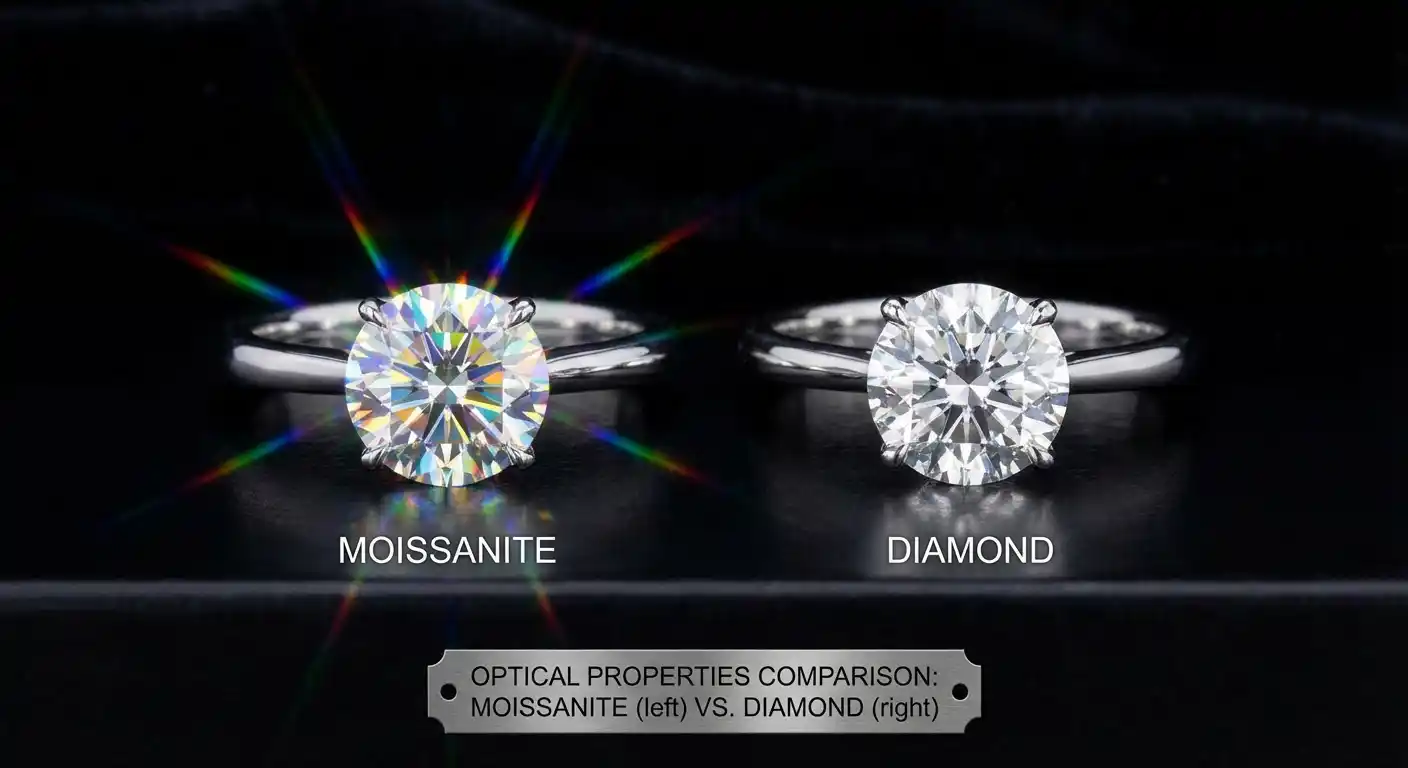
Moissanite has a higher refractive index (2.65-2.69) than diamond (2.42), meaning it bends light more dramatically and returns more light to your eye. The result: moissanite actually sparkles MORE than diamond.
Fire (Rainbow Sparkle)
This is where moissanite differs most noticeably. Moissanite displays more "fire"—the dispersion of light into rainbow colors. Under direct lighting, moissanite produces noticeable rainbow flashes.
Some people love this: The rainbow sparkle is beautiful and eye-catching.
Some prefer diamond's subtlety: Diamond's fire is more subtle, with primarily white sparkle.
How to Tell Them Apart
In normal lighting, most people cannot distinguish moissanite from diamond. Under very bright light or direct sunlight, moissanite's extra fire becomes more apparent.
Gemologists use specialized equipment (like thermal conductivity testers) to distinguish them instantly. For detailed testing methods you can use at home, see our complete guide on how to tell if a diamond is real.
Durability
Hardness Comparison
| Gemstone | Mohs Hardness | Scratch Resistance |
|---|---|---|
| Diamond | 10 | Hardest natural substance |
| Moissanite | 9.25 | Extremely scratch-resistant |
| Sapphire | 9 | Excellent |
| Ruby | 9 | Excellent |
Moissanite is the second-hardest gemstone used in jewelry. It resists scratching excellently and maintains its polish over decades.
Everyday Wear
Both moissanite and diamond are suitable for everyday wear in engagement rings. Neither will cloud, fade, or lose brilliance over time with normal wear.
Heat Resistance
Both withstand the heat from jewelry repairs and everyday exposure. Neither will be damaged by normal conditions.
Chipping and Breaking
Moissanite is slightly more brittle than diamond but still highly resistant to chipping under normal circumstances. Both require care around very sharp impacts.
Bottom line: For practical purposes, moissanite is nearly as durable as diamond and more than sufficient for lifetime daily wear.
Price Comparison
This is where moissanite truly shines as an alternative.
Cost by Carat Size
| Carat | Moissanite | Natural Diamond | Lab-Grown Diamond |
|---|---|---|---|
| 0.5 ct | $150-250 | $1,500-3,000 | $400-800 |
| 1.0 ct | $300-600 | $4,000-8,000 | $800-1,500 |
| 1.5 ct | $500-900 | $8,000-15,000 | $1,500-3,000 |
| 2.0 ct | $700-1,200 | $15,000-30,000+ | $2,500-5,000 |
What This Means Practically
For the price of a 1-carat natural diamond, you could purchase:
- A 3-4 carat moissanite
- A much higher quality setting
- Both rings (moissanite + lab-grown diamond)
For budget comparison, see our guides to engagement rings under $500 and under $1000.
Quality Grading
Moissanite Grades
Moissanite is typically graded on color:
| Grade | Color | Description |
|---|---|---|
| D-E-F | Colorless | Premium, indistinguishable from colorless diamond |
| G-H-I | Near colorless | Slight warmth, excellent value |
| J-K | Faint color | Warmer tones, some prefer this |
Most quality moissanite is sold in the D-F (colorless) range. Unlike diamonds, colorless moissanite is readily available at affordable prices.
Cut Quality
Like diamonds, well-cut moissanite maximizes brilliance. Look for:
- Excellent or Ideal cut grades
- Good symmetry
- Quality polish
Clarity
Moissanite is lab-created under controlled conditions, so most stones are eye-clean (no visible inclusions). VVS clarity is standard.
Ethical and Environmental Factors
Moissanite
- 100% lab-created: No mining required
- Conflict-free: No ethical sourcing concerns
- Lower environmental impact: Controlled production
- Sustainable: Reproducible process
Natural Diamond
- Mined from Earth: Environmental impact varies by mine
- Conflict diamond risk: Kimberley Process helps but isn't perfect
- Supply chain complexity: Multiple intermediaries
Lab-Grown Diamond
- Ethical: No mining
- Energy-intensive: Production requires significant energy
- Conflict-free: Guaranteed origin
For more on lab-grown diamonds, see our lab-grown vs natural guide.
Resale Value
Moissanite
Moissanite has minimal resale value. Like most gemstones (except diamonds), secondhand moissanite sells for a fraction of retail price.
But consider: Most engagement rings are never sold. They're worn, passed down, or kept for sentimental value. Resale value only matters if you plan to sell.
Diamond
Natural diamonds retain some value (typically 25-50% of retail). Exceptional natural diamonds can appreciate. Lab-grown diamonds have poor resale value.
Common Concerns Addressed
"Will people know it's moissanite?"
Most people cannot tell moissanite from diamond in everyday settings. Only someone specifically looking for differences (or using testing equipment) would know.
"Is moissanite 'fake'?"
Moissanite is a real gemstone—it's not trying to be diamond. It's its own material with unique properties. Calling it "fake" is like calling sapphire "fake ruby" because they're both corundum.
"Will the rainbow sparkle be obvious?"
In normal indoor lighting, moissanite's fire is beautiful, not excessive. Under very bright lights or direct sunlight, the rainbow effect increases. Many find this feature beautiful rather than problematic.
"Will it last forever?"
Yes. Moissanite is extremely stable and durable. It will not fade, cloud, or lose brilliance over time. With proper care, it lasts generations.
"Can jewelers tell the difference?"
Yes, instantly using thermal or electrical conductivity testers. Moissanite conducts heat differently than diamond.
Who Should Choose Moissanite?
Moissanite may be ideal if you:
- Want maximum sparkle
- Have a limited budget
- Prioritize size over prestige
- Value ethical sourcing
- Don't care about resale value
- Love the extra fire (rainbow sparkle)
- Plan to upgrade later
- Want conflict-free guarantee
Who Should Choose Diamond?
Diamond may be ideal if you:
- Value tradition and symbolism
- Care about resale potential
- Prefer subtler sparkle (less fire)
- Have a larger budget
- Want "the real thing"
- Are buying as an investment
- Prefer natural or lab-grown options
Making Your Decision
| Priority | Choose |
|---|---|
| Maximum size for budget | Moissanite |
| Traditional symbolism | Diamond |
| Most sparkle | Moissanite |
| Subtler fire | Diamond |
| Guaranteed ethical | Moissanite |
| Resale value | Natural diamond |
| Best value overall | Moissanite or lab-grown |
Frequently Asked Questions
Can moissanite scratch?
Only diamond can scratch moissanite. It won't be scratched by everyday objects, metals, or other gemstones (except diamond).
Does moissanite cloud or get dull over time?
No. Moissanite maintains its brilliance indefinitely. It can be cleaned to restore sparkle, just like diamond.
Is moissanite good for everyday wear?
Yes. With 9.25 Mohs hardness, moissanite is ideal for engagement rings worn daily for decades.
How do I clean moissanite?
Same as diamond: warm water, mild soap, and a soft brush. Ultrasonic and steam cleaners are safe.
Should I tell people my ring is moissanite?
That's entirely your choice. Many couples openly share their moissanite choice; others simply say "it's my engagement ring."
Related Guides
- Complete Engagement Ring Guide
- Lab-Grown vs Natural Diamonds
- Best Engagement Rings Under $500
- Best Engagement Rings Under $1000
- Engagement Ring Settings Guide
About the Author
Alfreda Borror
Alfreda Borror is the founding editor of Opulent Opal, writing research-based buying guides on diamonds, birthstones, and fine jewelry.