Best Cartilage Earrings: Helix, Conch and Tragus Picks

This post may contain affiliate links. Read our affiliate policy
- TOMIDES 16G Titanium Cartilage Earring Hoop for Conch Helix Tragus 8mm 10mm 12mm Hypoallergenic Hinged Clicker Nose Rings Septum Piercing Jewelry (12mm black)
- FINE4U Conch Piercing Jewelry Hoops Gold 16G 10mm, ASTM F136 Titanium Cartilage Earrings for Women & Men, Body Implant Grade Nose Rings, Hypoallergenic Hinged Clicker
- Titanium Cartilage Earrings for Women, CZ Double Hoop Helix Piercing Jewelry, Conch Hoop Tragus Rook Daith Piercing Jewelry,Surgical Steel Hypoallergenic Earrings Silver 8mm
- body freedom 20G, 18G, 16G Titanium Hoop Nose Ring, Hinged Silver Cartilage Hoop Earrings for Women, Clear CZ Conch Tragus Helix Earrings Septum Nose Piercing Jewelry 6/8/10mm
- 20G 18G 16G Titanium Nose Ring Hoop, Cartilage Hoop Earrings for Women Men Silver Gold Nose Ring Septum Ring Tragus Conch Helix Daith Lip Piercing Jewelry 6mm/7mm/8mm/9mm/10mm (Gold-18g, 7mm)
A cartilage listing can name an implant standard, suggest six placements across your ear, and still never tell you the one number that decides whether it fits. Two of our five do exactly that.
The best cartilage earrings at this price are dual-purpose body jewellery with a cartilage keyword stack bolted on, and four of the five are sold as nose rings too. That is not disqualifying, but it changes what you can trust, because a nostril diameter is not a conch diameter. Our picks run $6.95 to $14.99 as of October 2026.
This article contains affiliate links. We may earn a commission if you make a purchase through our links, at no extra cost to you.
We did not wear any of these. We read every listing line by line, checked each material claim against the standard it cites, and separated the numbers the makers publish from the numbers nobody publishes. If the format itself is new to you, our pillar covers flat back earring fit and why a flat disc behaves differently from a ring.
Why Cartilage Is Not a Lobe
The tissue is the reason every rule changes above the lobe.
According to StatPearls on external ear anatomy, published by the National Center for Biotechnology Information, the auricular cartilage is relatively avascular and depends on the perichondrial vascular supply for its nutrition. The cartilage has no blood vessels of its own; everything it needs arrives by diffusion from the membrane wrapped around it. The StatPearls chapter on pinna perichondritis supplies the consequence, stating that the scanty blood supply to this area makes it especially susceptible to infection even with aseptic ear-piercing technique.
The timeline follows from the biology. The Association of Professional Piercers states in its piercing FAQ that "with few exceptions, genital piercings will heal within a month or two, while tougher tissue such as ear cartilage, navels and nostrils may take six months or longer." Read the direction of that phrasing: six months or longer, not six weeks.
The APP also warns that the finish line is hard to see. Its aftercare guidance says a piercing "may seem healed before the healing process is actually complete," because this kind of wound heals from the outside inward, so the interior stays fragile while the surface looks fine.
Two further notes from that same page, because they bear directly on what you buy:
- Movement is the problem. The APP states that moving or rotating jewellery is not necessary during cleaning and may actually irritate the piercing.
- So is your pillow. The APP notes that sleeping directly on a healing cartilage piercing can cause irritation, "even causing shifts in the piercing's angle."
We are a jewellery publication, not a clinic, and none of this is aftercare advice. Only a piercer who can see your ear should say when to change jewellery or what diameter your anatomy takes.
The Two Numbers That Decide Whether a Cartilage Hoop Fits
Gauge is the thickness of the metal through the piercing. Diameter is the size of the ring. Almost every fit complaint here is one of those two numbers.
Gauge runs backwards, so a higher number means thinner metal. Our breakdown of earring gauge size covers the conversions; what matters here is which picks commit to one. TOMIDES, FINE4U and DIDISEE each state 16G and offer nothing else. The body freedom and DAI JY listings each publish 16g, 18g and 20g.
The published standards are quieter on this than retailers are. The APP's jewellery standard for initial piercings does not name a gauge number at all. It requires jewellery "of an appropriate gauge (thickness)" and explains the failure mode for getting it wrong: material that is too thin risks the body treating it "like a splinter, resulting in migration or rejection." That is a principle rather than a measurement, and it is the honest answer to the question of what gauge to buy. The specific number belongs to whoever did the piercing.
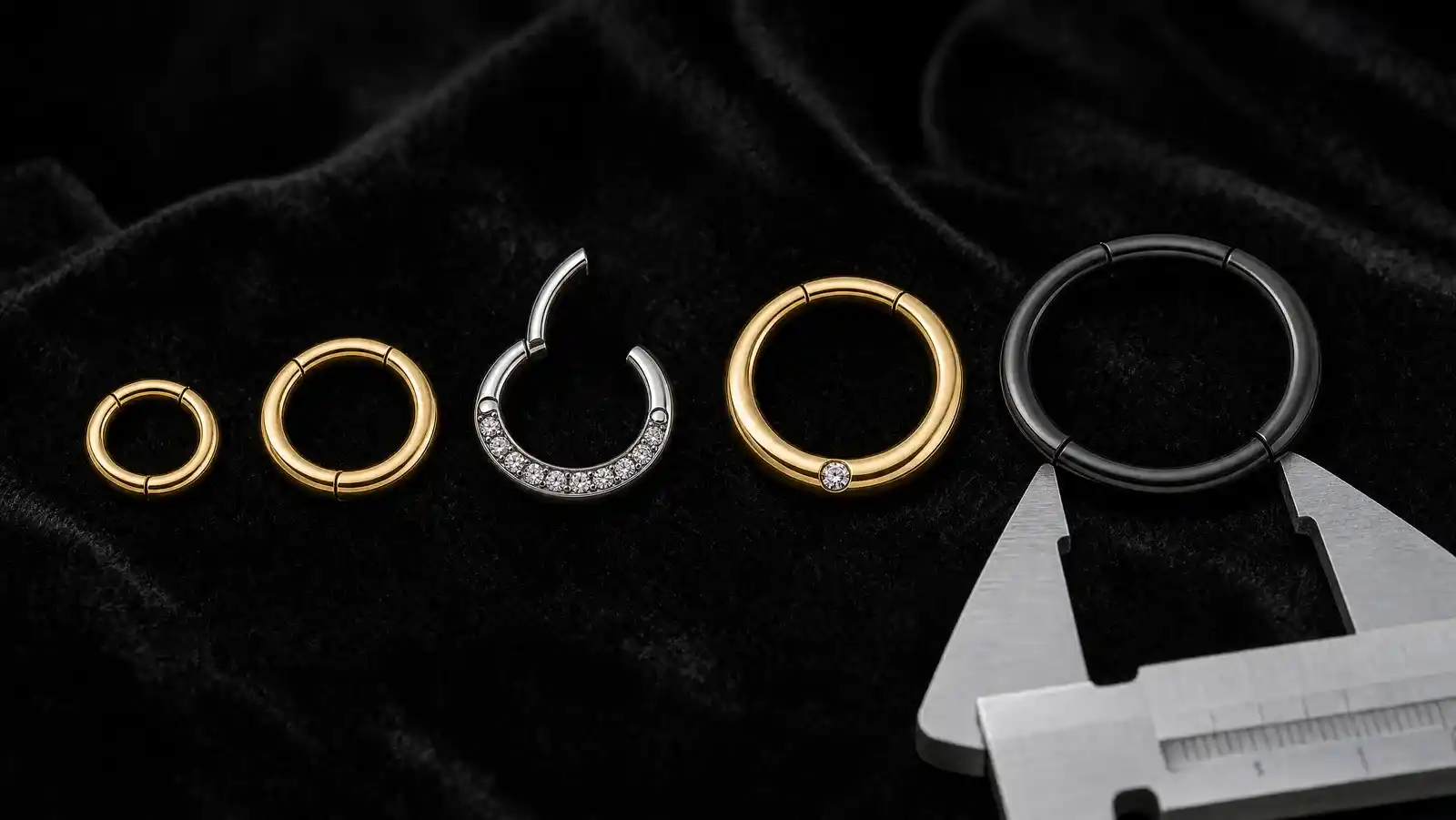
Diameter is the figure buyers misread, because the number on the page is the inner diameter, the hole in the middle, not the outside of the ring. Across these five picks, published inner diameters run 6mm to 12mm. A 6mm ring and a 12mm ring photograph almost identically against white and look like different products on an ear.
What Implant Grade Commits To, and What It Does Not
Four of our five listings point at an implant specification, by name or by grade. One of them puts a certifier behind it.
The APP's list of acceptable materials for initial piercings accepts "implant certified titanium (Ti6Al4V ELI) that is ASTM F-136 compliant, ASTM F1295, ISO 5832-3 compliant, or commercially pure titanium that is ASTM F-67 compliant." Note what that parenthetical does. F-136 specifies an alloy, Ti-6Al-4V ELI, titanium with aluminium and vanadium at extra low interstitial levels. G23, the label TOMIDES uses, designates that same alloy, so a listing carrying both is redundant rather than contradictory.
The APP standard also settles the closure question this whole category sits on. For initial piercings it calls for internally threaded jewellery, where "the part of the jewelry that passes through your skin is smooth, and the threads are on the removable end(s)," or for threadless press-fit jewellery. Four of our five picks state a hinged clicker closure and the fifth states no closure at all. None is internally threaded, and none is threadless. So treat all five as jewellery for a settled piercing, not as something to be pierced with.
One more gap deserves naming. An alloy specification says nothing about the condition of the finished object. ASTM maintains a separate practice, ASTM F2847, the Standard Practice for Reporting and Assessment of Residues on Single-Use Implants and Single-Use Sterile Instruments, which exists because manufacturing residues can produce anything from no tissue response to local inflammation of surrounding tissue. Per ASTM's published scope, it does not establish limit values for residues; it describes how cleanliness should be reported. No listing in this price band cites it, and we would not expect one to. It is the difference between proving the metal is right and proving the object is clean, and only the first claim is on the page.
Placement by Placement, With the Guidance Attributed
Here is the honest state of the evidence. Two of our five makers publish placement-specific diameter guidance, and nobody else does. We are not going to invent the rest.
Conch: The One Placement With Published Numbers
Both makers who commit to a diameter commit to the conch, which is not an accident: the conch is the broad bowl of the ear, so it takes a larger ring than any other cartilage placement here.
TOMIDES states that its 12mm suits a fresh or healing conch, and suggests 10 to 11mm for a tighter conch look. FINE4U states that its 10mm suits a healing small conch or a fresh cartilage piercing, and that it would recommend 12mm for a fresh conch or a larger ear.
Read together, those notes agree more than they disagree. Both treat 12mm as the fresh-piercing size and 10mm as the closer-fitting option. Two unrelated sellers landing in the same place is weak corroboration, but it is more than the other three pages offer, and it stays directional rather than prescriptive because neither maker has seen your ear.
Helix: Where the Smaller Diameters Live
The helix is the outer rim, a thinner and tighter curve than the conch, and the diameters offered for it here are correspondingly smaller. DIDISEE sells its double-hoop design at 8mm and 10mm only; the body freedom clicker starts at 6mm.
No maker here publishes a helix number. What they publish is a placement list, and four of the five name the helix on it. Treat that as marketing scope, not a fit recommendation.
Tragus: The Tightest Space and the Least Guidance
The tragus is the small flap in front of the ear canal, the placement where a diameter has the least room to be wrong. None of our five listings publishes a tragus diameter. Four name the tragus anyway.
So the useful pick for a tragus is whichever page goes smallest. DAI JY publishes five inner diameters starting at 6mm, which makes it the most plausible of the five for that placement, and the body freedom listing also reaches 6mm.
Rook and Daith: Suggested, Specified by Nobody
Three of these listings name the rook and three name the daith. Not one publishes a diameter for either. Both sit in folded cartilage where the curve, not the size of the ear, decides what fits, exactly where a piercer beats a size chart written for a nostril.
Planning more than one at once makes sequencing matter more than the jewellery, and how to build a curated ear covers how placements combine and in what order.
Our Picks
Five cartilage hoops in the order we assessed them, priced as of October 2026.
Best for Conch: TOMIDES 16G Titanium Hinged Clicker
$10.99 buys one hinged clicker in what TOMIDES calls implant grade G23 titanium, at 16G (1.2mm), in inner diameters of 8mm, 10mm and 12mm, with a 7mm option also listed. The fit note is the reason to buy it. The listing is one of only two here that says what the maker thinks a conch needs, and the only one publishing a 12mm. Set aside the absolute, since never corrode or turn green describes durability rather than guaranteeing it.
Best Documented: FINE4U ASTM F136 Titanium Conch Clicker, 10mm
$14.99 buys a single 16G (1.2mm) clicker at 10mm, described by FINE4U as ASTM F136 titanium certified by SGS, with a 5A cubic zirconia. Naming a third-party certifier puts this listing ahead of the group on documentation, and its fit note is our second piece of attributable diameter guidance. Check the quantity line, because this is one hoop and a box, not a pair.
Best for Helix Styling: DIDISEE CZ Double Hoop Cartilage Earring
$14.99 buys the only design here that does something a plain ring cannot. One piece, a pave curve with two teardrop accents, so a single piercing reads as two. It comes in gold or silver at 8mm and 10mm, and it is also the least documented piece here, because the title claims titanium and surgical steel in one line and names no standard. We recommend it for the look, with that caveat stated plainly.
Best Size Range: body freedom Titanium CZ Clicker Hoop
$9.99 buys the widest fit matrix in this roundup. Three inner diameters at 6mm, 8mm and 10mm across three gauges at 16g, 18g and 20g is nine combinations from one seller, the cheapest route to your own numbers. The maker states F136 titanium with clear cubic zirconia and claims the hinged segment resists deformation across repeated opening. Two caveats. No certifier stands behind the F136 claim, and the brand field returns as body oxo while the title says body freedom.
Best Budget: DAI JY Titanium Clicker Hoop, 18G 7mm
$6.95 is the cheapest listing here, and it still names ASTM F-136, which the DIDISEE page at more than twice the price never does. It publishes 20g, 18g and 16g across five inner diameters at 6mm, 7mm, 8mm, 9mm and 10mm, and the variant we priced is gold at 18g and 7mm. The page also claims secure wear while sleeping and showering, the one claim here we would not act on given what the APP says about sleeping on healing cartilage.
The Listing Problems Worth Knowing About
Four patterns recur across these five pages, and each is checkable before you spend anything.
A title claiming two materials has claimed neither. DIDISEE's title carries Titanium Cartilage Earrings in one clause and, a few commas later, describes the same piece as surgical steel and hypoallergenic. Those are different metals, and no bullet resolves which one arrives. Compare FINE4U, which names ASTM F136 and SGS in its first line. The thirty-second check is to search the page for the word steel: if it appears in the material description of a titanium listing, the titanium claim is partial at best.
Absolutes are durability claims wearing a guarantee's clothes. TOMIDES says its titanium will never corrode or turn green. DAI JY claims no tarnish, no turning green, waterproof and sweat-proof. Never is a long time for any metal, and no page here publishes a corrosion test behind the claim.
Comparison claims without numbers prove nothing. DAI JY states that titanium is significantly lighter than a surgical steel nose ring and publishes neither weight. The direction is right, since titanium is the less dense metal, but the word significantly does all the work. The body freedom page repeats the pattern with durability, claiming resistance to deformation across repeated opening with no cycle count attached.
Brand fields and titles do not always agree. The fourth pick returns a brand of body oxo while its title says body freedom. That is usually a seller-account artefact rather than a counterfeit signal, but it is worth noticing on a page whose material claim has no certifier. Where a brand is in doubt, we use the title's.
The Five Picks at a Glance
| Pick | Material as listed | Gauge as listed | Inner diameter | Quantity | Price (Oct 2026) |
|---|---|---|---|---|---|
| DAI JY | ASTM F-136 titanium | 20g, 18g, 16g | 6, 7, 8, 9, 10mm | Not stated | $6.95 |
| body freedom | F136 titanium | 16g, 18g, 20g | 6, 8, 10mm | Not stated | $9.99 |
| TOMIDES | Implant grade G23 titanium | 16G (1.2mm) | 7, 8, 10, 12mm | Not stated | $10.99 |
| FINE4U | ASTM F136 titanium, SGS certified | 16G (1.2mm) | 10mm | 1 hoop plus box | $14.99 |
| DIDISEE | Titanium and steel, unresolved | 16G | 8, 10mm | Not stated | $14.99 |
If Your Skin Reacts
Reactive skin narrows this list fast, and it narrows it on one line.
The APP accepts implant-certified titanium for initial piercings and names the exact standards involved. A listing citing ASTM F136 or ASTM F-67 has told you something checkable; one that says hypoallergenic has told you much less, because the FDA, which polices that term on cosmetic labels, notes there are no federal standards or definitions governing its use, so it means whatever the company using it wants it to mean. On that measure, FINE4U, DAI JY and body freedom name F136, TOMIDES names the G23 grade behind it, and DIDISEE names nothing.
Nickel is usually the metal at issue, which makes the unresolved titanium-versus-steel wording on the DIDISEE page a practical problem rather than a pedantic one. If you are choosing on material, our guide to the best flat back earrings for sensitive ears applies the same reading to studs. A dermatologist or a piercer should interpret an actual reaction; a product page cannot.
Cartilage Earring FAQ
What gauge does cartilage jewellery usually use?
In this group, 16G (1.2mm) is the default. Three of the five listings offer nothing else, and the other two offer 16g alongside 18g and 20g. The APP's published standard for initial piercings names no number, only an appropriate gauge, and warns that metal too thin can be treated by the body like a splinter and migrate or reject. Whatever gauge your piercing was made at is the gauge it takes.
What diameter cartilage hoop should I buy?
The only attributable answers here come from two makers and both concern the conch. TOMIDES suggests 12mm for a fresh or healing conch and 10 to 11mm for a tighter look. FINE4U suggests 10mm for a healing small conch and 12mm for a fresh conch or a larger ear. For a helix, tragus, rook or daith, no maker here publishes a number at all.
How long before cartilage jewellery can be changed?
Longer than most buyers expect. The APP states that tougher tissue such as ear cartilage may take six months or longer, and that a piercing can seem healed before it is, because this kind of wound closes from the outside inward. It also advises against changing jewellery yourself during early healing. None of the five hoops here qualifies as initial-piercing jewellery under the APP standard, which calls for internally threaded or threadless designs.
Is a hinged clicker a good choice for cartilage?
For a settled piercing it is convenient, because the hinged segment opens and closes by hand with no loose parts to drop down a drain, which some wearers find easier to handle than a threadless top with a separate removable end. For a piercing still settling the calculus differs, and the APP's aftercare guidance is blunt about movement and about sleeping on healing cartilage shifting the angle of the piercing. Ask your piercer first.
The Bottom Line
Five listings. Four claim an implant standard, one claims two different metals, and two publish a number you could act on. That is the honest state of this category under $15.
The hierarchy we would use is short. A standard beats an adjective, a certifier beats a standard, and a published diameter beats both, because fit is the one thing a photograph cannot tell you. On that ranking, FINE4U at $14.99 is the best-documented page in the group, TOMIDES at $10.99 has the most useful conch fit note, and DAI JY at $6.95 is the cheapest way to learn whether a diameter suits you.
What none of these pages can do is measure your ear. Every one is a nose-and-ear hybrid built around a size chart, and cartilage is the tissue least forgiving of a guess, which is why the two sellers who published a conch diameter earned the top two picks. For the format itself, and for how a flat disc differs from a hinged ring, our pillar on choosing the right flat back earrings is the page to read next.
TOMIDES 16G Titanium Cartilage Earring Hoop for Conch Helix Tragus 8mm 10mm 12mm Hypoallergenic Hinged Clicker Nose Rings Septum Piercing Jewelry (12mm black)
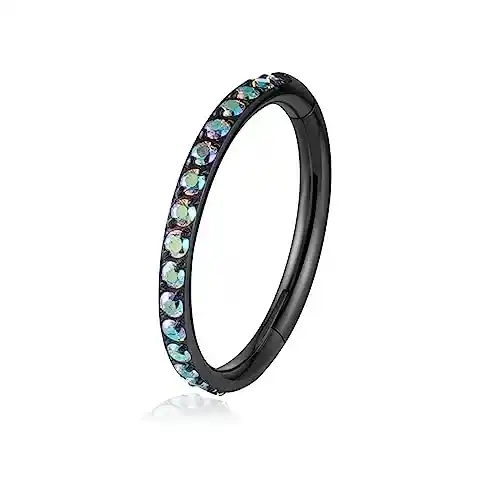
TOMIDES 16G Titanium Cartilage Earring Hoop for Conch Helix Tragus 8mm 10mm 12mm Hypoallergenic Hinged Clicker Nose Rings Septum Piercing Jewelry 12mm black
TOMIDES states this is implant grade G23 titanium, non-toxic, and says it will never corrode or turn green.
TOMIDES states this is implant grade G23 titanium, non-toxic, and says it will never corrode or turn green. The stated sizing is 16G (1.2mm) gauge with inner diameters of 8mm, 10mm and 12mm, and a 7mm option also appears on the page. Unusually for this category, the maker publishes its own fit note, saying 12mm suits a fresh or healing conch and suggesting 10 to 11mm for a tighter conch look. The closure is a hinged clicker the maker describes as opening and closing by hand with a click. TOMIDES suggests helix, rook, daith, septum, conch and tragus placements, and the title also sells the piece as a nose ring and septum ring.
"This is our conch pick because it is one of only two listings here that tells you which diameter the maker thinks a conch needs, and a number you can argue with beats an adjective. At $10.99 as of October 2026 it sits mid-group on price while publishing the largest diameter anyone here offers. The claim to discount is the absolute one, because never corrode or turn green reads as a durability claim rather than a guarantee, and no page here publishes a corrosion test behind it. The wider caveat is scope, since a listing written for six placements plus the nose is not a conch specialist, and a piercer looking at your ear remains the better source for diameter.
FINE4U Conch Piercing Jewelry Hoops Gold 16G 10mm, ASTM F136 Titanium Cartilage Earrings for Women & Men, Body Implant Grade Nose Rings, Hypoallergenic Hinged Clicker
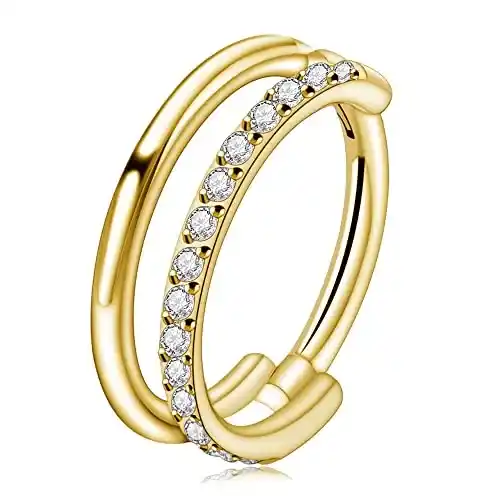
FINE4U Conch Piercing Jewelry Hoops Gold 16G 10mm ASTM F136 Titanium Cartilage Earrings for Women Men Body Implant Grade Nose Rings Hypoallergenic Hinged Clicker
FINE4U states ASTM F136 titanium, certified by SGS, hypoallergenic and 100 percent nickel-free, which is the only place in this group where a named standard and a third-party certifier appear together.
FINE4U states ASTM F136 titanium, certified by SGS, hypoallergenic and 100 percent nickel-free, which is the only place in this group where a named standard and a third-party certifier appear together. The stated size is 16G (1.2mm) with a length given as 3/8 in, or 10mm. The maker publishes its own fit note, saying 10mm suits a healing small conch or a fresh cartilage piercing while 12mm suits a fresh conch or a larger ear. The stone is described as 5A cubic zirconia. What ships is one clicker hoop plus a storage box, not a pair.
"The documentation is the reason to buy it, because naming SGS as a certifier goes a step further than any other page in this roundup. Its fit note is also the second piece of attributable diameter guidance we found, and it broadly agrees with the TOMIDES note, which is mild but real corroboration. The trade-off is arithmetic, since at $14.99 as of October 2026 you are buying a single hoop, so a matched pair costs more than twice the budget pick. Read the quantity line twice before you order.
Titanium Cartilage Earrings for Women, CZ Double Hoop Helix Piercing Jewelry, Conch Hoop Tragus Rook Daith Piercing Jewelry,Surgical Steel Hypoallergenic Earrings Silver 8mm
Titanium Cartilage Earrings for Women CZ Double Hoop Helix Piercing Jewelry Conch Hoop Tragus Rook Daith Piercing Jewelry Surgical Steel Hypoallergenic Earrings Silver 8mm
The design is the selling point, because DIDISEE builds a double-hoop look out of a single piece, pairing a cubic zirconia pave curve with two teardrop accents so one piercing reads as two.
The design is the selling point, because DIDISEE builds a double-hoop look out of a single piece, pairing a cubic zirconia pave curve with two teardrop accents so one piercing reads as two. The maker states 16G titanium and suggests helix, conch, tragus, rook, forward helix and daith, offered in gold and silver at 8mm and 10mm. It is also the only title in this group that never mentions the nose or a septum. The material claim is where the page falls apart, because the title carries Titanium Cartilage Earrings in one clause and describes the same piece as surgical steel and hypoallergenic in another, and no bullet resolves which alloy you receive. Unlike the FINE4U page it names no standard at all, calling the piece hypoallergenic, smooth and lightweight without saying what it is made of.
"We recommend this one on styling and we are explicit that the material claim is unresolved, which is an honest split rather than a hedge. If you want the look of a stacked helix from a single piercing, nothing else here does it, and the 8mm option is the right scale for that effect. The caveat matters, because titanium and surgical steel are different materials with different nickel content, so a reader avoiding nickel has not been answered by this page and should ask the seller. At $14.99 as of October 2026 you pay the top price in the group for the least documented metal.
body freedom 20G, 18G, 16G Titanium Hoop Nose Ring, Hinged Silver Cartilage Hoop Earrings for Women, Clear CZ Conch Tragus Helix Earrings Septum Nose Piercing Jewelry 6/8/10mm
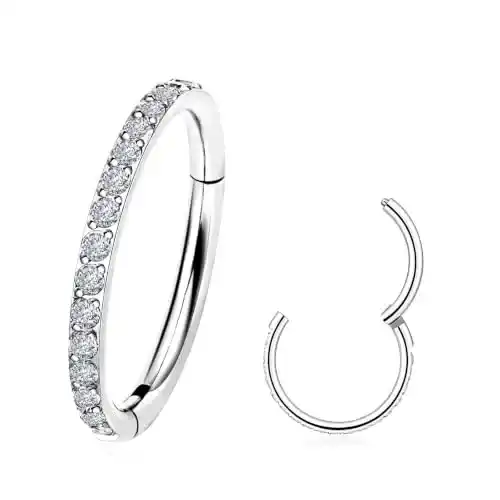
body freedom 20G 18G 16G Titanium Hoop Nose Ring Hinged Silver Cartilage Hoop Earrings for Women Clear CZ Conch Tragus Helix Earrings Septum Nose Piercing Jewelry 6 8 10mm
The reason to look at this listing is the fit matrix, because the maker publishes three inner diameters of 6mm, 8mm and 10mm across three gauges of 16g, 18g and 20g, which is nine combinations and the widest spread in this roundup.
The reason to look at this listing is the fit matrix, because the maker publishes three inner diameters of 6mm, 8mm and 10mm across three gauges of 16g, 18g and 20g, which is nine combinations and the widest spread in this roundup. The maker states F136 titanium with clear cubic zirconia, hypoallergenic and nickel free, though no third-party certifier is named behind that standard. The closure is a hinged segment clicker, and the maker claims it resists deformation across repeated opening without publishing a cycle count. Suggested placements run to nostril, septum, tragus, helix, conch, rook and general cartilage wear. One oddity is that the brand field returns as body oxo while the title says body freedom.
"Buy this one when you do not yet know your own numbers, because nine gauge and diameter combinations from a single seller is the cheapest way to stop guessing. At $9.99 as of October 2026 it is the second cheapest pick here and the only one pairing three gauges with three diameters. The trade-off is documentation, since F136 appears as a maker claim with no certifier behind it and the brand name on the page does not match the brand field. Confirm which variant you are ordering at checkout, because a nine-way matrix is also nine ways to order the wrong thing.
20G 18G 16G Titanium Nose Ring Hoop, Cartilage Hoop Earrings for Women Men Silver Gold Nose Ring Septum Ring Tragus Conch Helix Daith Lip Piercing Jewelry 6mm/7mm/8mm/9mm/10mm (Gold-18g, 7mm)
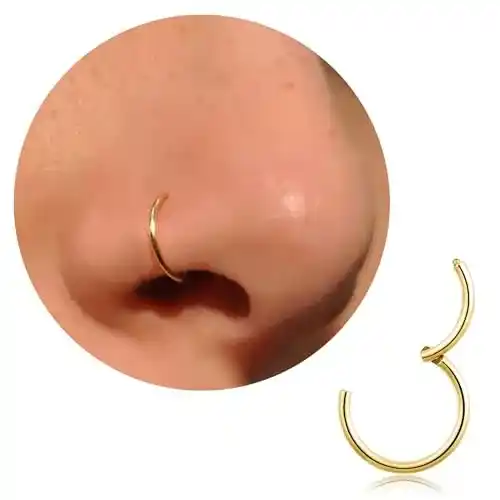
20G 18G 16G Titanium Nose Ring Hoop Cartilage Hoop Earrings for Women Men Silver Gold Nose Ring Septum Ring Tragus Conch Helix Daith Lip Piercing Jewelry 6mm 7mm 8mm 9mm 10mm Gold 18g 7mm
DAI JY states ASTM F-136 implant grade titanium, lead and nickel-free, on the cheapest listing in this group.
DAI JY states ASTM F-136 implant grade titanium, lead and nickel-free, on the cheapest listing in this group. The stated options are 20g, 18g and 16g with inner diameters of 6mm, 7mm, 8mm, 9mm and 10mm, and the seller refers buyers to its own size chart rather than recommending a diameter for a placement. The maker makes a comparison claim, saying titanium is significantly lighter than a surgical steel nose ring, while publishing neither weight. It also claims no tarnish and no turning green, waterproof and sweat-proof, plus secure wear while sleeping and showering. The title leads with nose ring and septum ring before it reaches tragus, conch, helix and daith, and the variant we priced is gold at 18g and 7mm.
"This is the budget pick and it still names a standard, which the pricier DIDISEE listing never manages. Five diameters reaching down to 6mm also make it the most plausible option in this group for a tragus, where the available space is smallest. The claims to set aside are the absolutes about tarnish and water, and the suggestion that a hoop is fine to sleep in, since the Association of Professional Piercers specifically warns that sleeping on a healing cartilage piercing can shift the angle of the piercing. At $6.95 as of October 2026 the cost of finding out whether a diameter suits you is about as low as it goes.
Review of Our Favorite 3
TOMIDES 16G Titanium Cartilage Earring Hoop for Conch Helix Tragus 8mm 10mm 12mm Hypoallergenic Hinged Clicker Nose Rings Septum Piercing Jewelry 12mm black
TOMIDES states this is implant grade G23 titanium, non-toxic, and says it will never corrode or turn green.
FINE4U Conch Piercing Jewelry Hoops Gold 16G 10mm ASTM F136 Titanium Cartilage Earrings for Women Men Body Implant Grade Nose Rings Hypoallergenic Hinged Clicker
FINE4U states ASTM F136 titanium, certified by SGS, hypoallergenic and 100 percent nickel-free, which is the only place in this group where a named standard and a third-party certifier appear together.
Titanium Cartilage Earrings for Women CZ Double Hoop Helix Piercing Jewelry Conch Hoop Tragus Rook Daith Piercing Jewelry Surgical Steel Hypoallergenic Earrings Silver 8mm
The design is the selling point, because DIDISEE builds a double-hoop look out of a single piece, pairing a cubic zirconia pave curve with two teardrop accents so one piercing reads as two.
About the Author
Alfreda Borror
Alfreda Borror is the founding editor of Opulent Opal, writing research-based buying guides on diamonds, birthstones, and fine jewelry.