Engagement Ring Settings Explained: Solitaire vs Halo vs Three-Stone

This post may contain affiliate links. Read our affiliate policy
This article contains affiliate links. We may earn a commission if you make a purchase through our links, at no extra cost to you.
The setting you choose for your engagement ring is just as important as the diamond itself. It determines how your stone catches light, how secure it stays during daily wear, and the overall style statement your ring makes. From timeless solitaires to glamorous halos, each setting has distinct advantages worth understanding before you buy.
This guide breaks down every major setting type, helping you find the perfect match for your stone, style, and lifestyle. For a complete buying overview, see our engagement ring guide.
Understanding Ring Settings: The Basics
A ring "setting" refers to how the center stone is mounted and secured to the band. The setting affects:
- Light performance: How much light enters and exits the diamond
- Perceived size: Some settings make stones appear larger
- Security: How well the diamond is protected from loss or damage
- Maintenance: Some settings require more upkeep
- Cost: More complex settings with accent stones cost more
- Comfort: Profile height and edge smoothness for daily wear
The right setting balances all these factors with your personal style preferences.
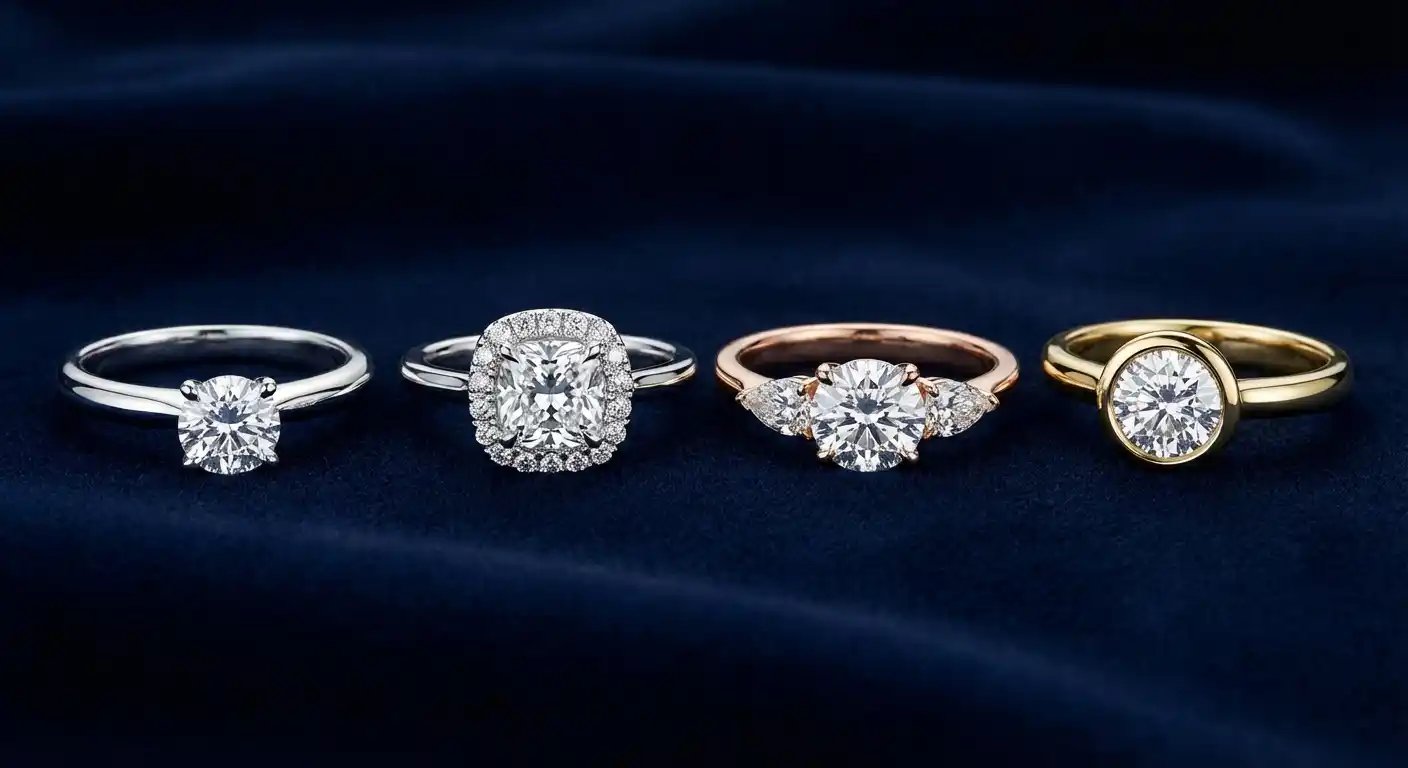
Solitaire Setting
The most popular engagement ring style, accounting for over 50% of engagement ring sales.
A solitaire features a single center stone mounted on a plain or minimally decorated band. The design has remained virtually unchanged since Tiffany & Co. introduced their iconic six-prong setting in 1886.
How It Works
Metal prongs (typically 4-6) grip the diamond's girdle, elevating it above the band. This allows maximum light to enter from all angles, maximizing brilliance and fire.
Prong Variations
| Type | Description | Best For |
|---|---|---|
| 4-Prong | Classic, shows more diamond | Round and cushion cuts |
| 6-Prong | More secure, slightly more metal visible | Round brilliants, active lifestyles |
| V-Prong | Protects pointed ends | Marquise, pear, princess cuts |
| Claw Prong | Decorative pointed tips | Vintage-inspired looks |
Pros
- Timeless elegance: Never goes out of style
- Maximum light exposure: Diamond sparkles brilliantly
- Easy matching: Works with any wedding band style
- Lower cost: No accent stones means lower price
- Easy maintenance: Simple design, easy to clean
Cons
- The diamond is everything: Quality matters more when nothing distracts
- Higher profile: Prongs can snag on fabrics
- Some find it too simple: No additional sparkle from accent stones
Ideal For
- Classic, understated style preferences
- Those prioritizing the center diamond
- Budget-conscious buyers (more money for the stone)
- Active lifestyles (fewer accent stones to lose)
Price Impact
Solitaire settings typically cost $300-$1,000 for the metal and mounting, allowing you to allocate more budget to the diamond itself.
Halo Setting
The second most popular choice at approximately 19.1% of couples.
A halo surrounds the center stone with a ring of smaller diamonds (pavé or micro-pavé set), creating a larger, more brilliant appearance.
How It Works
Tiny accent diamonds are set in a continuous circle around the center stone. Light reflects off multiple surfaces, dramatically increasing overall sparkle. The additional visual mass makes the center diamond appear 30-50% larger.
Halo Variations
| Type | Description | Effect |
|---|---|---|
| Single Halo | One ring of accent diamonds | Classic, elegant |
| Double Halo | Two concentric rings | Maximum size illusion |
| Hidden Halo | Halo beneath the center stone | Subtle side sparkle |
| Cushion Halo | Rounded square shape around any cut | Softens round centers |
| Floral Halo | Petal-shaped arrangement | Vintage, romantic |
Pros
- Perceived size: Makes center stone look significantly larger
- Incredible sparkle: Multiple diamonds catch light everywhere
- Vintage appeal: Popular in Art Deco and Victorian eras
- Budget-friendly: Smaller center stone looks bigger with halo
- Finger coverage: Creates substantial presence
Cons
- More maintenance: Small stones can loosen over time
- Higher profile: May catch on things
- Cleaning difficulty: Dirt accumulates around tiny stones
- Dated by some: Peak popularity in 2010s
- Higher cost: Accent diamonds add expense
Ideal For
- Those wanting maximum visual impact
- Budget-conscious buyers who want a larger look
- Vintage and glamorous style preferences
- Smaller center stones (halo amplifies them)
Price Impact
Halo settings typically add $500-$2,000+ to the ring cost depending on accent diamond quality and number.
Three-Stone Setting
A deeply symbolic choice representing past, present, and future.
Also called trilogy or trinity rings, three-stone settings feature a larger center diamond flanked by two smaller side stones. The style carries inherent romantic meaning.
How It Works
The center stone is mounted slightly higher than the side stones, creating visual hierarchy. Side stones are typically 30-50% of the center stone's carat weight and may match or complement its shape.
Shape Combinations
| Center Stone | Popular Side Stones | Effect |
|---|---|---|
| Round | Round | Classic, symmetrical |
| Oval | Pear (points out) | Elongated, elegant |
| Cushion | Half-moon | Vintage charm |
| Emerald | Trapezoid or baguette | Art Deco sophistication |
| Marquise | Round | Dramatic, unique |
Pros
- Symbolic meaning: Past, present, future resonates
- Incredible sparkle: Three diamonds catch light
- Versatile styling: Mix shapes, add color
- Anniversary upgrade: Can start smaller, upgrade later
- Visual weight: Substantial finger presence
Cons
- Higher cost: Three diamonds cost more than one
- More maintenance: Multiple settings to check
- Style limitations: Not everyone wants visible symbolism
- Proportion challenges: Stones must balance well
Ideal For
- Couples who value symbolism
- Those wanting substantial finger presence
- Colored gemstone incorporation (sapphire sides)
- Milestone celebrations (anniversaries, push gifts)
Price Impact
Three-stone settings cost significantly more—often 50-100%+ above equivalent solitaires due to additional diamonds and complex mounting.
Bezel Setting
Modern, sleek, and exceptionally secure.
A bezel setting encircles the diamond's entire circumference with a thin metal rim, holding it securely in place without prongs.
How It Works
A custom-made metal collar wraps completely around the diamond's girdle, securing it from all sides. The result is a smooth, snag-free surface that protects the stone's edges.
Bezel Variations
| Type | Description | Best For |
|---|---|---|
| Full Bezel | Metal surrounds entire stone | Maximum protection |
| Half Bezel | Metal on two opposite sides | Balance of security and light |
| Rubover | Thin metal edge, minimal coverage | Modern minimalism |
Pros
- Maximum security: Diamond cannot fall out
- Snag-free: Smooth edges won't catch fabric
- Active lifestyle friendly: Perfect for hands-on work
- Modern aesthetic: Clean, contemporary lines
- Edge protection: Shields vulnerable diamond edges
Cons
- Less brilliance: Metal blocks some light
- Stone appears smaller: Metal covers edge of diamond
- Limited shapes: Works best with round, oval, cushion
- Harder to resize: More complex construction
- Difficult stone replacement: Requires specialized work
Ideal For
- Active lifestyles (nurses, athletes, chefs, parents)
- Those who work with their hands
- Modern, minimalist style preferences
- Protecting vulnerable diamond cuts (marquise, pear points)
Price Impact
Bezel settings cost slightly more than prong settings due to the custom metalwork required—typically $400-$1,200 for the setting.
Pavé Setting
Maximum sparkle through a diamond-encrusted band.
Pavé (pronounced pah-VAY, French for "paved") features tiny diamonds set closely together across the band, creating a continuous sparkle effect.
How It Works
Small diamonds (typically 0.01-0.02 carats each) are set into small holes drilled in the band and secured by tiny beads of metal pushed over each stone. When done well, the metal is nearly invisible.
Pavé Variations
| Type | Diamond Size | Metal Visibility |
|---|---|---|
| Classic Pavé | 1.3mm-2mm | Some metal visible |
| Micro-Pavé | Under 1.3mm | Minimal metal |
| French Pavé | V-shaped grooves | Unique light patterns |
| U-Prong Pavé | U-shaped metal | More secure |
Pros
- Maximum sparkle: Dozens of diamonds catch light
- Elegant appearance: Sophisticated, luxurious
- Complements center stone: Enhances overall brilliance
- Versatile: Works with any center stone shape
- Modern and vintage: Suits various aesthetics
Cons
- Higher maintenance: Small stones can loosen
- Cleaning challenges: Dirt accumulates between stones
- Resizing limitations: Diamonds on band complicate adjustments
- Higher cost: Many small diamonds add up
- Durability concerns: Tiny prongs can wear over time
Ideal For
- Those seeking maximum brilliance
- Glamorous style preferences
- Complementing a larger center stone
- Special occasions (less ideal for hard daily wear)
Price Impact
Pavé adds $300-$1,500+ depending on diamond quality and band coverage.
Cathedral Setting
Elegant arches that elevate and protect.
Cathedral settings feature graceful metal arches rising from the band to support the center stone, resembling the architectural lines of Gothic cathedrals.
How It Works
Two or more metal supports curve upward from the band, meeting at the center stone's mounting. This creates a distinctive profile while providing structural support.
Pros
- Elegant profile: Distinctive and graceful
- Added height: Makes center stone prominent
- Structural support: Strong mounting
- Vintage appeal: Romantic, classic aesthetic
- Protects stone sides: Arches shield edges
Cons
- Higher profile: More prone to snagging
- Wedding band fit: May not sit flush with straight bands
- Limited styles: Not all designs incorporate arches
- Cleaning difficulty: Arches create crevices
Ideal For
- Vintage and romantic aesthetics
- Those who want a prominent center stone
- Pairing with curved wedding bands
- Princess and emerald cut diamonds (arches protect corners)
Tension Setting
The diamond appears to float between the band ends.
Tension settings use the pressure of the metal band itself to hold the diamond in place, creating the illusion that the stone floats suspended in air.
How It Works
The band is manufactured with a precisely calibrated gap slightly smaller than the diamond. When the stone is inserted, the metal's spring tension holds it securely. Only very hard metals (platinum, certain gold alloys) work for this design.
Pros
- Striking visual effect: Diamond appears suspended
- Maximum light exposure: No metal blocking light
- Modern aesthetic: Contemporary and unique
- Conversation starter: Unusual design draws attention
Cons
- Security concerns: Some worry about stone falling out (though modern tension settings are quite secure)
- Resizing impossible: Cannot be adjusted
- Limited jeweler availability: Requires specialized skills
- Stone replacement difficult: Must match exact specifications
- Not for all diamonds: Requires precise measurements
Ideal For
- Modern, minimalist aesthetics
- Those wanting a unique, contemporary look
- Confident buyers who understand the design
- Permanent size situations (no future resizing needed)
Vintage and Antique Settings
Period-inspired designs with historical character.
Vintage settings encompass various historical styles, each with distinctive characteristics:
Art Deco (1920s-1930s)
- Geometric patterns and symmetry
- Step cuts (emerald, Asscher)
- Milgrain detailing
- Platinum dominance
- Bold, architectural lines
Victorian (1837-1901)
- Ornate, romantic designs
- Yellow gold prominence
- Floral and nature motifs
- Rose cut diamonds
- Intricate filigree work
Edwardian (1901-1910)
- Delicate, lacy metalwork
- Platinum's introduction
- Garland and bow motifs
- Light, airy designs
- Exceptional craftsmanship
Pros
- Unique character: One-of-a-kind designs
- Historical significance: Connection to eras past
- Superior craftsmanship: Often better than modern mass production
- Sustainable choice: Recycled jewelry reduces environmental impact
- Conversation pieces: Rich stories to tell
Cons
- Sizing limitations: Antique rings may be hard to resize
- Durability questions: Old settings may need restoration
- Matching challenges: Finding wedding bands to match
- Unknown history: Previous wear and repairs
Explore more in our vintage engagement rings guide.
How to Choose the Right Setting
Consider Your Lifestyle
| Activity Level | Best Settings | Avoid |
|---|---|---|
| Very active | Bezel, low-profile solitaire | Tension, tall halos |
| Moderate | Any setting | None |
| Desk work | Pavé, halo, cathedral | None |
| Manual labor | Bezel, flush set | High-profile prongs |
Consider Your Diamond
| Diamond Shape | Best Settings |
|---|---|
| Round | Any setting (most versatile) |
| Princess | V-prong solitaire, bezel, halo |
| Oval | Solitaire, halo, three-stone |
| Cushion | Halo, solitaire, vintage |
| Emerald | Solitaire, three-stone, bezel |
| Marquise | Bezel, V-prong, halo |
| Pear | V-prong, halo, bezel for point |
For more on diamond shapes, see our diamond shapes guide.
Consider Your Budget
| Budget | Recommended Settings |
|---|---|
| Under $1,000 | Solitaire, simple bezel |
| $1,000-$3,000 | Solitaire, halo, simple pavé |
| $3,000-$7,000 | Any setting |
| $7,000+ | Custom, elaborate designs |
See our engagement rings under $1000 for budget-friendly options.
Setting Comparison Chart
| Setting | Security | Sparkle | Maintenance | Cost | Best For |
|---|---|---|---|---|---|
| Solitaire | Good | High | Easy | Low | Classic style |
| Halo | Good | Very High | Medium | Medium | Maximum impact |
| Three-Stone | Good | Very High | Medium | High | Symbolism |
| Bezel | Excellent | Medium | Easy | Medium | Active lifestyle |
| Pavé | Fair | Very High | High | Medium | Glamour |
| Cathedral | Good | High | Medium | Medium | Elegant profile |
| Tension | Good | Very High | Low | Medium | Modern unique |
| Vintage | Varies | Varies | High | Varies | Character |
Frequently Asked Questions
Which setting makes a diamond look biggest?
Halo settings make diamonds appear 30-50% larger. The surrounding accent diamonds add visual mass while drawing the eye outward.
What setting is most secure for daily wear?
Bezel settings offer maximum security since the metal surrounds the entire diamond. For prong settings, six prongs are more secure than four.
Can I change my ring's setting later?
Yes, diamonds can typically be reset into new settings. Consider this if your lifestyle changes or you want to update the style. Some settings (tension, certain bezels) are more difficult to work with.
What setting works best with a small diamond?
Halo settings amplify smaller diamonds beautifully, making them appear larger and more substantial. A 0.5-carat diamond in a halo can look like a 0.75-1.0 carat stone.
Do certain settings cost more to insure?
Insurance typically covers the ring's appraised value regardless of setting. However, rings with many small accent diamonds may have slightly higher premiums due to potential stone loss.
Continue Your Search
- Complete Engagement Ring Guide — Everything you need to know
- Diamond Shapes Guide — Find your perfect cut
- Best Engagement Rings Under $1000 — Budget options
- Lab-Grown vs Natural Diamonds — Compare your options
- Vintage Engagement Rings — Antique styles
About the Author
Alfreda Borror
Alfreda Borror is the founding editor of Opulent Opal, writing research-based buying guides on diamonds, birthstones, and fine jewelry.