Diamond Price Per Carat: 2026 Pricing Guide and Market Trends

This post may contain affiliate links. Read our affiliate policy
This article contains affiliate links. We may earn a commission if you make a purchase through our links, at no extra cost to you.
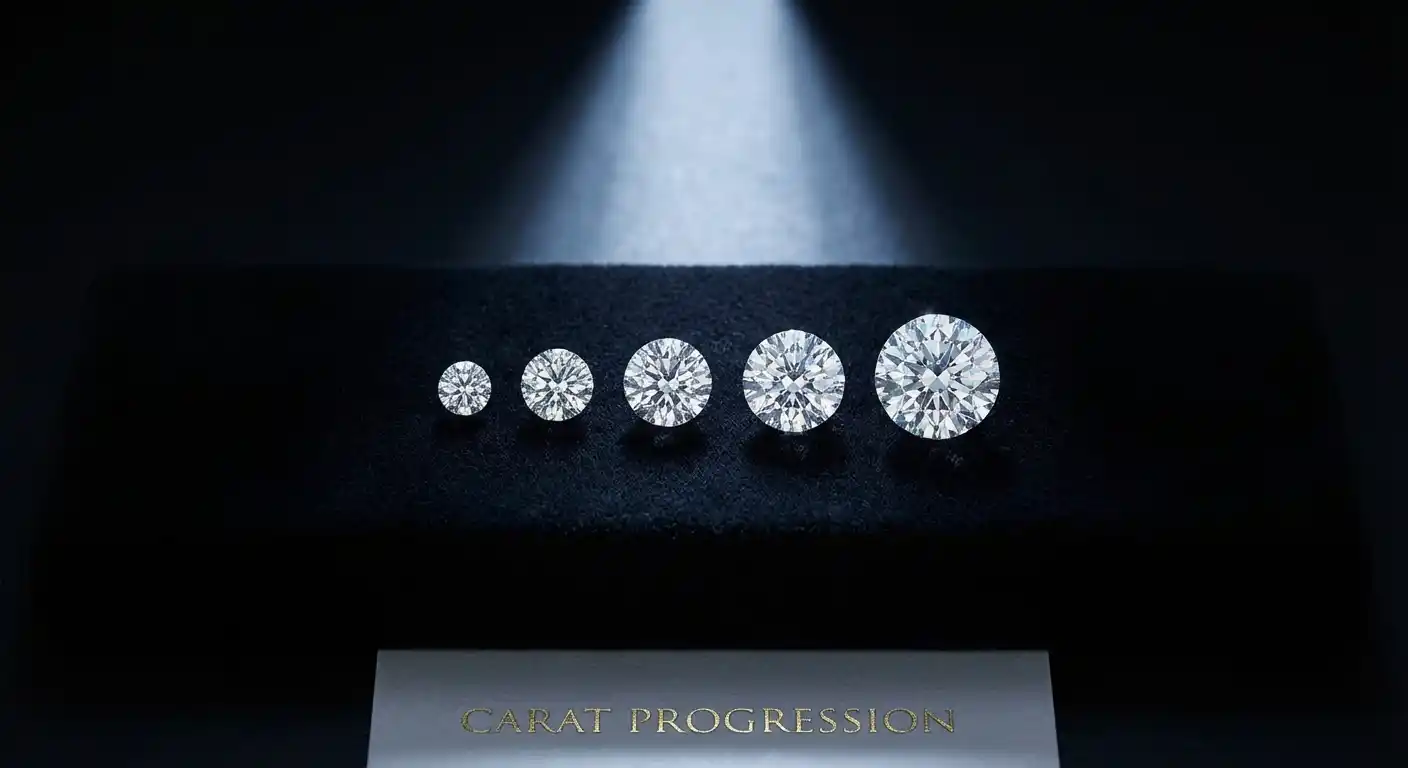
Diamond pricing seems straightforward—bigger costs more. But the relationship between carat weight and price follows patterns that create opportunities for informed buyers.
A 1-carat diamond doesn't cost twice as much as a 0.50-carat diamond of identical quality. It often costs 3-4 times as much. Understanding this exponential relationship and the "magic number" price jumps helps you find sweet spots where you get maximum visible impact for your budget.
This guide explains how diamond pricing works, what different carat weights actually cost in 2026, and how to use market dynamics to your advantage.
For a complete overview of diamond quality, see our comprehensive diamond buying guide.
Table of Contents
- How Diamond Pricing Works
- 2026 Diamond Price Ranges
- The Magic Number Effect
- Price-Per-Carat by Weight Range
- Color and Clarity Impact on Price
- Natural vs Lab-Grown Pricing
- Shape and Price
- Retail vs Online Pricing
- Value Optimization Strategies
- Using the Diamond Screener
- Frequently Asked Questions
How Diamond Pricing Works
Diamonds are priced per carat, then multiplied by the stone's weight. But the price-per-carat itself varies based on weight range and quality factors.
The Per-Carat Calculation
Total Price = Carat Weight × Price-Per-Carat
A 0.90-carat diamond at $4,500 per carat costs $4,050. A 1.10-carat diamond at $6,000 per carat costs $6,600.
The per-carat rate changes at certain weight thresholds, creating the non-linear pricing that savvy buyers can exploit.
Why Larger Diamonds Cost More Per Carat
Diamond prices increase exponentially rather than linearly because:
Rarity: Large rough diamonds are exponentially rarer than small ones. A 3-carat rough that can yield a 1.5-carat polished diamond is far scarcer than material for smaller stones.
Demand: Popular carat weights (especially 1.00) carry premium pricing due to psychological preference.
Cutting challenges: Larger rough requires more skill to maximize both weight retention and light performance.
2026 Diamond Price Ranges
Here's what you can expect to pay for natural diamonds with good quality specifications (G-H color, VS2-SI1 clarity, Excellent cut):
Price Ranges by Carat Weight
| Carat Weight | Price Range | Typical Price |
|---|---|---|
| 0.50 ct | $1,200-2,500 | ~$1,800 |
| 0.75 ct | $2,000-4,000 | ~$3,000 |
| 1.00 ct | $4,000-9,000 | ~$5,500 |
| 1.25 ct | $5,500-12,000 | ~$7,500 |
| 1.50 ct | $8,000-18,000 | ~$11,000 |
| 2.00 ct | $12,000-35,000 | ~$18,000 |
| 3.00 ct | $25,000-80,000 | ~$45,000 |
These ranges reflect round brilliant diamonds. Fancy shapes typically cost 25-35% less at equivalent specifications.
Premium and Budget Ends
Premium pricing (top of range) applies to:
- D-E color grades
- VVS1-IF clarity
- Ideal/Super Ideal cut
- Popular proportions and specifications
Budget pricing (bottom of range) applies to:
- H-I color grades
- SI1-SI2 clarity
- Very Good cut
- Less popular proportions
The Magic Number Effect
Diamond prices jump disproportionately at psychologically significant weights. These "magic numbers" create pricing thresholds that smart buyers avoid.
Major Price Jump Points
| Threshold | Price Jump | Strategy |
|---|---|---|
| 0.50 ct | 15-20% over 0.49 | Buy 0.45-0.49 ct |
| 1.00 ct | 20-30% over 0.99 | Buy 0.90-0.99 ct |
| 1.50 ct | 15-25% over 1.49 | Buy 1.40-1.49 ct |
| 2.00 ct | 20-30% over 1.99 | Buy 1.90-1.99 ct |
For detailed strategies on maximizing carat weight within budget, see our carat size and budget guide.
Real-World Savings Example
Consider two nearly identical diamonds:
0.98 ct, G color, VS2, Excellent cut: ~$5,100 1.02 ct, G color, VS2, Excellent cut: ~$6,300
The 1.02-carat stone costs $1,200 more (24% premium) for 0.04 carats of invisible weight difference. The diamonds look identical on a finger.
Price-Per-Carat by Weight Range
Understanding how price-per-carat changes across weight ranges helps you identify value opportunities:
Approximate Price-Per-Carat (G VS2 Excellent)
| Weight Range | Price Per Carat | Notes |
|---|---|---|
| 0.30-0.39 ct | $2,800-3,500 | Entry level |
| 0.40-0.49 ct | $3,200-4,000 | Pre-0.50 sweet spot |
| 0.50-0.69 ct | $4,000-5,000 | First major tier |
| 0.70-0.89 ct | $4,500-5,500 | Good value range |
| 0.90-0.99 ct | $5,000-6,000 | Best value before 1.00 |
| 1.00-1.24 ct | $5,500-7,000 | Popular range |
| 1.25-1.49 ct | $6,500-8,500 | Pre-1.50 value |
| 1.50-1.99 ct | $8,000-12,000 | Premium tier |
| 2.00-2.99 ct | $10,000-18,000 | Luxury tier |
| 3.00+ ct | $15,000-30,000+ | Rare/collector |
Color and Clarity Impact on Price
Quality grades significantly affect price-per-carat:
Color Premium/Discount (vs. G color baseline)
| Color | Price Impact |
|---|---|
| D | +40-60% |
| E | +25-35% |
| F | +15-20% |
| G | Baseline |
| H | -5-10% |
| I | -15-20% |
| J | -25-30% |
For color grade recommendations, see our diamond color guide.
Clarity Premium/Discount (vs. VS2 baseline)
| Clarity | Price Impact |
|---|---|
| IF | +50-70% |
| VVS1 | +30-40% |
| VVS2 | +20-30% |
| VS1 | +10-15% |
| VS2 | Baseline |
| SI1 | -10-20% |
| SI2 | -25-35% |
For clarity grade recommendations, see our clarity comparison guide.
Natural vs Lab-Grown Pricing
The diamond market has shifted dramatically with lab-grown diamonds now representing a significant portion of purchases.
Lab-Grown Price Advantage
Lab-grown diamonds typically cost 50-70% less than natural diamonds of equivalent specifications:
| Carat | Natural (G VS2) | Lab-Grown (G VS2) | Savings |
|---|---|---|---|
| 1.00 ct | $5,500 | $1,200-2,000 | 65-80% |
| 1.50 ct | $11,000 | $2,000-3,500 | 70-80% |
| 2.00 ct | $18,000 | $3,500-6,000 | 70-80% |
For detailed comparison, see our lab-grown vs natural diamonds guide.
Market Trends
Lab-grown diamond prices have dropped significantly since 2020 as production has scaled. This trend may continue, which is a consideration for buyers concerned about long-term value retention.
Natural diamond prices dropped 25-30% from 2022 highs but have stabilized in late 2024 and early 2025, with slight growth in diamonds over 1.50 carats.
Shape and Price
Diamond shape significantly affects price-per-carat:
Shape Price Comparison (vs. Round Brilliant)
| Shape | Price vs. Round |
|---|---|
| Round Brilliant | Baseline (highest) |
| Oval | -20-30% |
| Cushion | -25-30% |
| Princess | -25-35% |
| Emerald | -20-30% |
| Radiant | -25-35% |
| Pear | -20-30% |
| Marquise | -30-40% |
Round brilliants command premiums because:
- Most popular shape for engagement rings
- Cutting process wastes more rough diamond
- Standardized grading makes comparison easier
If budget is constrained, fancy shapes offer significantly more carat weight for the same spend.
Retail vs Online Pricing
Where you buy significantly affects what you pay:
Pricing Channels
| Channel | Price Premium | Notes |
|---|---|---|
| Online retailers | Baseline | Blue Nile, James Allen, etc. |
| Chain jewelry stores | +30-50% | Mall retailers, branded chains |
| Independent jewelers | +20-40% | Varies widely |
| Luxury brands | +100-300% | Tiffany, Cartier, etc. |
Online retailers operate on lower margins (15-25% vs 50%+ for brick-and-mortar), passing savings to buyers.
Diamond Screener Advantage
Our Diamond Screener compares certified diamonds across major online retailers, showing:
- Real-time pricing for identical specifications
- Price-per-carat efficiency
- Best-value diamonds on the efficiency frontier
Value Optimization Strategies
Strategy 1: Shop Under Magic Numbers
Buy 0.90-0.99 ct instead of 1.00+. The visual difference is imperceptible; the price difference is substantial.
Strategy 2: Optimize Color and Clarity
Instead of paying premium prices for top grades:
- Choose G-H color instead of D-F (saves 20-40%)
- Choose VS2-SI1 instead of VVS (saves 20-35%)
For eye-clean diamonds at lower clarity grades, see our eye-clean diamonds guide.
Strategy 3: Consider Fancy Shapes
A 1.25-carat oval costs roughly the same as a 1.00-carat round but appears larger due to its elongated face.
Strategy 4: Compare Across Retailers
Price variation of 10-20% for identical specifications is common between retailers. Our Diamond Screener enables easy comparison.
Strategy 5: Balance All Factors
The lowest price-per-carat means nothing if you sacrifice visible quality. Prioritize:
- Cut quality (never compromise)
- Eye-clean clarity
- Near-colorless color
- Maximum carat within budget
Using the Diamond Screener
Our Diamond Screener helps you find optimal price-per-carat value:
- Set your specifications (cut, color, clarity preferences)
- Set your budget range
- View diamonds sorted by efficiency
- Identify frontier diamonds offering best value
- Compare across retailers
The screener highlights diamonds that deliver superior quality relative to their price—the true bargains in the market.
Find the best values: Use our Diamond Screener to compare price-per-carat across thousands of certified diamonds.
Frequently Asked Questions
How much does a 1-carat diamond cost in 2026?
Natural 1-carat diamonds range from $4,000-$9,000 depending on quality. With recommended specifications (G-H color, VS2-SI1 clarity, Excellent cut), expect $4,500-$6,500. Lab-grown equivalents cost $1,200-$2,000.
Why does price-per-carat increase with size?
Larger diamonds are exponentially rarer than smaller ones. A 2-carat rough diamond is much rarer than two 1-carat roughs, even though they represent the same total weight.
What's the best carat weight for value?
The 0.90-0.99 carat range offers exceptional value—appearing virtually identical to 1.00-carat diamonds while avoiding the psychological price premium.
Are lab-grown diamonds a better value?
For pure visual bang-for-buck, yes. Lab-grown offers 50-70% more carat weight for the same money. However, natural diamonds hold value better over time. Your priorities determine which is "better."
How accurate are diamond price charts?
Price charts show averages but individual diamonds vary significantly based on specific proportions, fluorescence, and certification. Our Diamond Screener shows real-time market prices for actual stones.
Do diamond prices go up over time?
Historically, natural diamond prices have generally appreciated, though with significant fluctuations. The 2022-2024 period saw notable price drops. Lab-grown diamond prices have declined as production scaled and may continue falling.
The Bottom Line
Diamond pricing is complex, but a few key principles help you find maximum value:
- Avoid magic numbers (1.00, 1.50, 2.00 ct) where prices jump disproportionately
- Optimize color and clarity rather than paying for invisible grades
- Consider fancy shapes for 25-35% more carat weight
- Shop online retailers with lower margins
- Compare across vendors using consistent specifications
The diamond market rewards informed buyers. A little knowledge about pricing dynamics can save hundreds or thousands of dollars while getting an equally beautiful stone.
Ready to find the best value? Our Diamond Screener compares price-per-carat efficiency across major retailers, highlighting the diamonds that deliver the most beauty for your budget.
For more diamond education, explore our complete diamond buying guide, learn about cut grades, or understand certification.
About the Author
Alfreda Borror
Alfreda Borror is the founding editor of Opulent Opal, writing research-based buying guides on diamonds, birthstones, and fine jewelry.