Necklace Chain Thickness: Width, Gauge & Durability Explained

This post may contain affiliate links. Read our affiliate policy
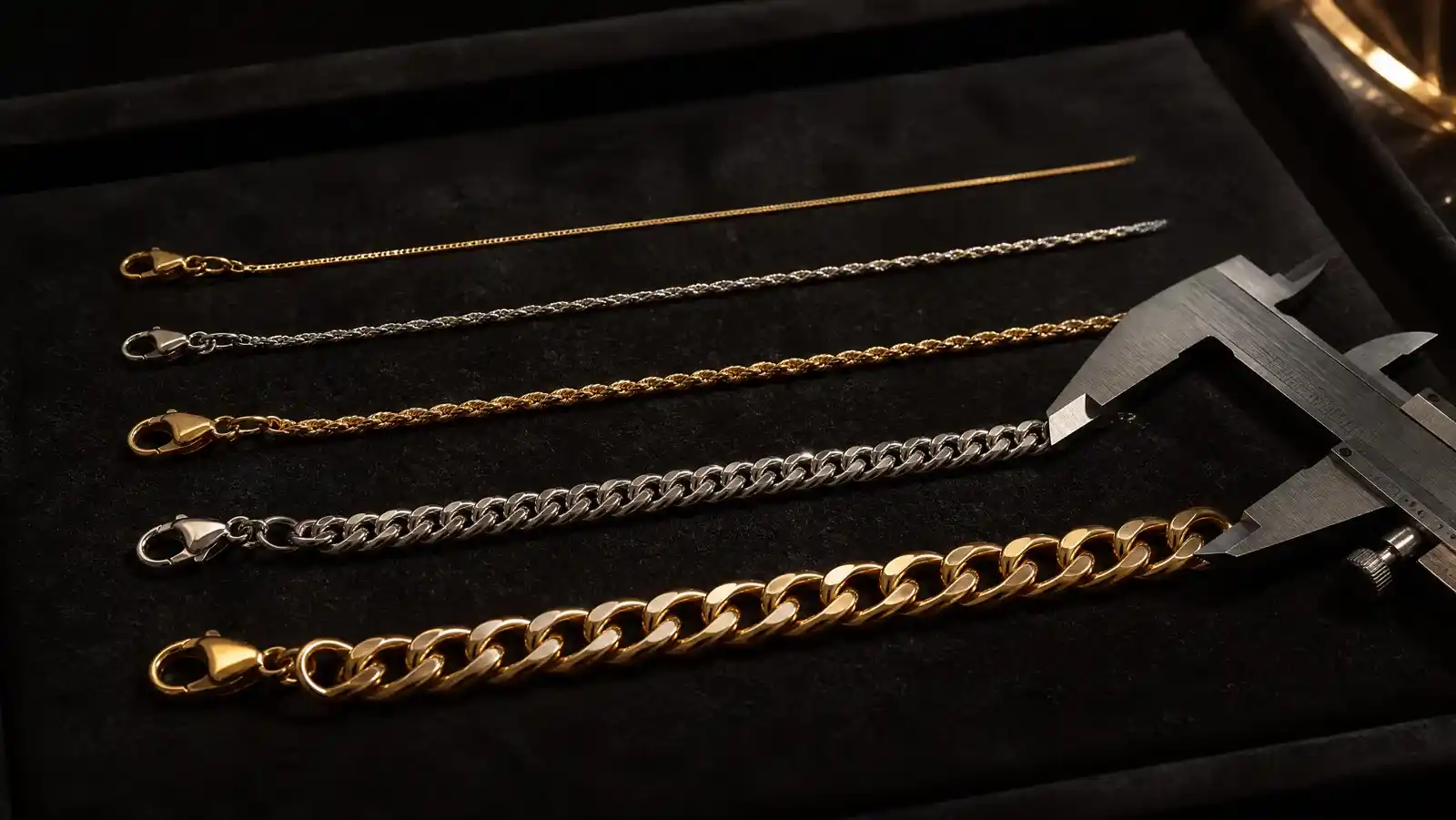
The millimeter figure is the least explained line in a chain listing. Necklace chain thickness tells you one thing: how wide the chain measures across its widest point. It is not a strength rating, not a weight, and not a promise that there is metal inside the links. Two chains can both say 6mm and differ by nearly three times in the gold you are actually buying.
This guide decodes it: what width and gauge each mean, what every millimeter range looks like on a neck, why solid versus hollow matters more than the mm figure, and how thickness drives price. Still deciding between chain styles altogether? Our necklace chain guide covers that; this page is about the number.
Table of Contents
- Width vs Gauge: Two Different Numbers
- What Each Millimeter Range Actually Looks Like
- Solid vs Hollow: The Number That Matters More Than mm
- Necklace Chain Thickness and Durability
- Choosing Necklace Chain Thickness for a Pendant
- Thickness, Weight and Price
- How to Measure a Chain You Already Own
- What We'd Buy
- FAQ
Width vs Gauge: Two Different Numbers
Width is the finished chain measured across its widest point, in millimeters. That is the number retailers print. According to Moody's Jewelry, chains are specified by width and length, and their stated range is blunt: "Thin chains start at 1mm, while statement chains can be 10mm or more."
Gauge is a different animal. In its original sense, gauge describes the drawn wire the links are made from — drawn wire being metal pulled through progressively smaller holes in a steel plate until it reaches a target diameter. According to Jewelry Tutorial HQ, the North American standard is the American Wire Gauge, also called the Brown and Sharpe gauge, and it runs backward from intuition: the smaller the gauge number, the thicker the wire.
Then retail muddies it. Sellers including Zales and Banter list rope chains under codes like "024 gauge" and "050 gauge," and those run the opposite direction — bigger code, wider chain. A Blake Bros listing pairs a sterling silver "ROPE 050" with a stated 2.2mm width, suggesting the codes describe wire stock in thousandths of an inch rather than the finished chain. We have found no published industry table mapping every code to millimeters.
Practical takeaway: treat a three-digit gauge code as a model number, not a measurement. Find the mm spec, and ask if the listing omits it. Millimeters are the only figure that compares cleanly across cable, curb, box, and rope.
What Each Millimeter Range Actually Looks Like
The gap between 1.5mm and 2.5mm sounds trivial and reads as a completely different piece of jewelry.
| Width | Visual read | Typical use | Suits |
|---|---|---|---|
| Under 1mm | A glint, not a chain | Delicate solo strands, very light charms | Anyone who wants the pendant, not the chain |
| 1–1.5mm | A chain up close, near-invisible across a room | Light pendant chains, the thin strand in a stack | Small pendants; petite frames |
| 1.5–2.5mm | Present without announcing itself | Everyday pendant chains and solo wear | Almost everyone; safest first buy |
| 2.5–4mm | Reads as jewelry on its own, worn bare | Chains meant to be seen, medium pendants | Anyone wanting the chain to be the piece |
| 4–6mm | Substantial; catches light across a room | Statement everyday wear, heavier pendants | Broader frames; bolder styling |
| 6mm+ | The chain is the outfit | Statement pieces | Deliberate styling only |
Those bands line up with how jewelers describe their own stock. According to JewelryLab, most people gravitate to the 1mm to 3mm range because it works under most outfits and stays comfortable. For men's chains, Marco Maveri puts the everyday window at 2mm to 6mm and calls 4mm the most versatile single width. Cladright frames the top end plainly: anything over 6mm goes into what they call "statement piece" territory, and is typically worn over a shirt rather than under a collar.
One thing to settle before committing: width changes how a length reads. A 1mm chain at 18 inches disappears into the neckline; a 5mm chain at the same 18 inches sits like a collar. Work through how to choose a necklace chain length alongside this page. The same logic governs layering — three chains of identical width read as one confused chain, while a 1mm, a 2mm and a 3mm give the stack a reason to exist.
Solid vs Hollow: The Number That Matters More Than mm
This is the section that saves money. A hollow chain buys visual width cheaply, because the links are tubes with air inside.
Westover Jewelers, a repair-focused jeweler in Lynchburg, Virginia, describes the construction directly: each link is formed from a tube of gold with very thin walls, so when two ends are joined there is very little surface area holding the joint together. They also note hollow chains have grown more common as gold prices climbed and manufacturers looked to cut costs.
The weight gap is the tell. Uverly's worked comparison shows the scale of it: a 6mm 14K, 24-inch solid Miami Cuban chain weighs approximately 68.0 grams, while the hollow version of the same chain weighs about 25.3 grams — a little over a third of the metal for the same stated width. That is the whole business model: the mm number stays, the metal leaves.
The failure mode is specific and ugly. Westover Jewelers warns that the thin wall eventually wears through, leaving a sharp edge that scratches skin or pulls hair — unavoidable in any hollow chain, they say, not a defect in a bad one. Their bottom line is worth quoting: if you cannot afford a solid chain, you cannot afford a hollow one, because it will cost more to fix and replace than you saved buying it.
How to spot a hollow chain before you pay:
- Find the gram weight. A wide chain with a suspiciously low gram figure is hollow or semi-solid.
- Watch for hollow, semi-solid, or lightweight construction buried in the description.
- Compare price to metal content. A 6mm chain priced below the gold it would hold if solid is not solid.
- If the listing publishes no weight at all, treat that as an answer.
Hollow is not automatically wrong — on a very wide statement chain, solid can be genuinely uncomfortable and genuinely expensive. But choose it knowingly, as a trade, not by discovering it after a link splits.
Necklace Chain Thickness and Durability
The claim we would most like to break: wider does not mean stronger. Chains rarely fail mid-run. They fail at the joints.
According to Halstead, a long-standing supplier to bench jewelers, jump rings — the small open rings connecting a clasp or a pendant to the chain — can be the weakest point on a finished chain, and are the number one repair item on finished jewelry chains. A jump ring that is not soldered closed works open slowly under the stress of daily fastening, and the wearer usually learns about it when the necklace is already on the floor.
That reframes the width question. A 4mm hollow chain on an unsoldered jump ring is more fragile than a 1.5mm solid cable with soldered connections, whatever the listing photo suggests. Look past the mm to:
- Is it solid? The biggest single variable. See above.
- Are the connections soldered? Halstead notes a trade-off — a soldered joint is stronger, but an unsoldered one gives way if the chain snags, which some jewelers consider a safety feature.
- How is it built? A herringbone and a curb of identical millimeters behave nothing alike under a snag. Our guide to the types of necklace chains covers which constructions tolerate daily abuse and which kink permanently.
- What metal, and what karat? Alloy and purity change how a width holds up. Weighing gold against silver or platinum? Start with our guide to jewelry metals and karats.
Buy construction first, width second. A well-made 1.5mm chain outlives a badly made 4mm one.
Choosing Necklace Chain Thickness for a Pendant
Two rules cover most of it.
The chain has to physically fit the bail — the small loop or hood on the back of a pendant that the chain passes through. Greenwich St. Jewelers puts it precisely: check that the bail opening is larger than your chain's gauge so the fit stays smooth and the pendant hangs straight. A chain that barely squeezes through will bind, twist the pendant off-center, and wear at one spot.
Then match visual weight. According to Robinson's Jewelers, 3mm to 5mm is the most versatile range for pendant chains — substantial enough to look intentional, strong enough for a medium cross, locket, or gemstone. They put 1mm to 2mm at the minimalist end: right for a small solitaire, a floating gemstone, or a subtle charm, where the chain all but disappears.
There is more to it — drop length, bail style, how the pendant loads the links. We cover those in choosing a chain for a pendant.
Thickness, Weight and Price
Precious-metal chains are priced substantially by the metal in them, and metal sells by weight. That means millimeters drive cost non-linearly — a chain twice as wide costs far more than twice as much.
Apples of Gold's 14K Miami Cuban chains, all at 24 inches, make it concrete:
| Width | Approximate weight |
|---|---|
| 3.5mm | 21.42 g |
| 4mm | 29.3 g |
| 4.3mm | 33.73 g |
| 6mm | 59.04 g |
Going from 3.5mm to 6mm is about a 70% increase in width — and roughly a 2.8x increase in gold. That is why a "small" jump in millimeters produces a large jump on the price tag.
As of July 31, 2026, MetalCharts lists 14K gold at $76.13 per gram. At that rate the metal alone in the 3.5mm chain runs a little over $1,600, while the 6mm chain's runs around $4,500 — before craftsmanship, brand, or retail margin.
How to sanity-check a price: Apples of Gold recommends dividing the price by the gram weight, then comparing that to the metal's current market price. Their worked example: a gold rope chain at $450 weighing 14 grams comes out to $32.14 per gram. The further above market that number sits, the more you are paying for design and margin rather than gold — fine, as long as you know that is the choice. It cuts the other way too: if a 6mm chain is priced well below its metal content, the metal is not there.
How to Measure a Chain You Already Own
The fastest way to learn which widths you like is to measure the chains in your own box.
With calipers. The reliable method. Lay the chain flat, open the jaws wide, position them across the outermost points, and close gently until they just make contact — do not squeeze, or you will compress the links and read low.
With a millimeter ruler. A fine metric scale works if the chain is 2mm or wider. Below that, a ruler will not resolve sizes that genuinely look different in wear.
With a known reference. Published U.S. coin specifications give you a free comparison set: a dime is 1.35mm thick, a quarter 1.75mm, and a nickel 1.95mm. Stand one on edge beside your chain to bracket the width within a few tenths of a millimeter.
Weigh it, too. A scale reading to 0.1g tells you what a caliper cannot. Compare your chain against what retailers publish for a solid chain of the same style, width, and length; a large shortfall points to hollow construction.
Clean the chain first — residue packed into the links inflates the reading and hides the geometry. Our guide to cleaning gold and silver at home covers doing that without damaging the finish.
What We'd Buy
Compressed to four lines:
- Ignore the gauge code, find the mm. Codes like 024 and 050 are model numbers with no universal conversion table.
- Read the gram weight before the width. It is the honest number, and the one that reveals hollow construction.
- For a first, do-everything chain, 1.5mm to 2.5mm solid is hard to beat. It carries a light-to-medium pendant, disappears under a collar, and survives daily wear.
- Buy construction, not millimeters. Solid metal and soldered connections outrank width every time.
Thickness is one of four specs that have to agree — width, length, construction, metal. To line them up, our full guide to choosing the right necklace chain walks the decision through in order.
FAQ
Is a thicker necklace chain always stronger?
No. Chains typically fail at their connection points rather than mid-run. According to Halstead, jump rings can be the weakest point on a finished chain and are the number one repair item. A thin solid chain with soldered connections can outlast a wide hollow one.
What necklace chain thickness is best for everyday wear?
For most people, 1.5mm to 2.5mm. JewelryLab notes most wearers prefer chains between 1mm and 3mm because they suit most outfits and stay comfortable. For men's chains, Marco Maveri puts the everyday window at 2mm to 6mm and calls 4mm the most versatile choice.
What do numbers like 024, 030, and 050 mean on chain listings?
They are trade gauge codes, seen mostly on rope chains at retailers such as Zales and Banter, and they run opposite to wire gauge — a larger code means a wider chain. A Blake Bros listing pairs a "ROPE 050" with a 2.2mm stated width. With no universally published conversion table, look for the millimeter spec instead of decoding the code.
Can a jeweler repair a dented or worn hollow chain?
It is difficult. Westover Jewelers describes hollow links as tubes with very thin walls offering very little surface area at a joint, and notes the wall eventually wears through and leaves a sharp edge. Their advice: repair and replacement typically cost more than the initial saving over a solid chain.
How do I tell if a chain is hollow before buying it?
Check the published gram weight against solid chains of the same style, width, and length — Uverly's comparison of a 6mm 14K, 24-inch Miami Cuban puts the solid version at about 68.0 grams against roughly 25.3 grams for the hollow one. Scan the description for "hollow" or "semi-solid," and be skeptical of any wide precious-metal chain priced below its metal content.
About the Author
Alfreda Borror
Alfreda Borror is the founding editor of Opulent Opal, writing research-based buying guides on diamonds, birthstones, and fine jewelry.