Types of Earrings: Complete Guide to Every Style and Name

This post may contain affiliate links. Read our affiliate policy
Huggies. Threaders. Martini settings. Lever-backs. The earring world has its own vocabulary—and walking into a jewelry store without knowing it can feel like ordering coffee in a foreign country.
This guide is your translation key. From basic studs to elaborate chandeliers, from ear climbers to jacket earrings, you'll learn what each style is called, how it looks, and when to wear it. Consider this your visual glossary for shopping with confidence.
Table of Contents
- Stud Earrings
- Hoop Earrings
- Drop and Dangle Earrings
- Chandelier Earrings
- Threader Earrings
- Ear Climbers
- Ear Cuffs
- Cluster Earrings
- Jacket Earrings
- Statement Earrings
- Earring Backings Explained
- Choosing the Right Style
Stud Earrings
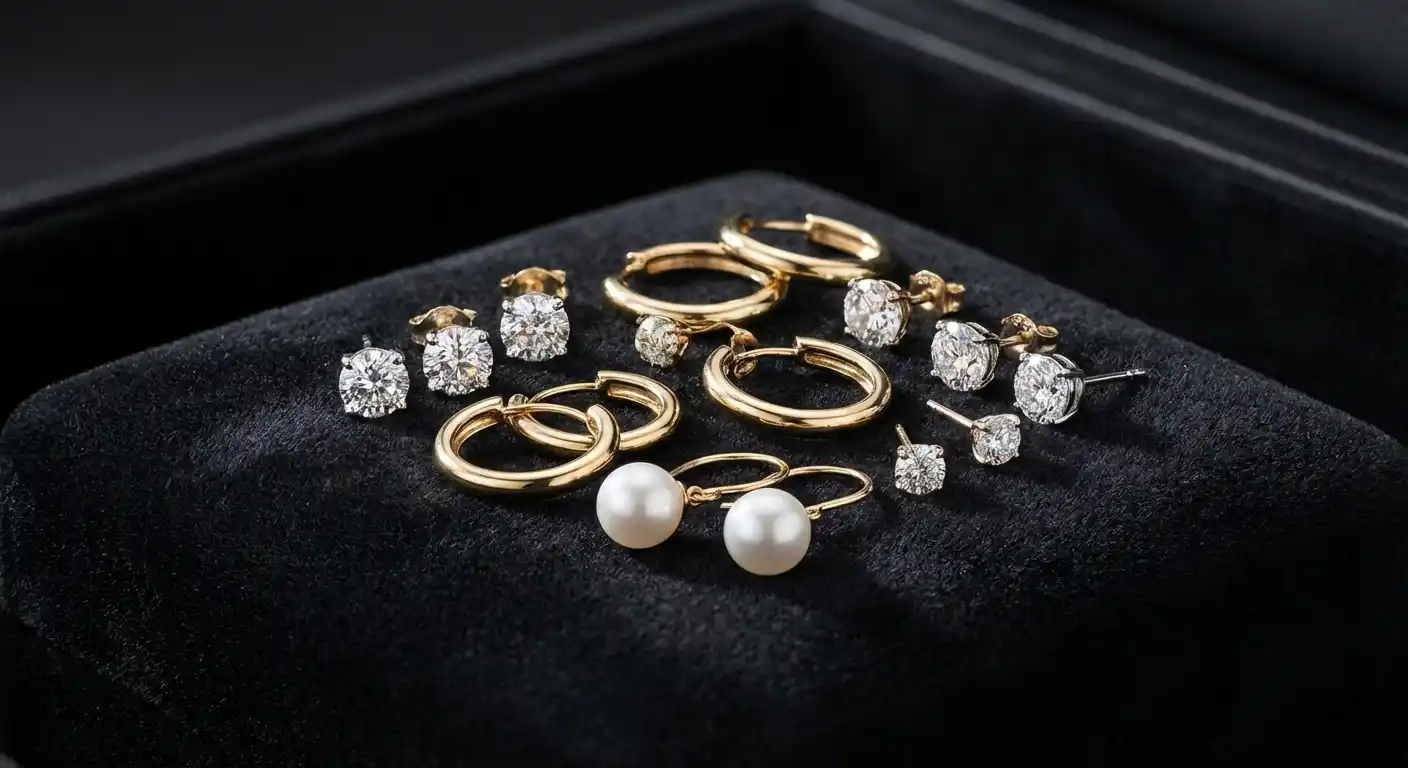
The most fundamental earring style, studs sit directly on the earlobe and fasten behind with a backing. Their simplicity makes them the most versatile option in any jewelry collection.
Classic Stud Variations
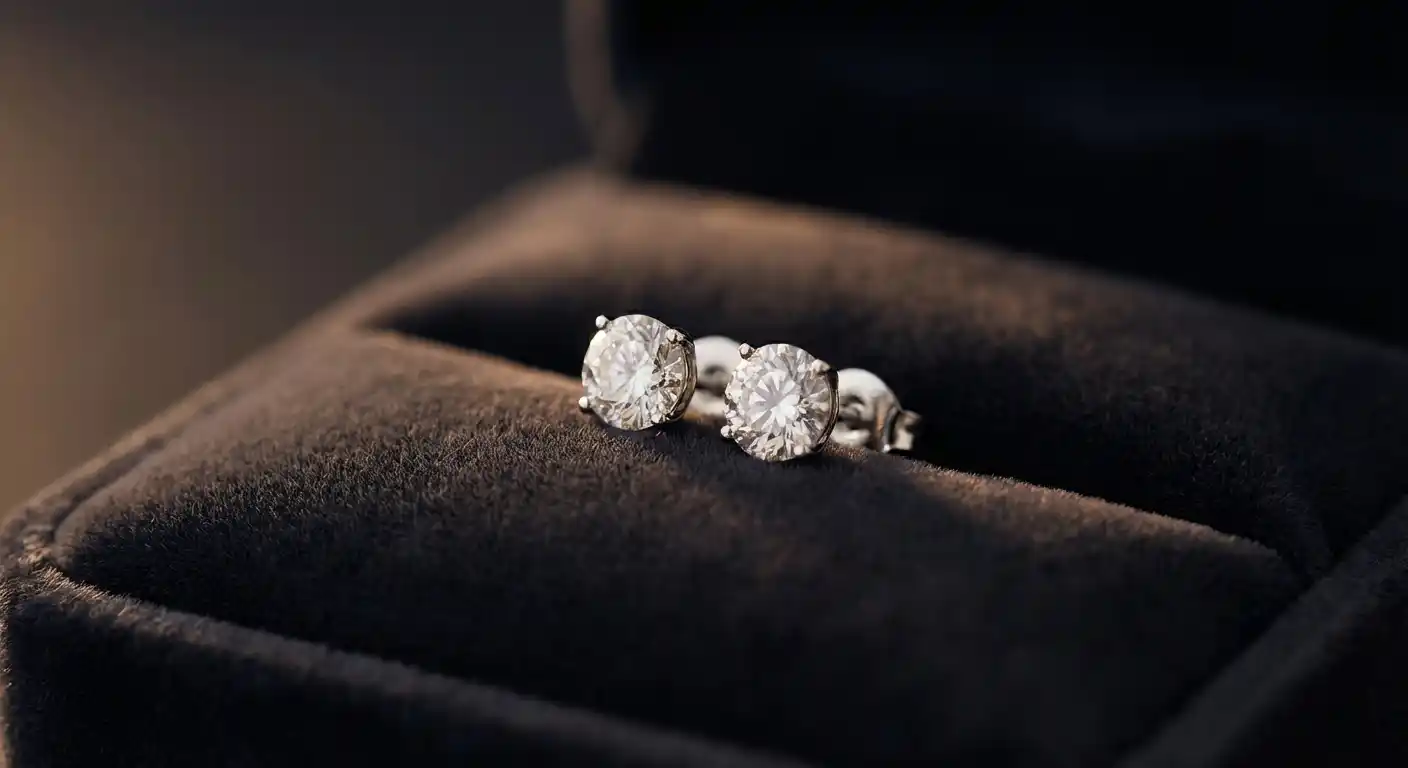
Solitaire studs: A single gemstone (typically diamond, pearl, or colored gem) in a simple setting. The quintessential earring that works for any occasion.
Ball studs: Solid metal spheres, available in polished, brushed, or textured finishes. Ranges from tiny 2mm dots to statement 10mm+ balls.
Martini studs: Diamond or gemstone studs in a three-prong setting that resembles an inverted martini glass. Popular for maximizing stone visibility.
Bezel studs: Stones fully enclosed in a metal rim for secure, sleek appearance. Excellent for active lifestyles.
Cluster studs: Multiple small stones grouped together, creating the appearance of one larger piece.
When to Wear Studs
- Everyday: Small to medium studs (4-6mm)
- Professional settings: Pearl or diamond studs
- Second holes: Tiny studs (2-3mm)
- Special occasions: Larger or more elaborate studs
For detailed diamond stud sizing advice, see our diamond stud size guide.
Hoop Earrings
Circular earrings that pass through the piercing and form a complete or near-complete circle. Hoops range from barely-there to unmissable statement pieces.
Hoop Variations by Size
Huggies (8-15mm): Tiny hoops that "hug" the earlobe closely. Perfect for minimalists or multiple piercings.
Small hoops (16-25mm): Visible but understated. Appropriate for professional settings and everyday wear.
Medium hoops (26-40mm): Classic proportion that suits most face shapes. Versatile for day or evening.
Large hoops (41-55mm): Bold statement pieces. Best for casual or evening occasions.
Oversized hoops (56mm+): Dramatic fashion statement. Requires confidence and the right occasion.
Hoop Variations by Style
Classic round hoops: Traditional circular shape, the most timeless option.
Oval hoops: Elongated shape that's more modern and face-flattering.
Continuous hoops: Seamless circles with no visible closure. The post passes entirely through the ear.
Click-top hoops: Feature a hinged mechanism that clicks shut. Easy to put on and secure.
Wire hoops: Thin wire construction for delicate appearance.
Tube hoops: Hollow, substantial-looking hoops that remain lightweight.
Thick hoops: Solid, chunky hoops (4mm+ wide) for bold style.
Inside-out hoops: Diamonds or stones set on both the outer and inner curves.
Textured hoops: Hammered, twisted, bamboo, or patterned designs.
Front-facing hoops: Designed to sit facing forward rather than perpendicular to the ear.
For comprehensive hoop guidance, explore our hoop earrings guide.
Drop and Dangle Earrings
Any earring that hangs below the earlobe qualifies as a drop or dangle. The terms are often used interchangeably, though "drop" sometimes refers to simpler designs and "dangle" to those with more movement.
Drop Styles
Linear drops: Straight, vertical designs that create clean lines. Modern and sophisticated.
Teardrop earrings: Pear-shaped drops, wider at the bottom. Romantic and classic.
Cascade drops: Multiple elements hanging at varying lengths, creating a waterfall effect.
Articulated drops: Multiple sections connected by jump rings or chains, allowing independent movement.
Single-stone drops: One gemstone hanging from a simple post or hook.
Bar drops: Geometric bars that hang vertically or horizontally.
Drop Lengths
| Length | Name | Best For |
|---|---|---|
| Under 1" | Short drop | Work, everyday elegance |
| 1-1.5" | Medium drop | Versatile, most occasions |
| 1.5-2.5" | Long drop | Evening events, special occasions |
| 2.5"+ | Shoulder duster | High fashion, dramatic statements |
For styling advice on drops, see our drop and dangle earrings guide.
Named for their resemblance to ornate ceiling fixtures, chandelier earrings feature elaborate designs with multiple tiers, branches, and dangling elements. They're the most dramatic earring category.
Chandelier Characteristics
- Multiple levels or tiers
- Often fan out wider than they are long
- Feature multiple stones, crystals, or metal elements
- Substantial visual weight
- Typically formal or special-occasion appropriate
Chandelier Styles
Tiered chandeliers: Distinct horizontal levels, each with hanging elements.
Girandole: Historic style with three drops hanging from a central element. Popular in 18th-century jewelry.
Cascading chandeliers: Elements flow downward in a continuous cascade.
Geometric chandeliers: Modern interpretations with clean angles and architectural shapes.
Crystal chandeliers: Featuring faceted crystals for maximum sparkle.
When to Wear Chandeliers
- Black-tie events and galas
- Weddings (as a bride or guest at formal ceremonies)
- Evening dinners and parties
- Photo shoots and special occasions
- When your hairstyle is up and earrings can be showcased
Threader Earrings
Also called chain earrings or pull-through earrings, threaders consist of a thin chain or bar that passes through the piercing, with decorative elements hanging on one or both sides.
Threader Variations
Simple chain threaders: Plain chain that threads through, adjustable for length.
Bar threaders: A straight bar on one end (the part visible from front) with chain hanging behind.
Double-ended threaders: Decorative elements on both the front and back portions.
Tassel threaders: Chain portion ends in a cluster or tassel.
Stone-end threaders: Gemstones or pearls on one or both ends.
Threader Benefits
- Adjustable length (just pull the chain through more or less)
- Minimalist, modern aesthetic
- Lightweight and comfortable
- Create an interesting look from both front and back
- Can be worn through multiple piercings for a "connected" look
Threader Considerations
- May not be secure for active wear (can slip out)
- Require piercing holes in good condition
- Not ideal for very new piercings
- Best in precious metals (costume versions may irritate)
Ear Climbers
Also called crawlers or ear sweeps, climbers follow the curve of the ear, traveling upward from the lobe toward the helix. They create the appearance of multiple piercings or climbing vines.
Climber Styles
Curved climbers: Follow the natural curve of the ear's outer edge.
Straight climbers: Vertical line design that appears to climb upward.
Floral climbers: Designed to look like flowers, branches, or vines.
Celestial climbers: Moon, star, and astronomical motifs.
Geometric climbers: Angular, modern designs.
How Climbers Work
Climbers typically have:
- A post that goes through the earlobe piercing
- A curved element that sits against the ear
- Optional second attachment point (chain or cuff) for stability
Climber Tips
- Position carefully to follow your ear's unique shape
- Some ears are better suited than others—try before buying
- Lightweight metals are most comfortable
- May take practice to put on correctly
Ear Cuffs
Ear cuffs clip onto the ear without requiring any piercing. They can wrap around the outer edge, attach to the helix, or connect to a stud for a coordinated look.
Ear Cuff Types
Simple cuffs: Basic bands that clip onto the outer ear edge.
Conch cuffs: Wider cuffs that sit in the ear's inner bowl (conch area).
Cartilage cuffs: Small cuffs that attach to the upper ear cartilage.
Chain cuffs: Connected to a stud by a delicate chain.
Statement cuffs: Elaborate designs that cover significant portions of the ear.
Cuff Advantages
- No piercing required—experiment freely
- Easy to add or remove
- Can be positioned anywhere on the ear
- Achieve the "multiple piercings" look without commitment
- Safe for those who can't have piercings
Cuff Wearing Tips
- Adjust for comfortable fit (not too tight or loose)
- Start with lighter-weight cuffs if you're new to the style
- Can be paired with regular earrings for layered looks
- Quality cuffs stay put; cheap ones may slide off
Cluster Earrings
Cluster earrings feature multiple stones or elements grouped together to create one unified design. The cluster can form a geometric shape, an organic arrangement, or a floral pattern.
Cluster Styles
Round clusters: Stones arranged in a circular formation.
Floral clusters: Designed to resemble flowers with petal-like stone placement.
Scattered clusters: Asymmetric, organic arrangements.
Geometric clusters: Stones arranged in triangles, hexagons, or other shapes.
Starburst clusters: Radiating design emanating from a center point.
Why Choose Clusters
- More visual impact than a single stone
- Can make smaller stones look substantial
- Interesting alternative to solitaires
- Often more affordable than one large stone
- Vintage-inspired appeal
Jacket Earrings
Earring jackets (also called earring enhancers) are decorative additions that attach behind or around a stud earring, creating a more elaborate look. They allow you to transform basic studs into statement pieces.
How Jackets Work
- Remove your stud's backing
- Slide the jacket onto the post behind your ear
- Reattach the backing behind the jacket
The jacket sits behind the earlobe, framing and enhancing the front stud.
Jacket Styles
Halo jackets: Create a halo of stones around your center stud.
Drop jackets: Add dangling elements below your stud.
Fan jackets: Fan out around and below the stud.
Geometric jackets: Add angular frames or shapes.
Benefits of Jackets
- Transform simple studs into evening-appropriate earrings
- Multiple looks from one stud purchase
- Often more affordable than buying complete statement earrings
- Customizable to your personal style
Statement Earrings
"Statement earrings" isn't a specific construction type but rather any earring designed to be a focal point. They're bold, attention-grabbing, and meant to stand out.
Statement Earring Characteristics
- Larger than average size
- Often colorful or feature unusual materials
- May combine multiple techniques (hoops with drops, for example)
- Designed to be noticed and admired
- Typically reserved for special occasions or intentional fashion moments
Statement Categories
Tassel earrings: Feature fringe or tassel elements, often in fabric or chain.
Sculptural earrings: Artistic, three-dimensional designs.
Mismatched earrings: Intentionally different left and right earrings.
Oversized versions: Extra-large hoops, studs, or drops.
Themed earrings: Novelty designs representing objects, animals, or concepts.
Styling Statement Earrings
- Keep other jewelry minimal
- Simple necklines show them best
- Pull hair back or wear up to let them shine
- Let them be the outfit's focal point
Earring Backings Explained
The backing (also called a clutch or earnut) secures a stud or post earring in place. Different backing types offer varying levels of security and ease of use.
Common Backing Types
Push backs (friction backs): The most common type. A small piece with a hole that slides onto the post and holds through friction. Easy to use but can loosen over time.
Screw backs: Twist onto a threaded post for maximum security. Excellent for valuable earrings but slower to put on.
La Pousette backs: Premium backs with a hinged mechanism that clicks securely and is easy to operate. More expensive but very secure.
Locking backs: Various mechanisms that click or lock into place for enhanced security without threading.
Lever backs: Found on drop earrings, these feature a hinged wire that snaps closed behind the earlobe. Very secure for dangling earrings.
French hooks/fish hooks: Open hooks for drop earrings. Allow maximum movement but can slip out—some have small notches or balls for added security.
Kidney wires: Curved wires that close with a simple hook mechanism. More secure than French hooks.
Omega backs: Large, curved backs that distribute weight and provide comfort for heavier earrings.
Clip-on backs: For non-pierced ears, these squeeze onto the earlobe using spring pressure.
Choosing the Right Backing
| Priority | Best Backing |
|---|---|
| Security (valuable earrings) | Screw back or La Pousette |
| Easy daily wear | Quality push back |
| Dropper/dangle earrings | Lever back |
| Heavy earrings | Omega back |
| Non-pierced ears | Clip-on |
Choosing the Right Style
With so many options, how do you choose? Consider these factors:
Consider Your Lifestyle
Active lifestyle: Studs, huggies, secure hoops Office professional: Classic studs, small hoops, subtle drops Social butterfly: Variety is key—build a diverse collection Minimalist: Quality basics in your preferred metal
Consider Your Face Shape
Earring shape affects how your face is perceived:
- Round face: Long drops, angular shapes
- Oval face: Any style works
- Square face: Curved shapes, medium hoops
- Heart face: Chandeliers, teardrop shapes
For detailed face-shape guidance, see our earrings for face shape guide.
Consider the Occasion
- Everyday: Studs, small hoops, huggies
- Work: Conservative studs, simple drops
- Evening out: Bigger hoops, elegant drops
- Formal events: Chandeliers, statement pieces
For occasion-specific advice, explore our earrings for every occasion guide.
Consider Your Sensitivity
If metals irritate your ears:
- Choose hypoallergenic materials (platinum, titanium, surgical steel)
- Avoid nickel-containing alloys
- Try niobium for extreme sensitivities
Learn more in our hypoallergenic earrings guide.
Build Your Earring Vocabulary
Now that you know the names and styles, you can shop with confidence and communicate exactly what you're looking for. Start with versatile basics—quality studs and classic hoops—then expand into drops, chandeliers, and statement pieces as your collection grows.
Continue exploring:
- Complete Earring Guide
- Earring Metals Explained
- Earring Care and Cleaning
- Best Diamond Stud Earrings
- Best Pearl Earrings
About the Author
Alfreda Borror
Alfreda Borror is the founding editor of Opulent Opal, writing research-based buying guides on diamonds, birthstones, and fine jewelry.