How to Measure Ring Size at Home: The Complete Guide

This post may contain affiliate links. Read our affiliate policy
This article contains affiliate links. We may earn a commission if you make a purchase through our links, at no extra cost to you.
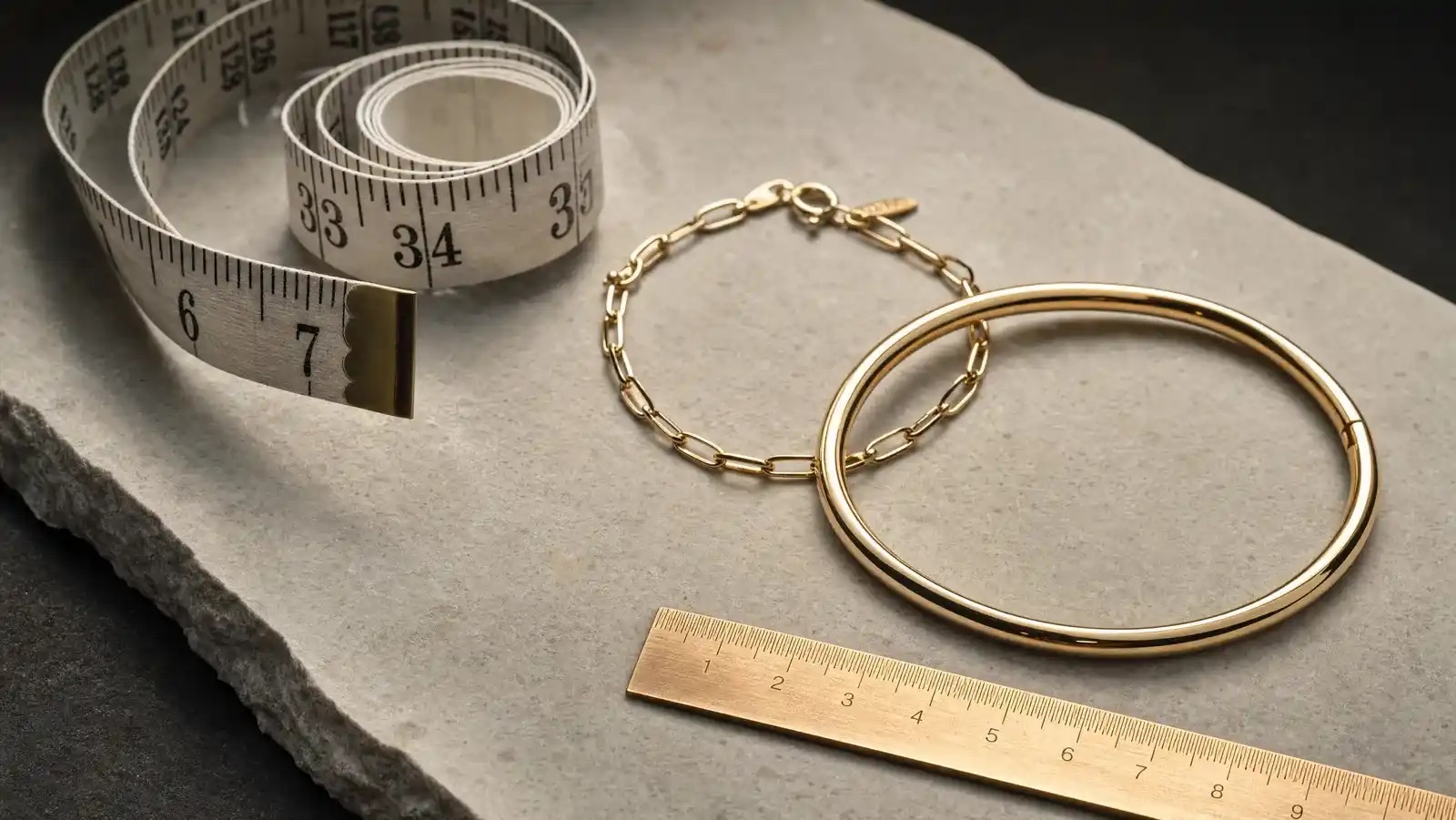
Getting the right ring size is crucial—especially for surprise proposals. A ring that's too tight won't fit over the knuckle, while one that's too loose risks slipping off. Fortunately, you can accurately measure ring size at home using simple methods, even without your partner's knowledge.
This guide covers every technique for finding the perfect fit, whether you're measuring yourself or secretly determining someone else's size. For complete engagement ring guidance, see our engagement ring guide.
Average Ring Sizes
Before measuring, it helps to know typical sizes:
| Gender | Average Size | Common Range |
|---|---|---|
| Women | 6 | 4-8 |
| Men | 9 | 8-12 |
These averages provide a starting point, but individual sizes vary significantly based on finger shape, knuckle size, and hand structure.
Method 1: String or Paper Strip
The most accessible method using materials you already have.
What You Need
- String, ribbon, or a strip of paper (about 6 inches long)
- A pen or marker
- A ruler with millimeter measurements
Steps
-
Wrap the string around the base of the ring finger (left hand for engagement rings). Position it where the ring will sit—below the knuckle but above the finger's base.
-
Pull snugly but not tight. The string should compress the skin slightly without cutting in. You need the ring to slide over the knuckle, so don't pull too tight.
-
Mark where the string overlaps. Use a pen to mark both where the string meets and where it wraps to.
-
Lay flat and measure. Measure the length between your marks in millimeters.
-
Find your size. Use the conversion chart below.
Circumference to Ring Size Chart
| Circumference (mm) | US Size | UK Size |
|---|---|---|
| 44.2 | 3 | F |
| 45.5 | 3.5 | G |
| 46.8 | 4 | H |
| 48.0 | 4.5 | I |
| 49.3 | 5 | J |
| 50.6 | 5.5 | K |
| 51.9 | 6 | L |
| 53.1 | 6.5 | M |
| 54.4 | 7 | N |
| 55.7 | 7.5 | O |
| 57.0 | 8 | P |
| 58.3 | 8.5 | Q |
| 59.5 | 9 | R |
| 60.8 | 9.5 | S |
| 62.1 | 10 | T |
| 63.4 | 10.5 | U |
| 64.6 | 11 | V |
| 65.9 | 11.5 | W |
| 67.2 | 12 | X |
Tips for Accuracy
- Measure 3-4 times throughout the day (fingers change size)
- Measure when hands are warm (cold shrinks fingers)
- If between sizes, round UP
Method 2: Existing Ring Measurement
If you have a ring that fits the intended finger, this method is the most accurate.
Option A: Use a Ring Sizer Chart
- Borrow a ring your partner wears on their left ring finger
- Place it on a printable ring sizer (available from Blue Nile, Brilliant Earth, and James Allen)
- Match the inside edge of the ring to the circles
- Note the size where it fits best
Important: Measure the INSIDE diameter, not the outside.
Option B: Measure the Diameter
- Place the ring on a flat surface
- Measure the inside diameter in millimeters using a ruler
- Use the conversion chart:
| Inner Diameter (mm) | US Size |
|---|---|
| 14.1 | 3 |
| 14.5 | 3.5 |
| 14.9 | 4 |
| 15.3 | 4.5 |
| 15.7 | 5 |
| 16.1 | 5.5 |
| 16.5 | 6 |
| 16.9 | 6.5 |
| 17.3 | 7 |
| 17.7 | 7.5 |
| 18.1 | 8 |
| 18.5 | 8.5 |
| 19.0 | 9 |
| 19.4 | 9.5 |
| 19.8 | 10 |
| 20.2 | 10.5 |
| 20.6 | 11 |
| 21.0 | 11.5 |
| 21.4 | 12 |
Borrowing Tips
- Borrow when they're sleeping or in the shower
- Trace the ring on paper if you can't take it
- Take it to a jeweler for professional measurement
- Note which finger the ring fits—sizes vary by finger
Method 3: Printable Ring Sizers
Many jewelers offer free printable ring sizers that work like a belt, wrapping around your finger with numbered markings.
Where to Get Them
- Blue Nile: Free printable sizer kit
- Brilliant Earth: Downloadable ring sizer
- James Allen: Print-at-home option
- Amazon: Physical plastic ring sizers ($3-8)
How to Use
- Print at 100% scale (do not scale to fit)
- Verify scale using the measurement check on the printout
- Cut out the sizer
- Wrap around finger and read the size where it overlaps
Printing Tips
- Disable "fit to page" in print settings
- Print on regular paper (card stock too stiff)
- Verify the test measurement on the printout matches a ruler
Method 4: Professional Sizing
The most accurate method—visit a jeweler.
What to Expect
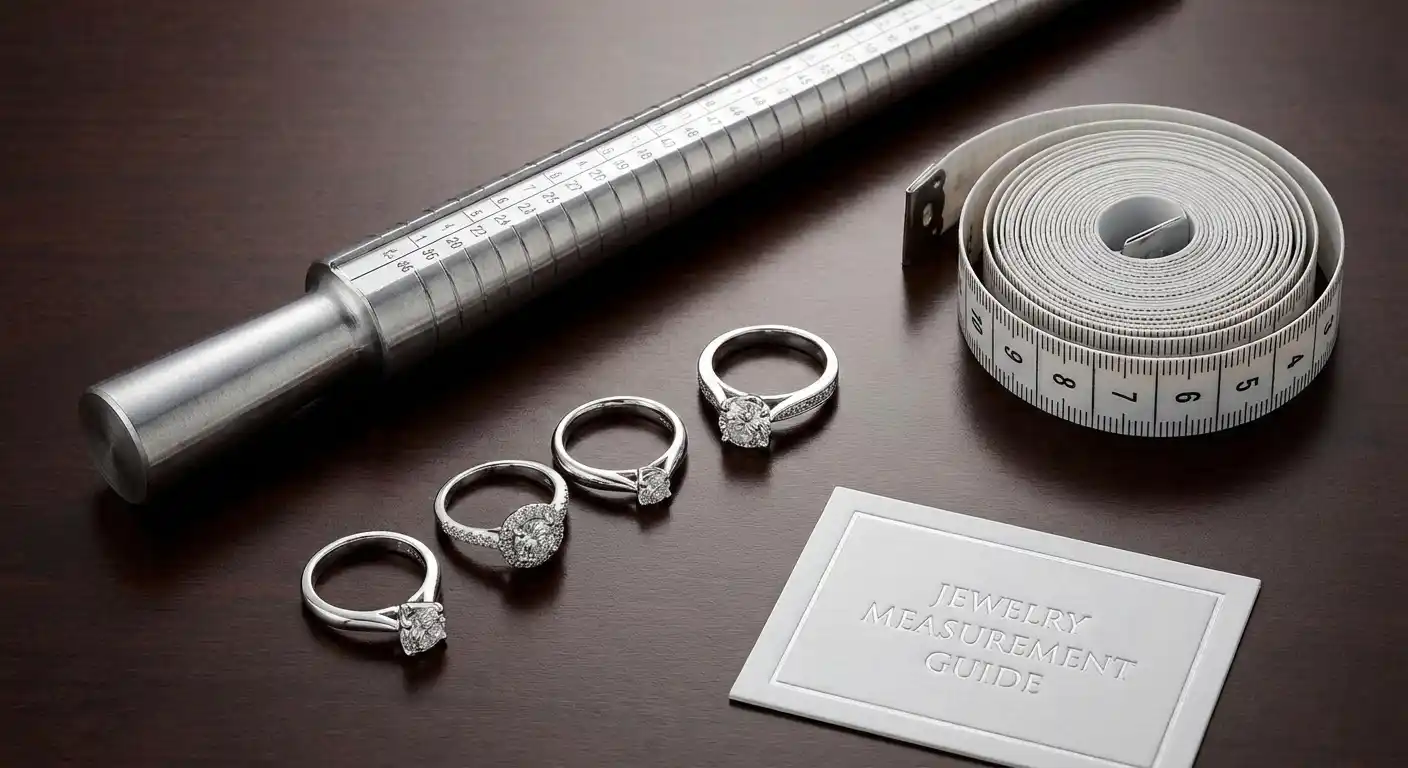
A jeweler will use a ring mandrel (graduated metal cone) or finger gauges (set of sizing rings) to determine your exact size. The process takes about 5 minutes and is usually free.
Benefits
- Most accurate method
- Accounts for knuckle size
- Jeweler can advise on band width impact
- Professional recommendation
Finding a Jeweler
Most jewelry stores offer free sizing:
- Chain jewelers (Kay, Zales, Jared)
- Local independent jewelers
- Department store jewelry counters
Secret Sizing for Proposals
Planning a surprise? Here's how to determine ring size covertly:
Strategy 1: Borrow a Ring
The most reliable method. Take a ring they wear on their left ring finger:
- While they're sleeping
- During a shower
- Take it to a jeweler for quick measurement
- Trace it on paper if you can't take the actual ring
Strategy 2: Ask Friends/Family
Someone close might already know, or can help find out:
- Mother or sister may know
- Best friend might have this information
- Someone can "try on rings" with them as cover
Strategy 3: Ring Box Impression
Press one of their rings into soap, clay, or dough to create an impression. Take this to a jeweler.
Strategy 4: Compare to Your Own Finger
Have them try on one of your rings "for fun." Remember which of your fingers it fits, then get that finger sized.
Strategy 5: Craft Store Trick
Go ring shopping together at a craft store for costume jewelry. Note which sizes fit when they try things on.
Strategy 6: Measure While Sleeping
Very carefully wrap string around their ring finger while they sleep. Mark and measure.
Factors That Affect Ring Size
Understanding these variables helps ensure accuracy:
Time of Day
Fingers swell throughout the day due to fluid accumulation.
- Smallest: Early morning
- Largest: Evening
- Best time to measure: Afternoon
Temperature
- Cold: Fingers shrink
- Hot/humid: Fingers swell
- Recommendation: Measure at normal room temperature
Activity Level
- Exercise: Temporarily increases finger size
- Salt intake: Causes fluid retention and swelling
- Recommendation: Measure on a typical day
Dominant Hand
Your dominant hand is slightly larger. If measuring yourself, ensure you measure the correct hand for ring wear (usually left for engagement rings).
Knuckle Size
Some people have large knuckles relative to their finger base. The ring must fit over the knuckle but stay secure at the base.
For large knuckles:
- Choose a slightly larger size
- Consider adjustable ring settings
- Spring inserts can help (added after purchase)
Band Width Considerations
Wider bands fit tighter than narrow bands. The metal pushes more flesh aside.
| Band Width | Size Adjustment |
|---|---|
| Under 3mm | No adjustment |
| 3-5mm | Consider half size up |
| 6mm+ | Size up half to full size |
If you're purchasing a wide wedding band to pair with a thin engagement ring, you may need different sizes.
What If You Get the Wrong Size?
Don't panic—most rings can be resized:
Easy to Resize
- Simple solitaires
- Plain bands
- Most gold and platinum rings
- Rings without stones all around
Difficult to Resize
- Eternity bands (diamonds all around)
- Tension settings
- Tungsten, titanium (usually cannot be resized)
- Intricate vintage settings
- Rings with patterns covering the entire band
Resizing Limits
Most rings can be adjusted 1-2 sizes up or down. Larger adjustments may require a new ring.
Cost
Resizing typically costs $25-75 for simple adjustments, more for complex work.
International Size Conversions
Different countries use different sizing systems:
| US | UK | EU | Japan | Australia |
|---|---|---|---|---|
| 5 | J | 49 | 9 | J |
| 5.5 | K | 50 | 10 | K |
| 6 | L | 51 | 11 | L |
| 6.5 | M | 52 | 12 | M |
| 7 | N | 54 | 13 | N |
| 7.5 | O | 55 | 14 | O |
| 8 | P | 57 | 16 | P |
| 8.5 | Q | 58 | 17 | Q |
| 9 | R | 59 | 18 | R |
| 9.5 | S | 60 | 19 | S |
| 10 | T | 62 | 20 | T |
Common Mistakes to Avoid
1. Measuring at the Wrong Time
Measure in the afternoon when fingers are at average size—not first thing in the morning or late at night.
2. Pulling String Too Tight
The string/paper should be snug but allow a piece of paper to slide under. Too tight = too small ring.
3. Wrong Finger
Engagement rings go on the left hand ring finger. Each finger is a different size.
4. Ignoring Knuckles
The ring must slide over the knuckle. If knuckles are large, size for them.
5. Scaling Printed Sizers
Always print at 100% and verify the scale check. Printers often resize.
6. One-Time Measurement
Measure multiple times across different days for consistency.
7. Forgetting Band Width
Wide bands fit tighter—account for this in sizing.
Frequently Asked Questions
How accurate is the string method?
When done correctly, within half a size. Measure multiple times and round up if between sizes.
What if my partner never wears rings?
Try the indirect methods: ask family, the craft store trick, or measure while sleeping. When truly impossible, buy a common size (6 for women, 9 for men) and plan to resize.
Can all rings be resized?
Most metal rings can be adjusted 1-2 sizes. However, eternity bands, tungsten/titanium, and tension settings may be difficult or impossible to resize. Ask before purchasing.
How tight should an engagement ring fit?
It should slide over the knuckle with slight resistance and sit comfortably at the base. It shouldn't spin freely or leave deep marks.
Do fingers change size over time?
Yes. Weight changes, pregnancy, aging, and health conditions can affect finger size. This is why resizing services exist.
Should I size up or down if between sizes?
Size up. A slightly loose ring is more comfortable and can use a size adjuster. A too-tight ring won't fit over the knuckle.
Ready to Shop?
Once you know your size, explore our engagement ring guides:
- Complete Engagement Ring Guide — Everything you need
- Best Engagement Rings Under $1000 — Budget options
- Engagement Ring Settings Guide — Setting types
- Diamond Shapes Guide — Find your cut
- Lab-Grown vs Natural Diamonds — Compare options
About the Author
Alfreda Borror
Alfreda Borror is the founding editor of Opulent Opal, writing research-based buying guides on diamonds, birthstones, and fine jewelry.