Necklace Chain Repair: Costs, Options & When to Replace

This post may contain affiliate links. Read our affiliate policy
A chain rarely fails in the middle. It fails at the small ring beside the clasp, or inside the clasp itself, usually while a sweater is coming off over your head. The useful thing to know is that necklace chain repair is one of the cheaper jobs on a jeweler's bench. The frustrating thing is that on some chains it costs more than the chain is worth, and on a few it cannot be done invisibly at all.
Below: what each break costs, what a bench jeweler can and cannot fix, and the arithmetic for choosing repair or replacement. If you are leaning toward buying new, our necklace chain guide covers construction, gauge, and metal.
Table of Contents
- First, Find Out What Actually Broke
- What Necklace Chain Repair Costs
- Solder vs Laser Welding
- Chains That Are Hard or Impossible to Repair
- Repair or Replace: The Arithmetic
- Where to Get Necklace Chain Repair Done
- Should You Try to Fix It Yourself
- How to Stop It Breaking Again
- The Bottom Line
- FAQ
First, Find Out What Actually Broke
Lay the chain flat under good light and identify the failure before you find a jeweler. Five things break, each at a different price. Start at the clasp end, where handling and load concentrate.
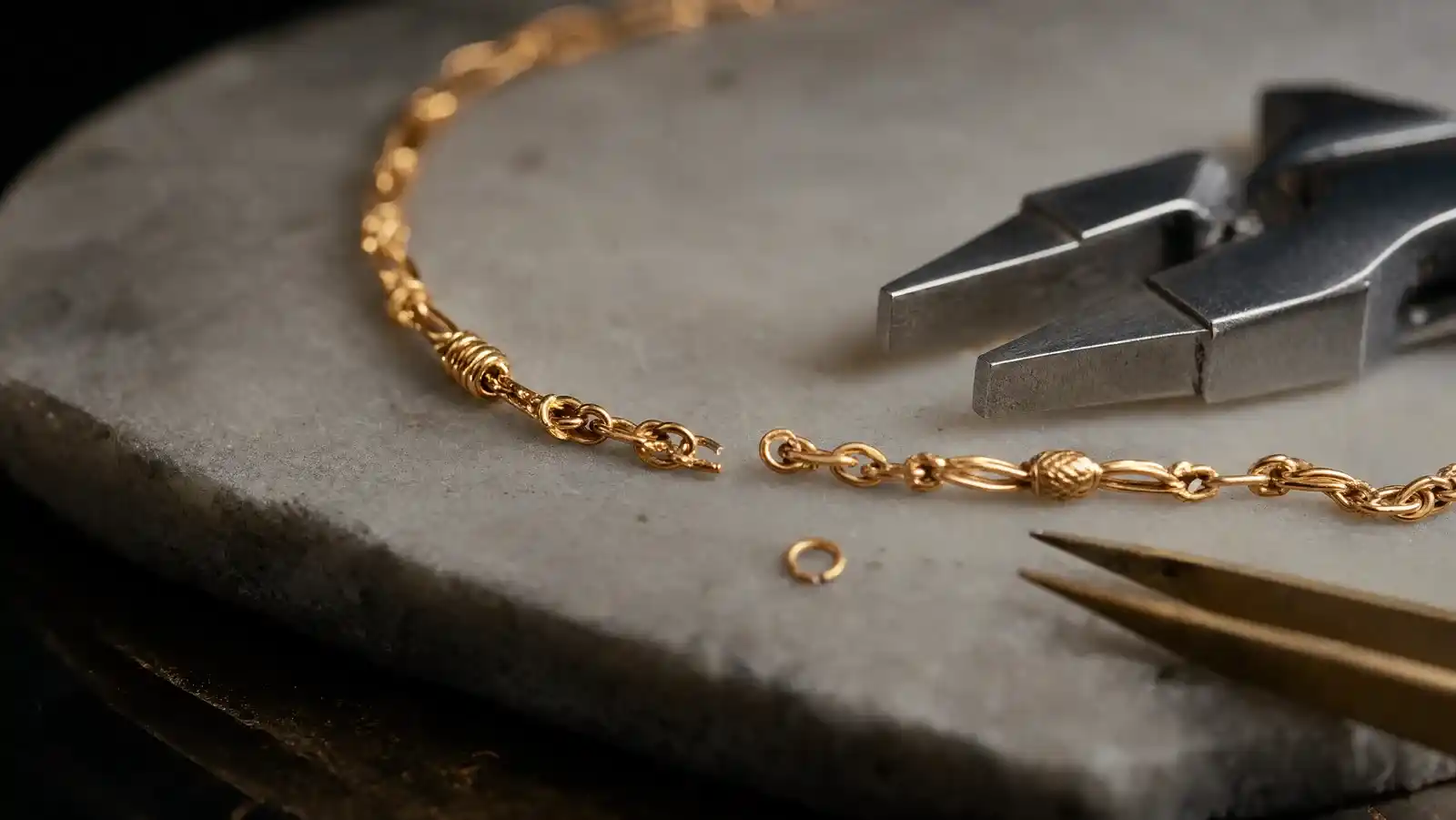
- A pulled-open jump ring. The jump ring is the small circle of wire joining the clasp, or a pendant bail, to the chain. It is often not soldered closed, so it springs open under load. Cheapest failure there is.
- A dead clasp. The gate no longer springs shut, but the chain is fine. What you replace it with matters more than most people expect, and our guide to necklace clasp types covers how each style fails.
- A snapped joint at the clasp end. The last link tore open, or an older repair let go.
- A broken link mid-chain. Less common, and likelier on hollow or fine-gauge chains.
- A kink or crease. Flat constructions like herringbone and snake do not break so much as fold. Different problem, covered below.
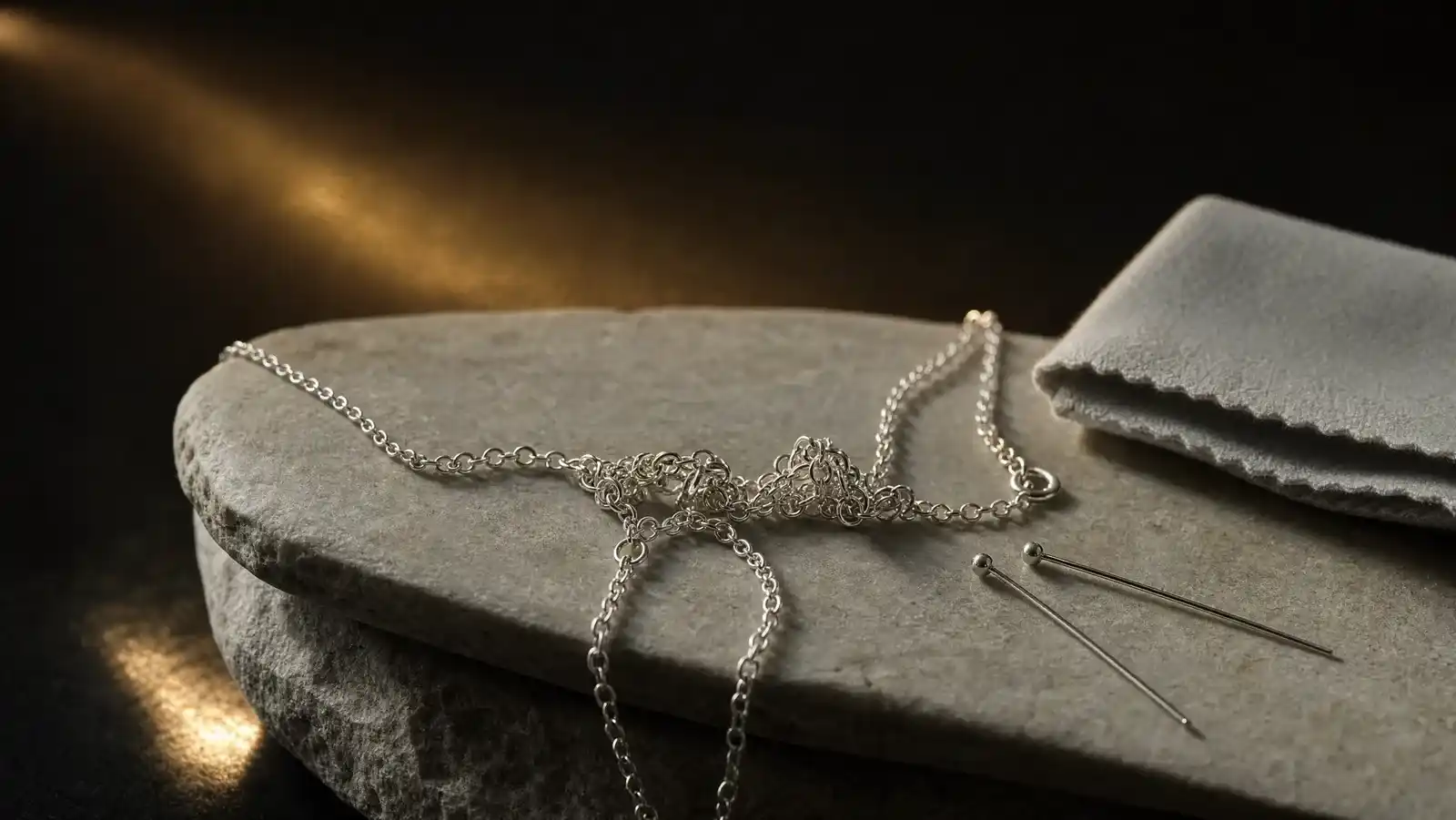
One thing that is not a break: a knot. If the metal is intact and the chain is simply seized up on itself, use our method to untangle a necklace chain first. Handing a tangled but sound chain to a shop invites a repair you did not need.
What Necklace Chain Repair Costs
According to Long's Jewelers, necklace chain repair generally runs $30 to $230, depending on the metal and where the break sits. Simple work sits at the bottom of that band; new clasps, new gold, and refinishing climb quickly.
The price ranges below are published figures from Long's Jewelers and Quick Jewelry Repairs, not what your shop will charge. The turnaround column is indicative rather than quoted, except where noted. Rates vary by region, by karat (gold purity, as in 10k, 14k, 18k), by torch versus laser, and by whether the piece needs replating.
| Repair | Published range | Typical turnaround |
|---|---|---|
| Solder one broken link | From $30 gold, $35 platinum | Same day to 3 days |
| Rope chain solder | At least $20 above the average chain repair | Longer |
| Repair an existing clasp | $30 to $40 | 1 to 3 days |
| New gold spring ring, 5mm | About $30 | 1 to 3 days |
| New lobster clasp | $65 to $250 by size and metal | 1 to 3 days |
| Jump ring soldered closed | From $29 | Often 1 day |
| Shorten a chain | $30 to $35, plus $20 or more for thick curb or Cuban | 1 to 3 days |
| Lengthen a gold chain with matching links | From $290 | A week or more |
| Flash plating afterward | About $80, or $200 and up for a 20-inch Cuban | 1 to 5 days |
Refinishing is the hidden line. The bright white surface on white gold is rhodium, a thin plating over a yellowish alloy. Heat and polishing at the joint remove it, so the piece often needs replating to look uniform. Quick Jewelry Repairs puts flash plating, a thin cosmetic layer, at about $80 for a regular chain. On a $150 necklace, that one line changes the calculation.
Solder vs Laser Welding
Two methods rejoin metal at the bench, and which one your shop owns changes both the price and what is possible.
Soldering flows a filler alloy into the joint with a torch. According to LaserStar, a laser systems manufacturer, it is a capillary process in which solder, an alloy formulated to melt below the host metal's melting point, bridges the two pieces. Fast, cheap, the default. It also heats a wide area, which is the source of its limits.
Laser welding fires pulses of light at a very small spot and fuses the metal to itself. LaserStar describes the result as "all one alloy" rather than two metals bridged by a third, with a minimal heat-affected zone in which the adjacent metal never becomes molten. The same source claims a good laser weld is three times as strong as the surrounding virgin metal and 260 times stronger than a solder joint. That comes from a company selling laser welders, so treat the multiplier as marketing.
The practical advantage is heat control. LaserStar notes a laser can work close to pearls, enamel, epoxy, and stringing thread without affecting them, while torch work forces a jeweler to remove those elements or shield them. That is the argument for laser on a pearl-strand clasp or anything with an opal or emerald near the joint.
Laser costs more: Laser MaxWave, another equipment maker, quotes roughly $60 to $120 in precision labor against $30 to $50 for a conventional solder. Read that as a vendor's illustration, but the gap matches what shops describe. Laser is the option to ask for on hollow chains, plated pieces, and heat-sensitive stones.
Chains That Are Hard or Impossible to Repair
What survives a repair is mostly a function of how the chain was built. Our guide to the types of necklace chains covers the constructions; here is how they behave on the bench.
Hollow chains. Hollow rope and hollow Cuban links are thin metal tubes with air inside, which is how a wide chain stays light. According to Quick Jewelry Repairs, whose example is rope, the design is "empty on the inside of the links," so "the item will be 'crushed' at the spot where the jeweler works," and "the repair is not strong and may not withstand daily wear." Stuller's bench guide to hollow rope adds a trap: "The solder pick works as a heat sink when repairing hollow rope chains. This causes the chain to overheat, and when the solder pick is removed the solder flows farther than you intended."
Herringbone. Quick Jewelry Repairs states that herringbone chains are "almost done for if they are broken," because if the chain is snagged it "unravels" the entire structure, "the areas of work will be very visible," and the links are "usually very thin slices of metal" that "once they're bent it's near-impossible to hammer them back." Van Adams Jewelers describes a herringbone as something everyday handling can leave "permanently creased." Jewelry Notes adds that having the damaged segment cut out and the chain rejoined leaves a joint that "will remain less flexible than the rest of the chain, and the necklace will twist more easily around that spot."
Snake chains. Same physics: tightly fitted plates over a flexible core. Straighten a fold and you leave a weak spot that folds again.
Plated chains. Quick Jewelry Repairs says repair work "removes that plating, exposing the original color of the metal underneath." Replating the whole piece often costs more than the necklace did.
Gold-filled chains. Gold-filled is a bonded layer of karat gold over a brass core. Halstead, a jewelry supply house, warns that torch soldering can alloy the gold layer into the brass core at the point of heat, leaving a dark, discolored join, and that any exposed brass will tarnish faster than the metal around it. Their remedy is to plate the entire piece in gold afterward so the join matches.
Mystery metal. Quick Jewelry Repairs notes that on brass, bronze, and copper the repaired area "won't match the rest of the chain" and the metal may "melt or burn." Stainless is repairable but slow: "a week or more."
Very fine gauges. Thin cable and box chains give a jeweler little to grip and little metal to absorb heat. Repairable, but the labor outweighs the chain's value.
Repair or Replace: The Arithmetic
Our working rule: get a written quote, then compare it to an equivalent new chain. Under about a third of replacement cost on a solid precious-metal chain, repair. Over half, you are buying a used chain at retail.
Four things move it. Solid or hollow: solid gold holds recoverable metal value and takes a clean repair that can be redone later. Break count: a first break is bad luck, a third in two years means the gauge is too light. Refinishing: add replating to the quote before comparing. Sentiment: if the chain came from someone who is gone, the arithmetic does not apply.
| Situation | What we'd do |
|---|---|
| Solid gold or platinum, one clean break | Repair |
| Solid chain, third break in two years | Replace, heavier gauge |
| Broken clasp only, chain sound | Replace the clasp |
| Hollow rope or box, break mid-chain | Quote it, expect visible work, lean replace |
| Herringbone or snake with a kink | Replace |
| Gold-filled | Clasp or jump ring only, no torch |
| Plated or unmarked metal | Replace, or fit a new clasp |
| Heirloom or sentimental piece | Repair, ask for laser |
The same logic runs across fine jewelry, and we work through it in more depth in our guide on when to repair versus replace a ring. One exception: if the chain is not broken but gone, that is an insurance question rather than a repair question.
Where to Get Necklace Chain Repair Done
Independent bench jeweler. Best mix of price, speed, and accountability, because the person quoting the job often does it. Ask one question at the counter: is the bench on the premises?
Mall chain stores. Convenient, but most ship work out. Longer turnaround, and a quote from someone who has not inspected the chain.
Mail-in specialists. A real option with no good local bench. Quick Jewelry Repairs quotes roughly 7 to 10 business days from receipt; My Jewelry Repair advertises 3 to 5 business days once a quote is approved. Insure the package both ways.
The original retailer. Check the warranty first. Some are voided by third-party repair, and a clasp that failed inside the period may be free.
A written quote should list the exact work, the method (torch or laser), whether replating is included, the turnaround, and what happens if the same joint fails again. On solid gold, ask the shop to record weight in and weight out.
Should You Try to Fix It Yourself
Sometimes, for a narrow set of jobs.
Reasonable at home: swapping a clasp or jump ring on an inexpensive chain with two pairs of flat-nose pliers. The technique that matters is opening a jump ring by twisting the ends sideways past each other rather than pulling them apart, which keeps the ring round so it closes flush.
Not reasonable at home: soldering anything. A torch on a chain you cannot identify is how a $40 problem becomes a melted chain. Keep hands off if the piece is solid gold, hallmarked, hollow, gold-filled, plated, strung with pearls or soft stones, or of any sentimental weight. Skip the glue, too: many jewelers ask that adhesive never go near a chain, because the residue has to be cleaned off before a proper joint can be made.
How to Stop It Breaking Again
- Buy gauge. The best predictor of survival is how much metal is in the chain. Our necklace chain thickness guide covers which widths hold up under a pendant and where hollow construction stops making sense.
- Solid over hollow for anything worn daily or paired with a heavy pendant.
- Upgrade the clasp. A larger lobster claw on a soldered jump ring outlasts a small spring ring on the same chain.
- Take it off for sleeping, the gym, and anything with a collar coming over your head.
- Have the clasp checked whenever the chain is cleaned. A jump ring that has started to open is a two-minute fix before it is a lost pendant.
- Store it hung or flat, not coiled in a dish. Tangles create the yanking that breaks links.
A repair is not a reset. Jewelry Secrets puts it bluntly: break anything into two pieces and put it back together and "it will always be weaker in those areas." On flat chains the same site describes the mechanism — once soldered, the chain is "stiff in that soldered area which will cause the chain on either side of the solder to bend and kink as well." An argument for laser on a chain you intend to keep, and a better one for buying enough gauge the first time.
The Bottom Line
Most broken chains are a $30 to $50 problem, fixed in a day or two by a bench jeweler working on site. The exceptions are worth memorizing: hollow, plated, gold-filled, herringbone, snake, and unmarked metal. There the repair is visible, weak, or dearer than the chain, and replacement is the rational move rather than the lazy one.
Find the failure, get it in writing, add refinishing to the quote, and compare it to buying new. If the numbers point to new, put the money into gauge rather than length, and read our notes on choosing a stronger necklace chain first.
FAQ
How much does it cost to fix a broken necklace chain?
According to Long's Jewelers, chain repair generally runs $30 to $230 depending on metal and break location, with a single soldered link starting near $30 in gold and $35 in platinum. Quick Jewelry Repairs prices extra break points at $5 to $10 each. Prices vary by shop and region.
Can a broken chain be repaired invisibly?
On a solid chain in a simple construction, usually. On hollow rope, herringbone, and plated chains, Quick Jewelry Repairs states the repaired area will be visible, because the chain is crushed where the jeweler works or the plating is stripped at the joint.
Can you solder a hollow chain?
Yes, with caveats. Quick Jewelry Repairs describes hollow chains as crushed at the work site, with a repair that "is not strong and may not withstand daily wear." Stuller adds that a solder pick acts as a heat sink on hollow rope, causing the chain to overheat so "the solder flows farther than you intended." Ask whether the shop can laser weld instead.
Is it worth repairing a plated chain?
Rarely. According to Quick Jewelry Repairs, the repair strips the plating and exposes the base metal, so an acceptable result means replating the whole chain, which the same shop prices at about $80.
How long does necklace chain repair take?
Quick Jewelry Repairs describes a reattachment near the clasp as a one-day job and a pearl necklace clasp replacement as about three days, and notes stainless can take a week or more. Mail-in runs longer: the same service quotes 7 to 10 business days from receipt, and My Jewelry Repair advertises 3 to 5 business days after quote approval.
Is a repaired chain weaker than it was?
At the joint, generally yes with solder. Jewelry Secrets says any object broken and put back together "will always be weaker in those areas," and that on a soldered flat chain the stiff repaired area "will cause the chain on either side of the solder to bend and kink as well." LaserStar, a laser equipment maker, claims a laser weld is stronger because it fuses the host alloy to itself rather than bridging it with a filler.
About the Author
Alfreda Borror
Alfreda Borror is the founding editor of Opulent Opal, writing research-based buying guides on diamonds, birthstones, and fine jewelry.