How to Untangle a Necklace Chain Without Damaging It

This post may contain affiliate links. Read our affiliate policy
The knot in your hand is almost certainly not a knot. It is a loop that slipped through another loop, and it will fall open on its own terms given a flat surface, a lubricant, and ten quiet minutes. Learning how to untangle a necklace chain is mostly learning what not to do, because the damage that lands chains on a jeweler's bench often comes from the rescue attempt rather than the tangle.
Below: the rules before you touch it, the pin-and-lubricant procedure, safe lubricants by material, and the constructions that never recover from being forced. Still deciding what to buy? Our guide to necklace chains covers construction and durability.
Table of Contents
- Before You Pull: Three Rules
- How to Untangle a Necklace Chain: The Method
- What to Use as a Lubricant
- Chains That Should Never Be Forced
- How to Untangle a Necklace Chain When It's Two or Three at Once
- When to Stop and Take It to a Jeweler
- How to Stop Chains Tangling in the First Place
- What We'd Do
- FAQ
Before You Pull: Three Rules
1. Never pull the two ends apart. It is the reflex, and the most expensive move available. Tension cinches every loop tighter and dumps the load onto whichever link is bent hardest. According to Quick Jewelry Repairs, aggressive pulling "can stretch out delicate chains or even break them." A stretched link — one ring, oval, or plate in the chain — does not go back.
2. Work on a hard, flat, light-colored surface. Not your lap, not a bed. Fabric grips the chain, hides the loops you need to see, and swallows a dropped clasp. Borsheims' untangling guide lists the basic supplies as a flat surface, a clean cloth, sewing needles or straight pins, baby oil or lubricant, and "most importantly, patience."
3. Open the clasp. With a free end you can slide loops off the chain instead of forcing them through it, which is often the entire solution. The reverse holds in storage: Quick Jewelry Repairs warns that an open clasp "allows the necklace to more easily twist around itself," so re-clasp the chain before it goes back in the box.
How to Untangle a Necklace Chain: The Method
- Set up. Hard flat surface, light cloth, the brightest light in the house, magnification if you own a loupe.
- Open the clasp and spread the chain flat. More often than not this reveals one pinched loop and a pile of slack.
- Find the loosest loop, not the tightest knot. Every loop you open feeds slack to the ones beneath it.
- Add a drop of lubricant to the knot only. A drop, not a puddle; which one depends on your chain.
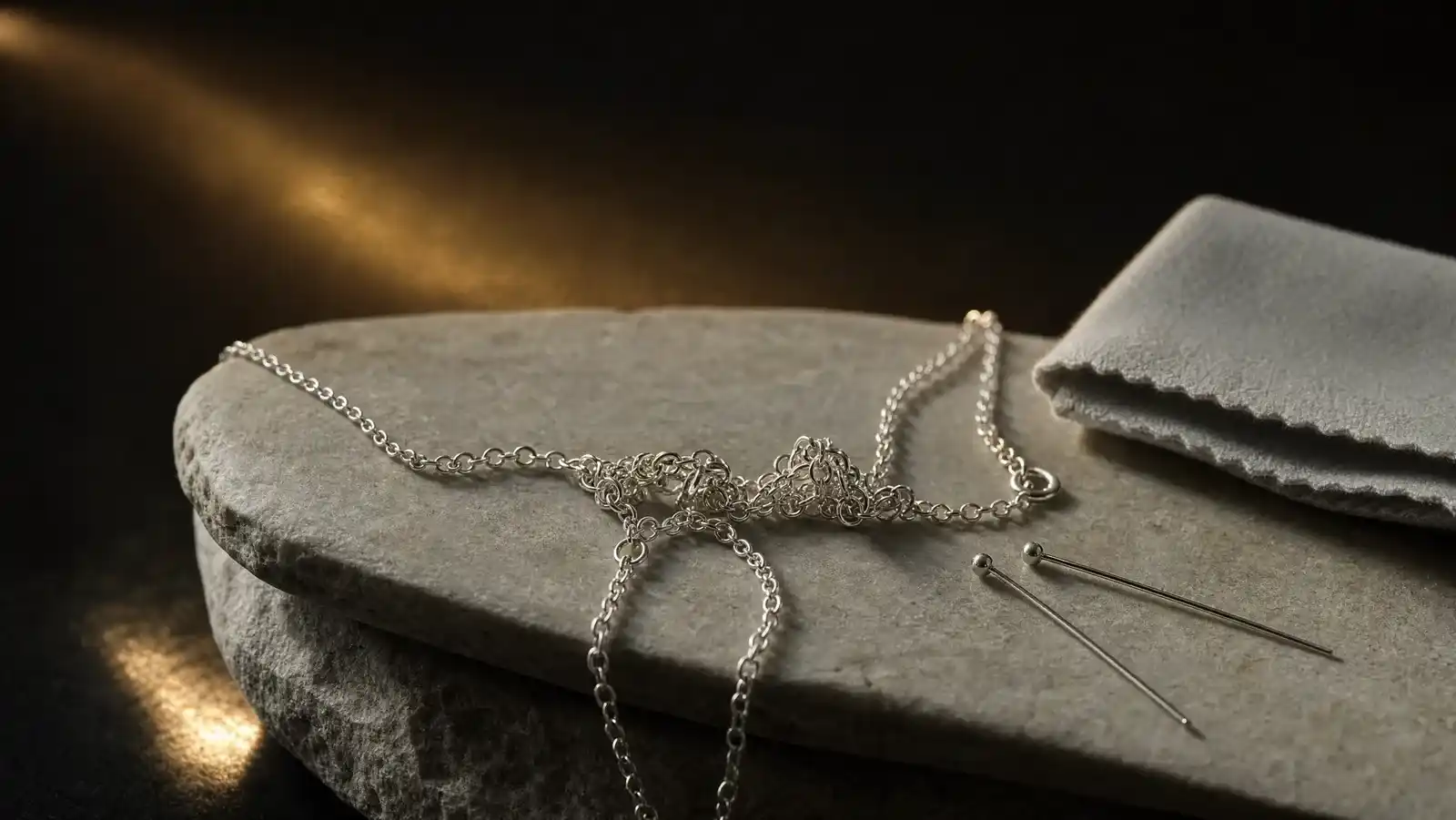
- Use two straight pins or sewing needles. According to jewelry retailer Eternz, pins work because they "fit into the smallest gaps in the chain links," letting you work a knot surgically instead of by force. The same guide suggests wooden toothpicks on delicate gold.
- Widen, never lever. Slide a pin into the loosest loop and pull outward to open it, then walk the crossing strand out with the second pin. Never brace a pin against a link and twist — that is how a round link becomes an oval one.
- Re-spread every thirty seconds. Lift, let it hang, lay it flat again. Tangles collapse in steps.
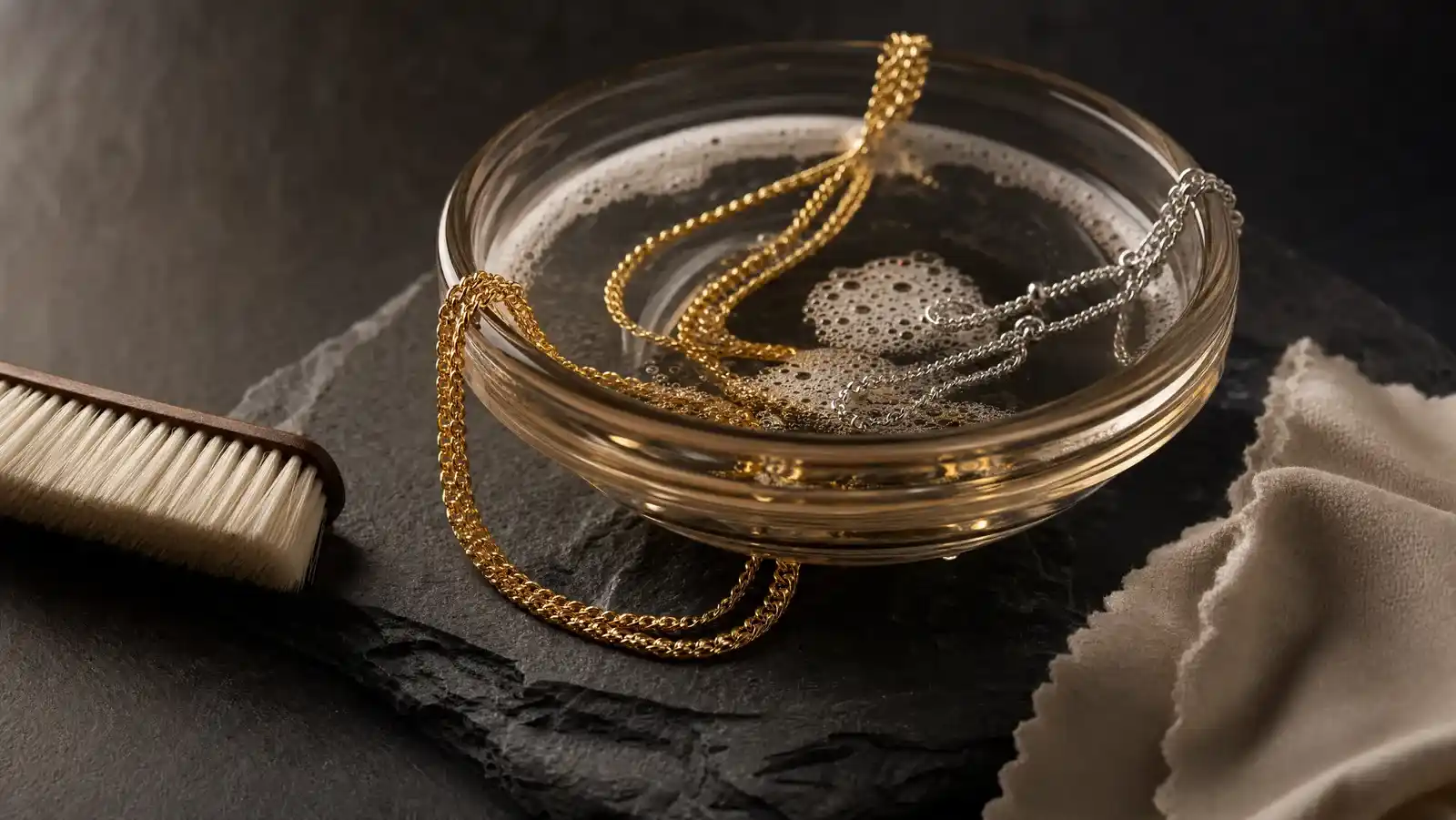
- Wash the oil off. Jack Weir & Sons advises removing oil with warm soapy water as soon as the knot is out; our guide to cleaning gold, platinum and silver at home has the metal-by-metal detail.
Expect minutes, not seconds — five to twenty is normal for a fine chain, and Borsheims warns that "rushing the process may lead to more knots or, worse, breakage." Stop if a link no longer matches its neighbors, if the chain develops a stiff spot, or if twenty minutes buys nothing.
What to Use as a Lubricant
The lubricant does the work, not your fingers.
Baby powder or cornstarch — safest general choice. Eternz describes powder as "a dry lubricant that coats the metal and allows links to slide past one another," and rates it safe for all metals with an easy rinse. This is our default for anything plated.
Baby, mineral, or olive oil — most effective, messiest. Eternz describes oil as giving the "maximum amount of lubrication possible" via a slippery film that lets links "slide apart with almost no effort," rating it safe for most materials but advising you avoid it "on porous stones like turquoise." We would use it on a bare gold or silver chain with no stones, and nowhere else. Mild soapy water is the low-mess alternative.
Glass cleaner — the sources genuinely disagree. REEDS Jewelers says diamond jewelry can be "soaked overnight in an ammonia based household cleaner like Windex" — though the same page calls ammonia "particularly harmful" to metals and rules out ammonia-based cleaners on opals and pearls. Robinson's Jewelers goes further, warning that "the ammonia and other chemicals in Windex can be too harsh for many precious metals and gemstones," singling out porous stones — opal, pearl, and turquoise — and noting ammonia "can actually cause white gold to yellow and may damage the rhodium plating." Both are defensible: they describe different jewelry. Our read: acceptable on a bare unplated chain, not worth it on anything plated, strung, or set.
Keep oil and cleaner off these
- Pearls and anything strung on silk. Jewelry Carats' care guide is blunt — never submerge pearls in water, because it "damages nacre and silk thread." Oil wicks into drill holes and thread and does not come out. A knotted strand is a job for a stringer.
- Opals, which the same guide notes contain 5 to 10 percent water and can dry out and crack, and emeralds, which it says should never see an ultrasonic cleaner and are best cleaned with a slightly damp cloth.
- Turquoise and other porous or treated stones, which drink whatever you apply.
- Gold-plated and gold-filled chains. BeadifulBABY's care guidance warns that abrasive cleaners and silver polish "can strip or scratch the gold surface"; the same guide puts that layer at "usually less than 0.5 microns." Powder, not scrubbing.
Chains That Should Never Be Forced
Constructions fail in very different ways, which is why it pays to know what you own — covered in our guide to the types of necklace chains.
Herringbone and snake chains barely tangle, and that is the trap. Both are built from flat or closely fitted segments seated tight against their neighbors with almost no slack, which is what produces that liquid surface. It also means a bend cannot spread along the chain the way it does in a cable or rolo — it concentrates in one row and creases. That crease is a kink: a permanent fold where the metal has yielded.
The repair outlook is not encouraging. The jeweler behind Jewelry Secrets describes rolling a kink out with a rounded object such as a pen or a mandrel, but says that afterward "the chain will always be weaker and more fragile in that spot," and that soldering leaves the area stiff, pushing the next kink to either side of the repair. Van Adams Jewelers notes minor bends can sometimes be straightened, while severe kinks may require replacing a section or the whole chain.
Hollow chains are the quiet casualty. Hollow links are tubes: once a wall collapses, nothing inside pushes it back out. Fine gauges compound it, which is why our chain thickness guide matters here.
| Construction | Tangle risk | Behavior under force |
|---|---|---|
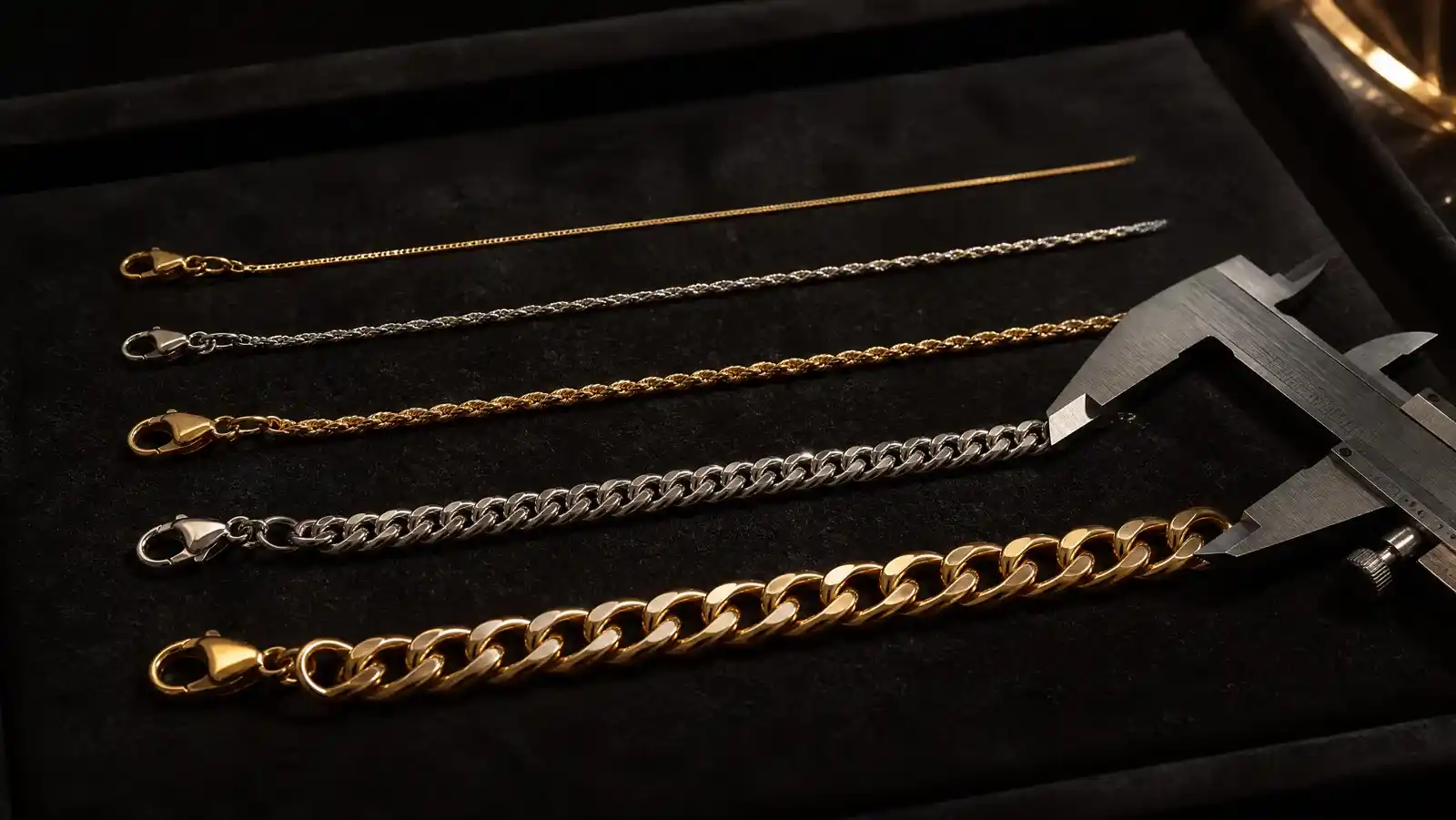
| Fine cable or rolo, under 1mm | High | Threads through its own loops; stretches before it snaps |
| Singapore, twisted curb | High | The twist springs into loops and kinks at the twist |
| Rope, bead or ball chain | Moderate | Self-supporting, but hard to open once cinched |
| Box, and flat heavier curb | Low | Squared or weighty links resist rolling over one another |
| Herringbone and snake | Very low | Rarely tangles; kinks permanently if bent |
How to Untangle a Necklace Chain When It's Two or Three at Once
Several chains knotted together look worse than one and are usually easier: there are more places to introduce slack.
- Separate the pieces before touching any knot. Trace each chain from its clasp, open every clasp, and lay each along its own path. With all ends free, most multi-chain tangles unthread rather than untie.
- Take the outermost piece off first, and pull anything fragile out early — a herringbone, a snake chain, or a strung pearl or bead strand leaves the pile before anyone reaches for pins.
- Then treat each chain individually. A tangle that survives separation is a single-chain tangle.
Layered stacks are the usual source. Quick Jewelry Repairs recommends layering necklaces of different lengths and textures so they stay far enough apart, and placing heavier chains at the bottom — the separation logic behind how to layer necklaces well.
When to Stop and Take It to a Jeweler
Hand it over when you see any of these:
- A kinked link — one link visibly folded, flattened, or out of plane with its neighbors.
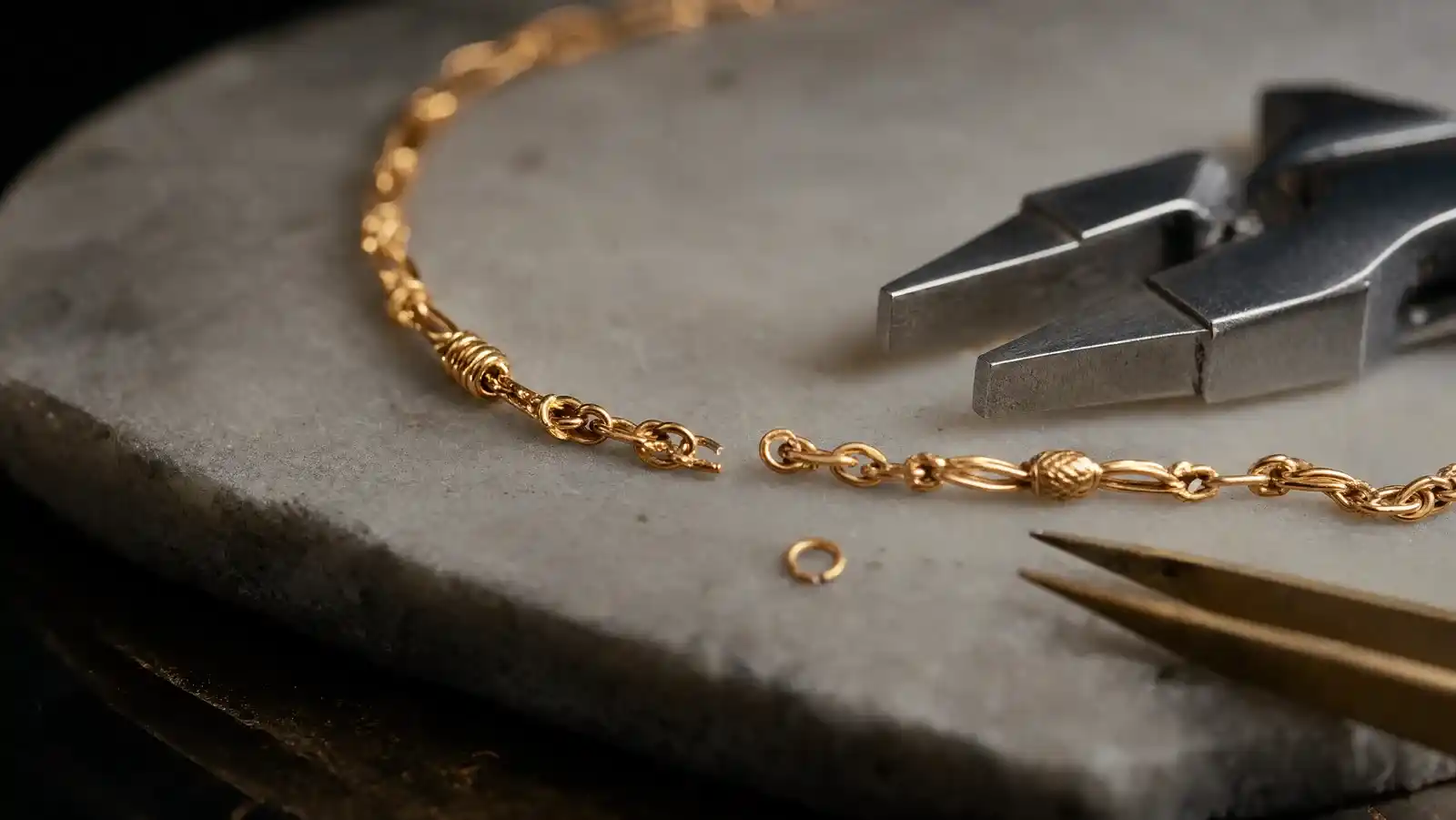
- A stretched or opened jump ring — the small wire ring joining a clasp or pendant bail to the chain, closed by a seam that can spring open.
- A chain that has already parted, at a link or a solder joint.
- Anything strung, knotted, or set with pearls or soft stones.
- Anything with real value. Borsheims advises that for an intricate, valuable, or heirloom necklace you should "consider seeking help from a professional jeweler."
Untangling itself may cost little — Quick Jewelry Repairs states that they will untangle necklaces when home attempts fail. Repair is a different line item. Robinson's Jewelers' published repair price guide puts soldering a simple broken link at "$25 - $65," a snapped herringbone or rope chain at "$75 - $200+," and a replacement clasp at "$30 - $150+." Treat those as orientation, not a quote: prices vary by region, shop, and metal. Our necklace chain repair guide covers what each job involves.
How to Stop Chains Tangling in the First Place
Tangling is physics, not carelessness. In a 2007 study published in the Proceedings of the National Academy of Sciences, Dorian Raymer and Douglas Smith tumbled string in a box and found complex knots formed within seconds, and that below a critical length — around 46 centimeters, roughly 18 inches — knots essentially stopped forming. Many chains sit at or above that threshold, and a drawer is a tumbler.
- Hang each chain separately. Quick Jewelry Repairs puts it plainly: necklaces "should ideally be stored hanging to avoid tangling," on a stand, hooks, or a hanging organizer.
- Fasten the clasp before storing. A closed chain has no free end to thread through anything.
- One pouch per piece. Two chains in one compartment is the classic recipe for a knot.
- Keep fine and heavy chains apart. A 1mm strand and a 5mm curb chain in one box is not a fair fight.
- Use the straw trick for travel. Quick Jewelry Repairs lists threading necklaces through plastic drinking straws as a DIY answer to travel tangling. Fasten the clasp outside the straw.
For the wider system — travel cases, humidity, tarnish — see our jewelry storage guide.
What We'd Do
Hard flat surface, good light, clasp open. Powder if the piece is plated or set with anything, oil if it is bare metal. Two pins, loosest loop, outward, never levering against a link. Twenty minutes. If a link has changed shape, or the piece is herringbone, snake, or strung, let a bench jeweler take it. Then fix the storage — and if a piece keeps knotting whatever you do, our necklace chain guide covers which constructions hold up to daily wear.
FAQ
Does baby oil damage a silver chain?
We found no evidence that brief contact with baby oil harms sterling silver, and Borsheims lists baby oil among the basic supplies for this job. The caveat is residue: Jack Weir & Sons advises washing it off with warm soapy water as soon as the knot is out. Skip oil on plated pieces, pearls, and porous stones.
Can a jeweler untangle a chain?
Yes, and it is usually a small job. Quick Jewelry Repairs states that they will untangle necklaces for customers, and Borsheims recommends a professional for intricate, valuable, or heirloom pieces, because bench jewelers have tools for knots that defeat home attempts.
Why do necklaces tangle in a drawer?
Because a drawer agitates them. The Raymer and Smith study in the Proceedings of the National Academy of Sciences found that tumbling a string in a box produced complex knots within seconds once the string exceeded roughly 46 centimeters, as free ends thread through loops in the rest of it.
Can you untangle a ?
Carefully, and without pins or pulling. Herringbone chains rarely tangle; what usually happens is a kink. According to Jewelry Secrets, a jeweler can try rolling a kink out with a rounded object, but "the chain will always be weaker and more fragile in that spot." Van Adams Jewelers notes severe kinks may require replacing a section or the entire chain.
Should you use Windex to untangle a necklace?
Only on bare, unplated metal, and even then it is optional. REEDS Jewelers says diamond jewelry can be soaked overnight in an ammonia-based cleaner like Windex, while the same page calls ammonia "particularly harmful" to metals; Robinson's Jewelers warns its ammonia is too harsh for many metals and stones. Given a disagreement that sharp, we would use powder or mild soapy water instead.
About the Author
Alfreda Borror
Alfreda Borror is the founding editor of Opulent Opal, writing research-based buying guides on diamonds, birthstones, and fine jewelry.