How to Layer Necklaces: Lengths, Spacing & Metal Mixing

This post may contain affiliate links. Read our affiliate policy
Layering looks like a taste problem. It is mostly a geometry problem. Three chains cut within an inch of each other, in the same width and the same weight, occupy the same strip of chest — so they cross, ride up, and braid themselves together by mid-afternoon. Knowing how to layer necklaces starts with putting distance between the strands, not with having a better eye.
Vary the geometry and most of the trouble disappears. Below are the numbers: inches between strands, which length sets stack cleanly, where the pendant belongs, and how to make a gold-and-silver mix read as deliberate. If you are still assembling the chains themselves, start with how to choose a necklace chain and come back here for the styling.
Table of Contents
- How to Layer Necklaces: The Spacing Rule That Does Most of the Work
- Pick a Focal Point, Then Build Around It
- Vary Width and Texture, Not Just Length
- Mixing Metals: The Rules Worth Keeping
- Where the Pendant Goes
- Necklines: What Actually Works With What
- How to Layer Necklaces Without Tangling
- Common Layering Mistakes
- Putting a First Stack Together
- FAQ
How to Layer Necklaces: The Spacing Rule That Does Most of the Work
Leave roughly two inches between strands. That one number solves more layering problems than any styling instinct, because two inches is about the gap at which neighboring chains stop sharing contact points.
Sources do not agree on one figure. Brilliant Earth advises one to two inches between necklaces for clean visual separation, and at least two inches of difference between pieces to reduce contact points. Hamilton Jewelers is more permissive, recommending layering at least half an inch apart while stressing that each piece should vary in length "by a couple of inches." The honest summary: half an inch is the floor, two inches the safe default, three to four inches where layers read as separate statements.
Note the arithmetic trap. A two-inch difference in chain length does not produce a two-inch gap on the body. A necklace hangs as a loop, so as a rule of thumb two extra inches of chain drop the lowest point by roughly one inch; a visible two-inch gap needs about four inches of difference in stated length. For where each size lands, see our necklace chain length guide.
Three starting sets that work
| Set | Lengths | What it looks like |
|---|---|---|
| Tight and modern | 14" / 16" / 18" | Collar, base of neck, just under the collarbone. One deliberate cluster; needs an open neckline, since all three sit high. |
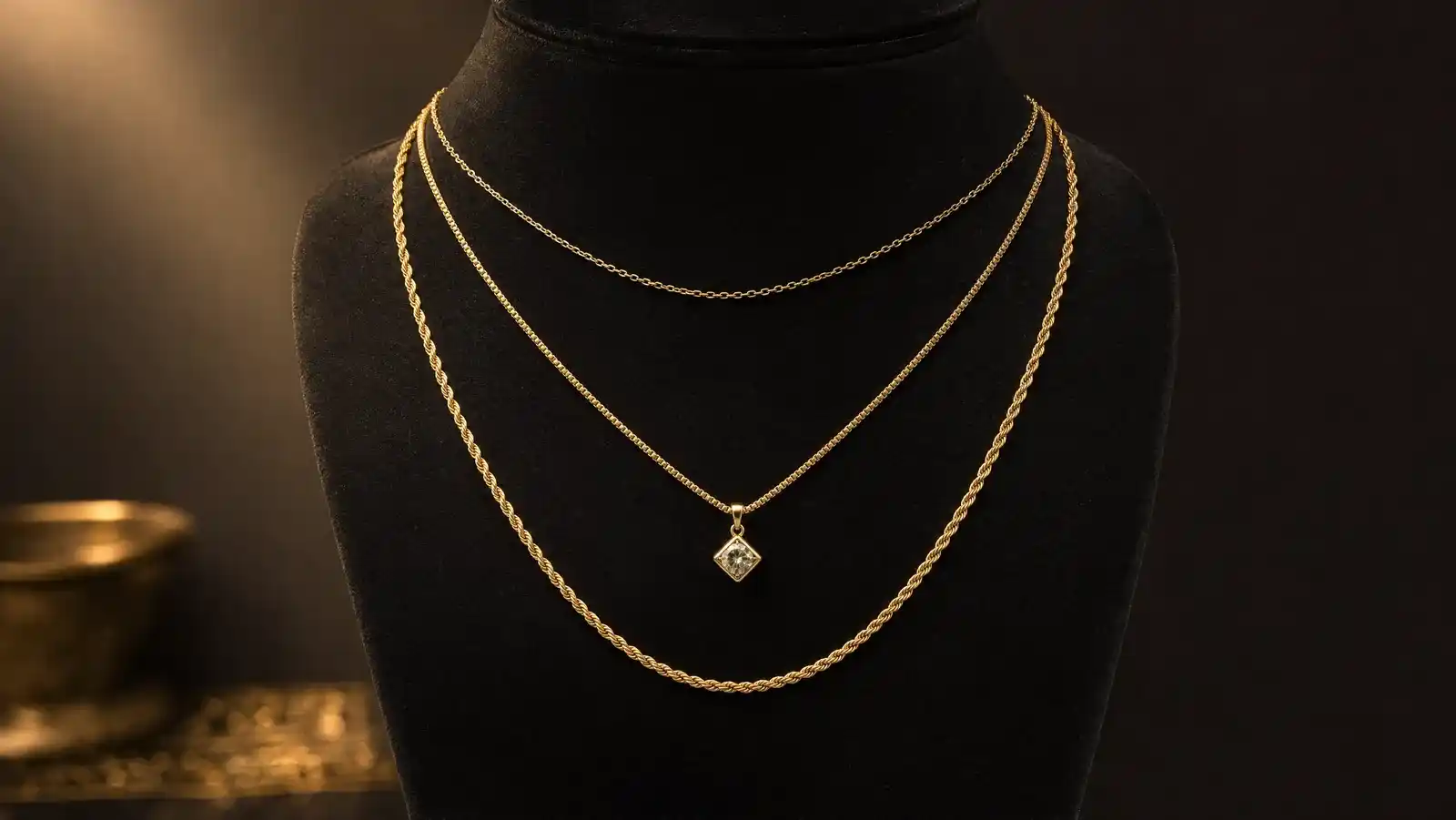
| The safe default | 16" / 18" / 20" | Choker, princess, upper sternum. Even one-inch drops; the most forgiving set for daily wear. |
| Wide and graphic | 14" / 18" / 22" | Real air between strands, with room for a pendant on the longest chain. |
Brilliant Earth's starting formula follows the same logic: a 16-inch choker or collar, an 18-inch chain with a small pendant, and a 22- to 24-inch necklace carrying the statement piece.
According to the length chart published by Borsheims, 16 inches is choker, 18 is princess, 20 to 24 is matinee, and 28 to 36 is opera. Most layering happens between choker and matinee.
Pick a Focal Point, Then Build Around It
One strand carries the interest; the others are structure. A stack with a single clear focus — a pendant, a station chain, a wider curb link — reads as composed; a stack in which every strand competes reads as inventory.
The mechanics back up the aesthetics. Two pendants of similar size on adjacent chains find the same low point on the chest, settle against each other, then push each other off center. Each is also the heaviest object on its strand, so both drag their chains toward the middle.
For more than one charm, vary the scale and put them on chains far apart in length: a small initial disc at 16 inches and a larger locket at 22, not two medallions at 18 and 20. Brilliant Earth arranges multiple pendants smallest-on-shortest to largest-on-longest, keeping the visual weight at the bottom.
A station chain — one with small beads, discs or stones spaced along its length rather than gathered at one point — makes a good focal strand because its interest is distributed. It never fights a pendant for the same square inch.
Vary Width and Texture, Not Just Length
Three identical fine cables at three different lengths will still braid. Length separates resting positions; width, weight and surface texture decide whether chains slide past each other or catch when you move. This is why Brilliant Earth's tangle advice is to vary chain weights and styles, on the reasoning that different-weight chains naturally separate rather than intertwining. A heavier chain sits deeper into the curve of the neck and resists being pulled sideways by a lighter one.
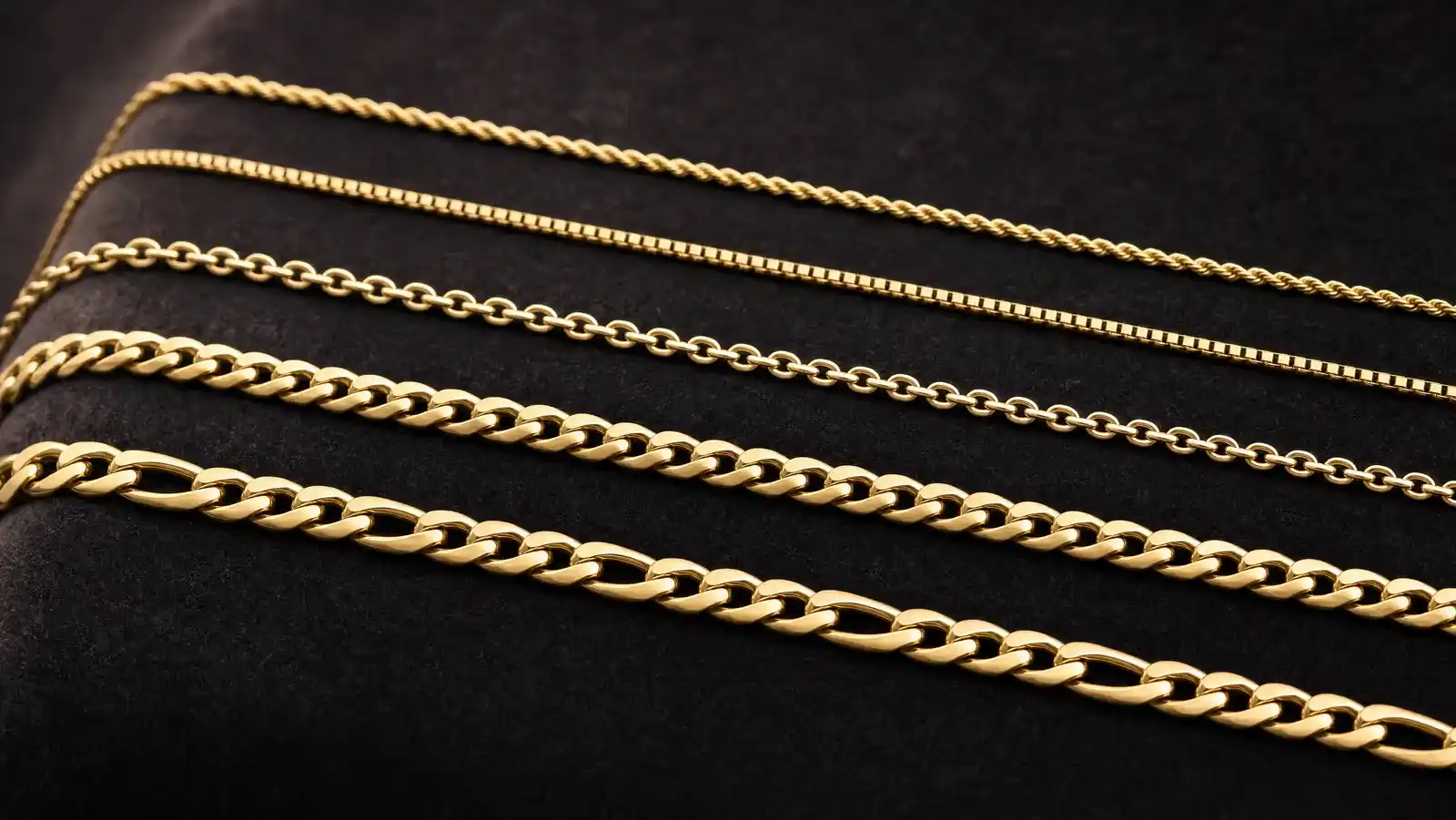
Link construction matters as much as gauge. According to Arden Jewelers, the simple design of a cable chain makes it "very flexible and nearly impossible to kink," and curb chains are "very difficult to kink" despite being flat. Tightly articulated links behave differently: the same jeweler notes that herringbone chains are "quite susceptible to twisting and kinking," that snake chains "can break, kink, or become stretched out easily," and that box chains pull hair and can twist.
A workable three-chain recipe: a fine cable or rolo at 1.0–1.3mm on top, a wider flat curb or paperclip at 2.5–4mm in the middle, and a beaded, rope or station chain at the bottom for a different surface and enough mass to stay put. The types of necklace chains differ widely in drape and friction, which is what makes three constructions safer than three lengths of the same one.
Mixing Metals: The Rules Worth Keeping
Yellow, white and rose together is fine. "Never mix metals" is an outdated convention, not a standard. Hamilton Jewelers puts it plainly in its layering guide: contrasting metal colors make a bold statement, and combining rose, white and yellow gold — once considered taboo — is now encouraged.
What separates an intentional mix from an accidental one is repetition and proportion.
- Repeat each metal at least twice. One silver chain among four gold ones reads as an oversight. Two silver elements — a chain and a clasp, or a chain and a bail — read as a choice.
- Or let one metal dominate. Brilliant Earth suggests letting a single metal make up roughly 60 to 70 percent of the stack, with the second as the accent.
- Use a bridge piece. A necklace that already combines two metals gives the eye permission for the rest of the mix; Brilliant Earth calls these "bridges."
- Mind the easy pairings. Brilliant Earth notes that yellow gold pairs naturally with rose gold, and white gold with silver. Warm-with-cool is not forbidden, just less automatic.
Treat the skin-tone advice you see everywhere as preference, not law. The common suggestion — warm undertones favor yellow and rose gold, cool undertones favor white metals — is a starting point for people who have no preference, nothing more.
Where the Pendant Goes
Put the weight on the longest strand. A pendant is the heaviest point on a necklace and migrates to the lowest point of the loop, pulling its own chain toward the center and dragging neighbors into the same channel. On the bottom chain, it has nothing below to disturb.
Two fit details decide whether a pendant hangs straight in a stack:
Bail and chain width have to match. The bail is the loop at the top of a pendant that the chain passes through. Jeweler guidance is consistent that the opening should be slightly larger than the chain's thickness, with enough clearance for the chain to move freely. Too tight and the pendant sits crooked and wears the bail unevenly; too loose and it slides and flips. Jewelry Shopping Guide notes that chains wider than about 6mm often will not pass through a standard bail at all.
Chain strength has to match pendant weight. A substantial medallion on a 1.0mm cable will stretch links and eventually fail at the weakest one. Our pendant chain guide covers matching gauge and construction to a specific pendant.
For a pendant mid-stack, make it a small one and give the strand below it four or more inches of clearance.
Necklines: What Actually Works With What
The stack has to clear the fabric. If the shortest layer disappears under a collar, the composition breaks no matter how well spaced the chains are. The pairings below draw on Dana Rebecca Designs' neckline guide, which covers every neckline here except the button-down; the specific length notes are our own.
| Neckline | What tends to work | Notes |
|---|---|---|
| V-neck | Medium-to-long lengths with a pendant or drop | Leave about an inch between where the neckline ends and where the pendant begins |
| Crew neck | Multiple layers of varying lengths | "The blank canvas of necklines"; start the shortest layer at or below 18 inches so it clears the ribbing |
| Scoop neck | Delicate weights, nothing that competes | Ultra-dainty pendants or simple chains; let the neckline lead |
| Button-down | Two layers, one inside and one outside the placket | Undo one extra button and let the shortest chain frame the opening |
| Turtleneck | Long lengths only | "Length is your friend here" — short chains look cramped against a high neck |
| Strapless | Chokers and collar lengths, or short pendants | Nothing competes, so the stack sits on skin; keep it tight and high |
How to Layer Necklaces Without Tangling
Tangling happens in three places: on the body, in the moment you take everything off, and overnight in storage. Each has a fix.
- Stagger the clasps around the back of the neck. Three clasps stacked at the nape will interlock. Rotate each necklace so its clasp sits a couple of inches around from its neighbors.
- Use a layering clasp or necklace detangler. These are small connectors — usually a bar or cylinder with several attachment points — that hold two to four necklaces at fixed intervals so the chains cannot swap positions.
- Put the stack on shortest first, and take it off in reverse. Brilliant Earth recommends starting with the shortest piece and working outward. Removing the longest first means never pulling a chain up through two others.
- Fasten every clasp before storing. An open clasp is a hook; a closed loop cannot thread itself through another chain.
- Store strands separately. BriteCo's guidance is separation-first: necklaces should be hung on a jewelry tree, hanger or rack, which keeps the chains apart and stops them tangling, with a jewelry box as the alternative for keeping them organized. Our jewelry storage guide covers travel cases and longer-term protection.
Some constructions are bad candidates for a busy stack. Since herringbone and snake chains kink under sharp bending and box chains can twist, we would keep those as solo pieces or as the lowest strand with real clearance — not sandwiched in the middle all day. Very fine rope is the borderline case: Arden Jewelers describes rope chains as strong and very flexible, but notes that, like box chains, they can catch and pull hair. If a stack does knot, work it flat and slowly rather than pulling; our walkthrough on how to untangle a necklace chain covers the method that does not stretch links.
Common Layering Mistakes
- Too many strands. Brilliant Earth suggests two or three for everyday wear; Hamilton Jewelers puts the common range at three to five.
- Every chain the same gauge. Identical widths at different lengths still braid. Vary the millimeters, not only the inches.
- Mismatched clasp bulk. A heavy lobster clasp on a fine chain drags that strand around to the side.
- Ignoring chain weight. A dense curb pulls a lightweight neighbor into its path. Put the heaviest chain lowest.
- Layering a chain that cannot take the friction. Anything prone to kinking — herringbone above all — should not spend eight hours rubbing against two other chains.
- Two pendants at similar lengths. They collide, then push each other off center.
Putting a First Stack Together
Start with three chains at 16, 18 and 20 inches, in three constructions and three widths — a fine cable, a wider flat curb, a beaded or station chain. Put the only pendant on the 20-inch strand. Stagger the clasps at the back, and take the set off longest-first into three separate slots.
That is the whole method, and it is deliberately unglamorous, because layering fails for mechanical reasons far more often than aesthetic ones. Get the geometry right and the styling becomes genuinely a matter of taste. If you are buying chains specifically to build a stack, our necklace chain guide covers metals, gauges and constructions in more depth.
FAQ
How many necklaces should you layer?
Two or three for daily wear, three to five for a fuller look. Brilliant Earth recommends starting with two to three pieces; Hamilton Jewelers describes three to five as the common choice, noting the consensus that "good things come in threes."
How far apart should layered necklaces be?
Roughly two inches is the reliable default. Brilliant Earth advises one to two inches for visual separation and at least two inches of length difference to reduce contact points; Hamilton Jewelers sets a floor of half an inch. Because a necklace hangs as a loop, about four inches of extra chain produces roughly two inches of extra drop.
Can you mix gold and silver necklaces?
Yes. Hamilton Jewelers describes combining rose, white and yellow gold as now encouraged rather than taboo. To keep it intentional, either repeat each metal at least twice or let one metal make up the majority — Brilliant Earth suggests roughly 60 to 70 percent — with the second as an accent.
How do you keep layered necklaces from tangling?
Vary chain weights and constructions, keep about two inches between strands, stagger the clasps around the back of the neck, and consider a layering clasp or detangler. Put necklaces on shortest-first, remove them longest-first, fasten every clasp before storing, and store each strand separately.
What lengths layer best?
16 / 18 / 20 inches is the most forgiving set; 14 / 18 / 22 gives more visible separation and room for a pendant on the bottom strand. Using the Borsheims length names, most layering happens between choker (16 inches) and matinee (20 to 24 inches).
About the Author
Alfreda Borror
Alfreda Borror is the founding editor of Opulent Opal, writing research-based buying guides on diamonds, birthstones, and fine jewelry.