How to Clean a Necklace Chain: Gold, Silver & Everyday Grime

This post may contain affiliate links. Read our affiliate policy
The grime in a chain is not on the chain. It is inside it, in the hundreds of tiny joints where one link pivots against the next — the one place a polishing cloth never reaches. That is why how to clean a necklace chain is a different question from how to clean a ring: a chain can look bright and still smell, and the method that rescues one construction quietly destroys another. Our guide to necklace chains covers construction and durability.
Table of Contents
- Identify What You Have First
- The Safe Default Method: How to Clean a Necklace Chain at Home
- Gold Chains: Solid, Filled and Plated
- Silver Chains and Tarnish
- What Not to Use
- When Ultrasonic and Steam Are a Bad Idea
- Cleaning the Clasp
- How Often to Clean a Necklace Chain, and What Prevents Grime
- When to Hand It to a Jeweler
- How to Clean a Necklace Chain: What We'd Do
- FAQ
Identify What You Have First
Start with the stamp, usually on the clasp or end link. 925 is sterling silver; 417, 585 and 750 mark 10K, 14K and 18K gold; GF means gold filled; GP, HGE and vermeil mean plating over a cheaper core. That last group is what ruins chains. According to the Federal Trade Commission's Jewelry Guides, "gold filled" requires a gold layer of at least 1/20th of the article's total weight, while ordinary "gold plate" electroplating needs only 0.175 microns — seven millionths of an inch. A finish that thin cannot survive treatment solid metal shrugs off.
Then check solid versus hollow. Hollow rope and box chains are thin tubes, not solid wire; the links dent, and water inside does not come back out. Two terms: tarnish is a surface film formed when metal reacts with air, and a jump ring joins clasp or pendant to the chain.
| Chain type | Safe method | Avoid |
|---|---|---|
| Solid gold (417/585/750) | Soap and water, soft brush | Chlorine, bleach, abrasives |
| Gold filled (GF) | Soap and water, soft cloth | Polishing compounds, ultrasonic |
| Gold plated, vermeil (GP, HGE) | Brief soapy wash, no scrubbing | Toothpaste, polishing cloths, ultrasonic, heat |
| Sterling silver (925) | Soap and water; polishing cloth | Abrasive pastes; foil bath on antiqued finishes |
| Rhodium-plated silver/white gold | Soap and water only | Anything abrasive or chemical |
| Stainless steel | Soap and water, soft brush | Bleach, steel wool |
| Hollow construction | Short soak, long air drying | Ultrasonic, steam, long soaking |
| Stone-set pendant | Damp cloth on the chain only | Soaking, ultrasonic, steam |
The Safe Default Method: How to Clean a Necklace Chain at Home
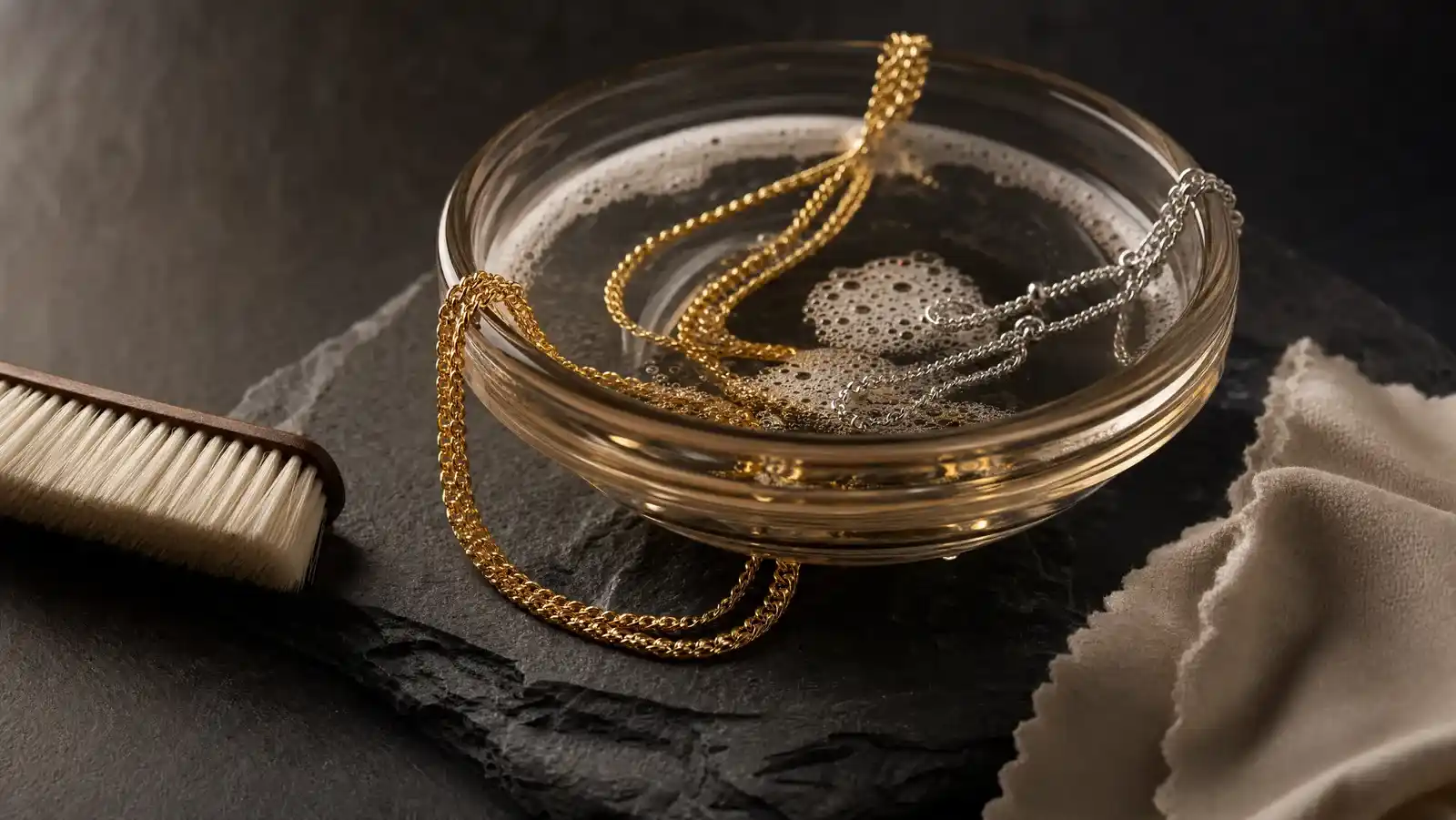
According to GIA, most jewelry can be cleaned with warm water, mild dish soap — no detergents — and a soft brush, with a clean toothbrush kept solely for jewelry to lift what remains. Use it whenever you are unsure.
- Work over a bowl, not an open sink. GIA advises rinsing jewelry in a glass of water rather than under a running tap; a loose piece can go down the drain.
- Warm water, two or three drops of mild dish soap. Warm, not hot; fragrance-free.
- Soak ten to fifteen minutes. The soak does most of the work, softening the paste of oil and lint inside the joints.
- Brush along the links, not across them. Work in two-inch sections with light strokes, including the clasp and jump ring.
- Rinse twice in clean water. Residue dulls metal and settles back into the joints you cleared.
- Dry completely — the step people skip. Blot with a lint-free cloth, then lay the chain flat for twenty to thirty minutes before storing.
Trapped water is not cosmetic: moisture in a clasp housing or hollow link keeps metal damp long after the surface looks dry. The National Park Service's museum handbook lists relative humidity and atmospheric pollutants among the primary causes of metal deterioration.
The same routine for rings is in our guide to cleaning gold, platinum and silver at home.
Gold Chains: Solid, Filled and Plated
Solid gold is the forgiving case. A stone-free 14K or 18K chain takes the method above; according to jewelry insurer BriteCo, warm water, a few drops of mild dish soap and a soft brush is the standard home routine.
Gold filled tolerates gentle washing. Because the gold is a real fraction of the piece's weight rather than a micron-thin skin, it washes like solid gold. What it cannot take is abrasion.
Plated chains must never be scrubbed, polished or machine-cleaned. "Polishing" sounds gentle, but a polishing cloth is a mild abrasive, a chemical tarnish remover, or both, and it works by removing a microscopic layer of metal. The National Park Service states the mechanism plainly — "cleaning and polishing remove original metal" — and warns separately that an object gilded with a thin layer of gold can have that layer destroyed by polishing. That guidance is written for museum silver, where there is metal to spare; on a plated chain, the layer you are polishing is the gold.
So for plated: brief wash in cool-to-warm soapy water, a light pass on the clasp, rinse, pat dry, air out. Plating wears through at friction points regardless; the fix is re-plating, not cleaning.
Silver Chains and Tarnish
Tarnish on a silver chain is silver sulfide — the metal reacting with sulfur-bearing compounds in the air, as Compound Interest's chemistry explainer describes. It is a surface layer, not damage — but every method that removes it by rubbing removes a little silver too.
Polishing cloths handle light tarnish; Jewelers of America says regular polishing removes tarnish and restores sterling's luster, and suggests taking silver to a jeweler annually. Use it on the outer faces of the links, and use it rarely.
The aluminum foil and baking soda bath is not a polish. According to Compound Interest, aluminum has a stronger affinity for sulfur than silver, so in a hot solution it displaces silver from the silver sulfide, freeing metallic silver and forming aluminum sulfide on the foil. The baking soda cleans nothing: its job is to strip the thin aluminum hydroxide layer off the foil so the reaction has a ready supply of aluminum. The caveats:
- It is indiscriminate. It strips the deliberate darkening in the recesses of an oxidized chain — that contrast is the design.
- Not for plated pieces. A hot alkaline bath is the last thing a plated or vermeil finish should meet.
- Not for stone-set or glued pieces. Heat plus alkalinity harms porous or organic gems and adhesive-set pendants.
- Not for antique or collectible silver, where conservation-minded sources warn against it.
Many sterling chains are rhodium-plated at the factory to resist tarnish; if your 925 chain has never tarnished, treat it as plated. Our roundup of sterling silver chains covers durable constructions.
What Not to Use
Toothpaste. It contains abrasives by design, and jewelry supplier Westpack still warns that it "can actually be abrasive to silver plated jewelry, so only use this hack if you're sure your pieces are pure silver." On a chain we'd skip it — you cannot rinse gritty paste out of several hundred joints.
Baking soda paste. Different from the foil bath, where soda is only an electrolyte. Rubbed onto metal it is an abrasive, with the same risks as toothpaste.
Bleach and chlorine. Chlorine attacks the alloy metals that give karat gold its strength. Stuller's technical article on stress-corrosion cracking identifies chlorine as a halogen that promotes SCC in gold jewelry alloys, where residual stress plus a corrosive environment causes brittle failure. Testing summarized by watchmaker supplier Esslinger reports a 14K nickel white gold setting failing after roughly 21 hours in heated 5% bleach, versus about 120 hours at room temperature.
Ammonia and household sprays. Formulated for countertops, not plated finishes, porous stones or soldered joints; the National Park Service warns that commercial polishes containing ammonia can permanently damage delicate surfaces, and GIA steers home cleaning toward plain mild dish soap. Jewelers of America does suggest spraying a glass cleaner onto a soft-bristled toothbrush, but we'd keep that off plating and porous stones.
Very hot water, abrasive pads and hand sanitizer. Heat accelerates plating wear and risks thermal shock for a pendant stone; steel wool and powdered cleansers leave scratches that cannot be buffed out without removing metal; alcohol gels leave residue in the links.
When Ultrasonic and Steam Are a Bad Idea
An ultrasonic cleaner collapses microscopic bubbles in fluid to scour grime out of crevices — in principle, exactly what a chain needs. Often it is also the fastest way to ruin a piece.
Generally fine: stone-free solid gold, solid sterling and platinum. According to Blue Nile, solid gold, platinum and sterling silver are the metals commonly put through these machines, and diamonds — natural or lab-grown — are acceptable.
Not fine:
- Plated and vermeil. Blue Nile warns that an ultrasonic cleaner speeds up the wearing away of any plating.
- Hollow chains. Water enters through the joints and does not fully drain, and thin walls can dent.
- Glued components. Pendant bails and glued-in stones can loosen.
- Soft, porous, treated or organic gems on a pendant. Blue Nile lists pearls, emeralds, opals, turquoise and fracture-filled stones as unsafe; GIA warns against gems with breaks filled with oil, resin or glass-like material.
Steam adds heat and pressure, so every exclusion applies plus thermal shock. If you cannot say with certainty that a chain is solid, unplated and stone-free, don't.
Cleaning the Clasp
The clasp is the part that actually fails. A spring ring is a hollow circle housing a coiled spring and lever; a lobster clasp is a spring-loaded gate. Both are precision springs in a compartment open to skin oil, lint and dried soap, which stiffens the action — and forcing a stiff lever bends it.
After the main soak, hold the clasp under a gentle stream of warm water and work the lever twenty to thirty times, brush the housing and lever slot, rinse again while moving the lever, then dry with the gate held open.
If the gate still does not snap back after full drying, the spring has fatigued — replacement, not cleaning. Long's Jewelers quotes necklace and bracelet clasp replacement at between $65 and $250 depending on size and material, with a standard gold 5mm spring ring closer to $30. Our guide to necklace clasp types covers which style to ask for.
How Often to Clean a Necklace Chain, and What Prevents Grime
The cheapest cleaning is the one you avoid needing.
Last on, first off. Put the chain on after makeup, perfume, hairspray and sunscreen have dried. Jewelers of America advises against wearing jewelry while applying sunscreen and lotions, because those products form a film that leaves metal dull — and in a chain that film goes into the joints.
Take it off for four things. Showering, because soap scum collects in the links faster than anything else. Swimming and hot tubs, for the chlorine reasons above. Sleeping, because a chain caught on bedding is how a link gets stretched. Workouts, because sweat is salty and chains catch.
Wipe after wear. Ten seconds with a dry soft cloth removes the day's oil before it sets.
Store it dry and enclosed. Humidity and airborne sulfur drive tarnish, so a closed box or sealed bag slows the reaction; our jewelry storage guide covers practical setups.
Cadence: a wipe after each wear, a full wash every two to four weeks for a daily chain, sooner if it smells. Jewelers of America suggests a professional clean roughly every six months, which doubles as an inspection.
When to Hand It to a Jeweler
Some jobs are not home jobs: heavy tarnish in an antiqued finish, where the intended contrast is easy to erase; a pendant with organic or porous stones; worn-through plating; and anything you cannot identify. A stretched or kinked link is structural — our necklace chain repair guide covers what is fixable.
Quick Jewelry Repairs puts a thorough professional clean and polish at around $45 and up; Long's Jewelers lists ring cleaning and polishing around $80 and rhodium re-plating in the $80 range for a ring. For necklaces and bracelets, jewelry guide publisher Nakassi puts rhodium re-plating at $80 to $150. Metal, condition and your local market all move the number — ask for a written estimate.
How to Clean a Necklace Chain: What We'd Do
Match the method to the construction, and when unsure use the gentlest one available. Warm water, mild dish soap, a short soak, a soft brush along the links, two clean rinses and a complete dry will handle nearly every chain in a drawer. If you are choosing a chain to wear daily, Opulent Opal's necklace chain guide covers which constructions survive that life.
FAQ
Can you clean a gold chain with dish soap?
Yes — it is the standard advice. GIA recommends mild dish soap in warm water with a soft brush, and BriteCo describes the same routine for gold chains. Rinse twice and dry completely, including inside the clasp.
Does toothpaste clean a silver chain?
It lifts tarnish and often leaves a dull, finely scratched chain. Jewelry supplier Westpack cautions that toothpaste is abrasive enough to damage silver-plated jewelry. We'd use a polishing cloth or plain soap and water instead.
Why does my necklace chain smell?
Because the joints hold what a cloth cannot reach. Jewelry care guides attribute the odor to sebum, dead skin and sweat in crevices, broken down by skin bacteria; on silver, tarnishing itself involves sulfur compounds. A soak, brush, rinse and complete dry usually fixes it. If it returns at once, or the skin under the chain is irritated, ask a jeweler or a doctor.
Can you put a necklace chain in an ultrasonic cleaner?
Only if it is solid, unplated and stone-free. Blue Nile lists solid gold, sterling silver and platinum as the common metals for these machines, and diamonds as acceptable, while flagging pearls, emeralds, opals, turquoise and gold-plated pieces as unsafe. GIA adds gems with surface-reaching breaks filled with oil, resin or a glass-like material.
How do you clean a gold plated chain without ruining it?
Briefly and gently: cool-to-warm water, a drop of mild dish soap, swish rather than scrub, rinse, pat dry, air out. Plated-jewelry care guides such as Caeli Jewelry's rule out hot water, toothpaste, baking soda, rubbing alcohol and polishing cloths; Blue Nile separately warns that ultrasonic machines accelerate plating wear. Once the finish wears through, that is a re-plating question.
About the Author
Alfreda Borror
Alfreda Borror is the founding editor of Opulent Opal, writing research-based buying guides on diamonds, birthstones, and fine jewelry.