Best Vintage & Antique Style Engagement Rings

This post may contain affiliate links. Read our affiliate policy
This article contains affiliate links. We may earn a commission if you make a purchase through our links, at no extra cost to you.
Vintage engagement rings offer what modern mass-produced jewelry often lacks: character, craftsmanship, and a story. Whether you choose an actual antique or a vintage-inspired new ring, these styles connect you to jewelry-making traditions spanning centuries. From the geometric drama of Art Deco to the romantic flourishes of Victorian design, vintage rings make a distinctive statement.
This guide explores major vintage eras and helps you find the perfect ring with old-world charm. For complete buying guidance, see our engagement ring guide.
Why Choose Vintage?
Unique Character
Vintage and antique rings have personalities. Whether crafted a century ago or inspired by historical designs, they stand apart from cookie-cutter modern styles.
Superior Craftsmanship
Many vintage rings display hand-fabricated details—filigree, engraving, milgrain—that require skills rarely found in mass production.
Sustainable Choice
Choosing antique jewelry means no new mining. Even vintage-inspired new rings often emphasize quality over disposability.
Investment Potential
Authentic antique rings from desirable eras can appreciate in value, unlike modern mass-produced jewelry. However, reproductions are common—learn how to authenticate antique jewelry before investing.
Conversation Starters
A vintage ring invites questions and tells a story, whether it's your family heirloom or a carefully chosen antique.
Major Vintage Eras
Victorian Era (1837-1901)
Named for Queen Victoria's reign, this era produced romantic, ornate jewelry reflecting the period's sentimental values.
Characteristics:
- Yellow gold dominance
- Ornate, romantic designs
- Nature motifs (flowers, leaves, birds)
- Rose-cut and old mine-cut diamonds
- Colored gemstones (sapphires, rubies, emeralds)
- Intricate metalwork and engraving
- Serpent and symbolic motifs
Sub-periods:
| Period | Years | Style |
|---|---|---|
| Early Victorian | 1837-1860 | Romantic, nature-inspired |
| Mid-Victorian | 1860-1880 | Darker, memorial jewelry |
| Late Victorian | 1880-1901 | Lighter, more feminine |
Best for: Romantic souls who love ornate detail and warm gold tones.
Edwardian Era (1901-1915)
The Edwardian era introduced platinum to jewelry, enabling delicate, lacy designs impossible in softer gold.
Characteristics:
- Platinum and white gold introduction
- Delicate, lacy filigree
- Garland and bow motifs
- Light, airy appearance
- Old European cut diamonds
- Exceptional craftsmanship
- Feminine, romantic aesthetic
Signature elements:
- Milgrain (tiny beaded edges)
- Pierced metalwork
- Knife-edge bands
- Laurel and ribbon designs
Best for: Those who love delicate, feminine designs with intricate detail.
Art Deco Era (1920-1935)
The roaring twenties brought bold geometry, contrasting colors, and modern materials to jewelry design.
Characteristics:
- Bold geometric patterns
- Strong symmetry
- Contrasting colors (sapphires with diamonds)
- Platinum prevalence
- Emerald and Asscher cut diamonds
- Step-cut gemstones
- Egyptian and Eastern influences
- Machine-age aesthetics
Signature elements:
- Geometric shapes (rectangles, triangles, circles)
- Linear, stepped designs
- Calibré-cut colored stones
- Strong architectural lines
Best for: Bold personalities who love clean lines and dramatic geometry.
Retro/Hollywood Regency (1935-1950)
War-era jewelry featured bold, sculptural designs using available materials.
Characteristics:
- Rose and yellow gold (platinum reserved for war)
- Large, sculptural designs
- Patriotic and floral themes
- Cocktail ring influences
- Bold, oversized aesthetics
Best for: Those wanting bold, statement-making vintage style.
Vintage Diamond Cuts
Antique diamonds were cut by hand, creating unique light patterns different from modern precision cuts.
Old Mine Cut
Era: 1700s-late 1800s Shape: Cushion-like with rounded corners Facets: 58, but different arrangement than modern Appearance: Softer sparkle, larger facets, visible culet (bottom point)
Old European Cut
Era: 1890s-1930s Shape: Round Facets: 58 Appearance: Predecessor to round brilliant; smaller table, higher crown, larger culet
Rose Cut
Era: 1500s-1800s Shape: Dome-topped, flat bottom Facets: 3-24 triangular facets Appearance: Subtle glow rather than sparkle; romantic, antique appeal
Single Cut
Era: Various Shape: Round Facets: 17-18 Appearance: Used for small accent stones; simpler sparkle
Vintage Cut Characteristics
| Cut | Sparkle | Fire | Uniqueness |
|---|---|---|---|
| Old Mine | Soft, candlelight | Good | High |
| Old European | Moderate | Good | High |
| Rose | Subtle glow | Low | Very high |
| Modern Round | Brilliant | Excellent | Standard |
Vintage-Inspired vs. True Antique
True Antique Rings
Pros:
- Genuine historical piece
- Unique, one-of-a-kind
- Potential investment value
- Sustainable (no new mining)
- Rich provenance possible
Cons:
- Size limitations
- Wear and potential repairs needed
- Unknown history of repairs
- May be more fragile
- Limited selection
Vintage-Inspired New Rings
Pros:
- Made to your size
- New condition, full warranty
- Modern durability standards
- More affordable often
- Greater selection
- Can use modern or antique-cut diamonds
Cons:
- Not truly antique
- Less unique (reproducible designs)
- No historical provenance
Key Vintage Design Elements
Milgrain
Tiny beaded metal edges that create a vintage appearance. The term comes from "mille grains" (thousand grains).
Filigree
Delicate, lacy metalwork created by twisting and soldering fine metal threads. Signature of Edwardian era.
Hand Engraving
Detailed patterns carved into metal by hand. Each piece is unique.
Scrollwork
Curved, flowing decorative metal patterns, often with botanical inspiration.
Split Shank
Band divides as it approaches the center stone, creating elegant negative space.
Cluster Settings
Multiple smaller stones arranged together, popular in Georgian and Victorian eras.
Shopping Tips
For Authentic Antiques
- Buy from reputable dealers — Estate jewelers, auction houses, vetted antique dealers
- Request documentation — Provenance, any restoration history
- Inspect carefully — Look for wear, repairs, stone security
- Verify materials — Test gold karat, platinum vs. silver
- Check sizing feasibility — Some antique rings are difficult to resize
- Understand condition grades — "Excellent" antique still shows wear
For Vintage-Inspired New
- Research the era — Know what defines your preferred style
- Examine details — Milgrain, filigree, and engraving quality matters
- Consider stone cuts — Old mine or old European cuts add authenticity
- Check craftsmanship — Hand-finished details vs. mass production
- Mix eras thoughtfully — Some designs blend periods successfully
Combining Vintage with Modern
Lab-Grown and Moissanite in Vintage Settings
Modern stone options work beautifully in vintage-inspired settings:
- Lab-grown diamonds offer value with antique-style cuts available
- Moissanite comes in old mine and old European cuts
- Both can be set in period-accurate settings
See our lab-grown vs natural guide and moissanite vs diamond guide.
Modern Durability with Vintage Style
New rings can incorporate:
- Vintage aesthetics with modern prong security
- Period-inspired designs with contemporary durability
- Antique-cut stones in well-engineered settings
Caring for Vintage Rings
General Care
- Remove during activities (cleaning, exercising)
- Store separately to prevent scratches
- Clean gently with soft brush and mild soap
- Avoid ultrasonic cleaners for antiques (can loosen settings)
Professional Maintenance
- Annual inspection for loose stones and worn prongs
- Professional cleaning maintains appearance
- Address repairs promptly to prevent further damage
Insurance
- Get proper appraisal from qualified appraiser
- Update appraisals every few years
- Specialized jewelry insurance protects better than homeowner's policies
Frequently Asked Questions
Are vintage rings good quality?
Often exceptional quality—antique rings that survived decades were typically well-made. However, condition varies, and some may need restoration.
Can vintage rings be resized?
Usually, but limitations exist. Intricate patterns may not survive sizing. Some stones and settings restrict adjustment. Always ask before purchasing.
Are antique diamonds valuable?
Old mine and old European cuts have collector value. They're hand-cut, unique, and increasingly rare. Some prefer their softer sparkle to modern precision cuts.
Where can I find authentic vintage rings?
Estate jewelers, auction houses (Christie's, Sotheby's), antique dealers, and vetted online marketplaces (1stDibs, Ruby Lane).
How do I know if a ring is truly antique?
Professional appraisal, construction methods, wear patterns, and hallmarks help determine age. Experienced dealers can identify era-appropriate techniques.
Related Guides
- Complete Engagement Ring Guide
- Engagement Ring Settings Guide
- Diamond Shapes Guide
- Engagement Ring Trends 2026
- Best Engagement Rings Under $1000
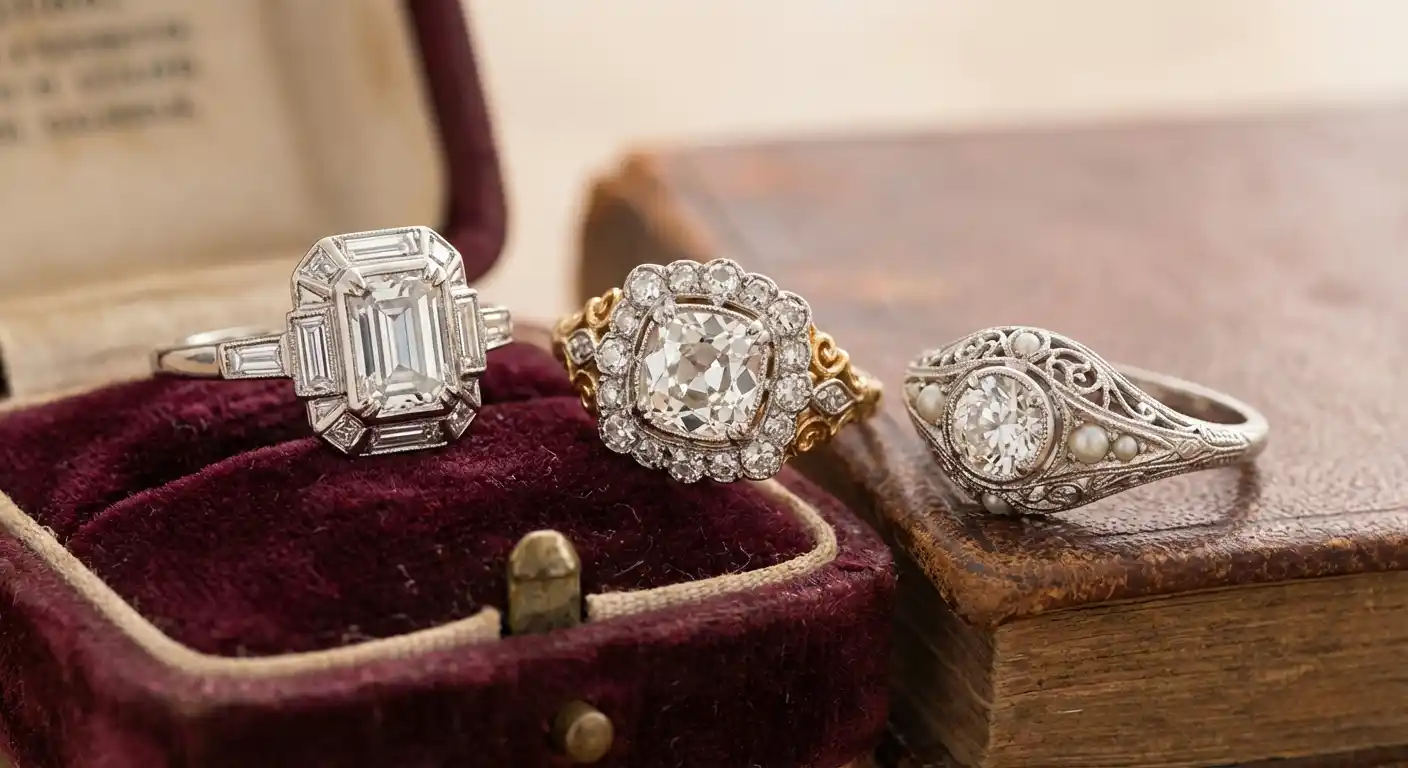
Art Deco Style Emerald Cut Moissanite Ring with Baguettes

Art Deco Style Emerald Cut Moissanite Ring with Baguettes
Geometric Art Deco design featuring an emerald cut center stone flanked by baguette accents.
Geometric Art Deco design featuring an emerald cut center stone flanked by baguette accents. The stepped design echoes 1920s glamour.
"Art Deco Pick - Timeless geometric elegance.
Victorian Style Cushion Cut Halo Ring with Milgrain

Victorian Style Cushion Cut Halo Ring with Milgrain
Romantic Victorian-inspired design with cushion cut center, ornate halo, and delicate milgrain edging throughout.
Romantic Victorian-inspired design with cushion cut center, ornate halo, and delicate milgrain edging throughout.
"Victorian Pick - Romantic old-world charm.
Edwardian Style Filigree Engagement Ring

Edwardian Style Filigree Engagement Ring
Delicate filigree metalwork inspired by Edwardian craftsmanship.
Delicate filigree metalwork inspired by Edwardian craftsmanship. Features intricate lacy patterns and feminine details.
"Edwardian Pick - Exceptional delicate craftsmanship.
Review of What We Liked
Art Deco Style Emerald Cut Moissanite Ring with Baguettes
Geometric Art Deco design featuring an emerald cut center stone flanked by baguette accents.
Victorian Style Cushion Cut Halo Ring with Milgrain
Romantic Victorian-inspired design with cushion cut center, ornate halo, and delicate milgrain edging throughout.
Edwardian Style Filigree Engagement Ring
Delicate filigree metalwork inspired by Edwardian craftsmanship.
About the Author
Alfreda Borror
Alfreda Borror is the founding editor of Opulent Opal, writing research-based buying guides on diamonds, birthstones, and fine jewelry.