Gold Karats Explained: 10K vs 14K vs 18K vs 24K

This post may contain affiliate links. Read our affiliate policy
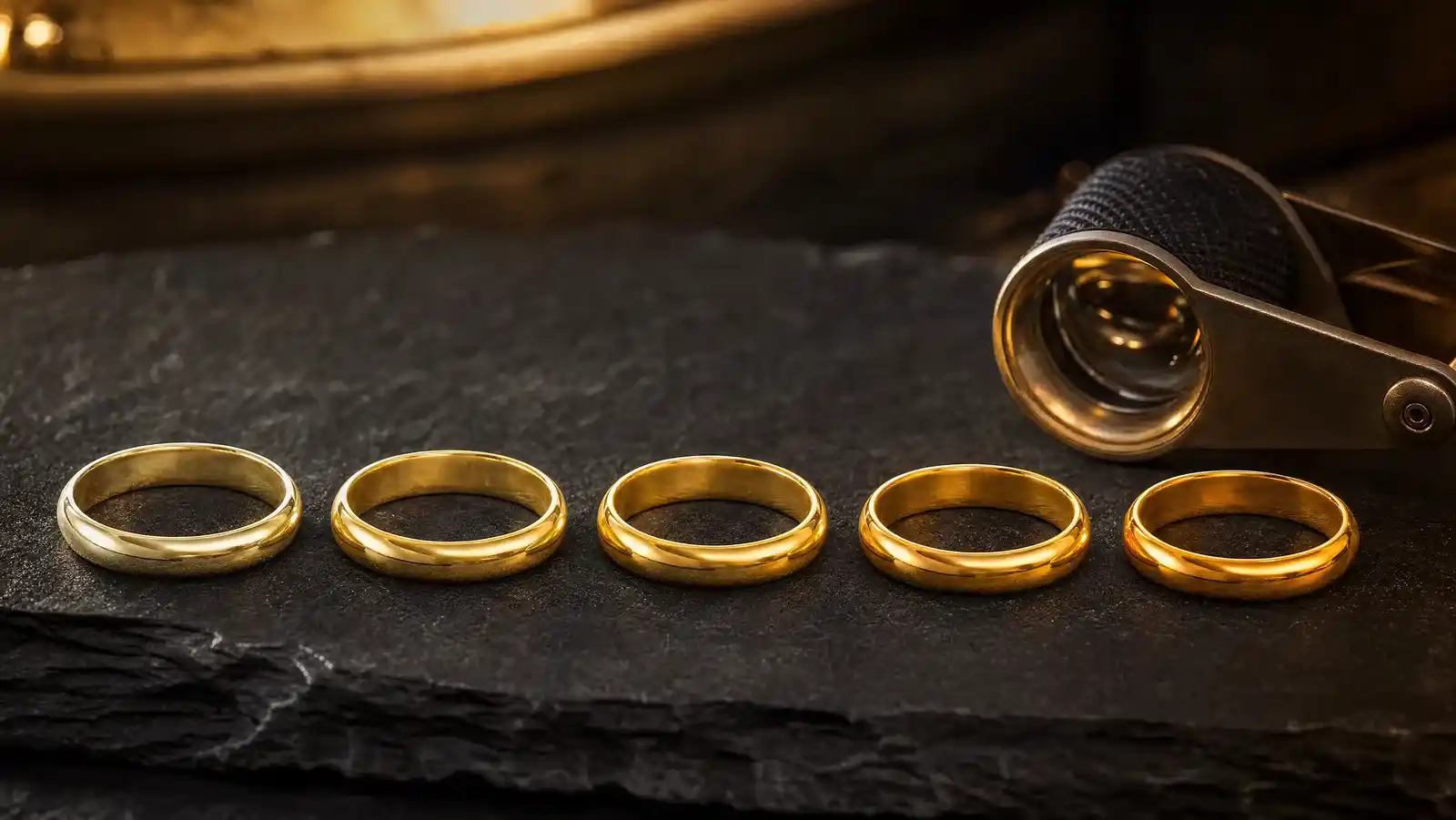
A karat is a fraction out of 24, and it measures exactly one thing: how much of the metal is gold. 10K is 10 parts gold out of 24, or 41.7 percent gold by weight. 14K is 58.3 percent. 18K is 75 percent. 24K is pure gold. That is the whole system.
What a karat number does not tell you is what the other parts are, and that silence is where most disappointing gold purchases begin. The karat mark is a purity claim — not a durability, color, or quantity claim.
This guide works through the math, the hardness trade-off, the karat-versus-carat confusion, and what the stamp inside a piece is legally allowed to say. Every number below is cited to a government, standards, or published-research source rather than to a retailer.
Table of Contents
- What a karat actually measures
- The gold karat chart, 10K to 24K
- Karat vs carat
- Why gold's price made this urgent
- Why 24K is almost never used
- Why 14K dominates the US market
- What the rest of the metal does
- Is a higher karat better?
- Regional convention
- FAQ, then twelve deeper dives
What a Karat Actually Measures
Gold karats explained in one line: karat states the proportion of gold in an alloy out of 24 parts. According to the US Geological Survey's general-interest publication on gold, "Karat" indicates the proportion of solid gold in an alloy based on a total of 24 parts, so 14-karat gold is 14 parts gold and 10 parts other metals. The USGS adds the part most listings skip — "Karat" should not be confused with "carat," a unit of weight used for precious stones.
The companion measure is fineness, which the USGS defines as gold content in parts per thousand — a nugget with 885 parts gold is 885 fine. Divide the karat number by 24, multiply by 1,000, and you have it: 14 divided by 24 is 0.5833, or 583 fine.
Here is the limitation that matters most. According to the USGS mineral commodity profile for gold, karatage and fineness "refer only to the gold content of an alloy and not its nongold components," so "there can be many 10-karat alloys, many 14-karat alloys, etc., that differ from each other" in their non-gold metals.
Two rings stamped 14K are both 58.3 percent gold. Beyond that they may have nothing in common: one hardened with copper, another with nickel, another with palladium. Color, hardness, tarnish behavior, and skin reactions all come from that unstamped 41.7 percent — which no listing we have read publishes.
The Gold Karat Chart: 10K to 24K
| Karat | Parts gold out of 24 | Gold by weight | Fineness | Typical use | Relative durability |
|---|---|---|---|---|---|
| 10K | 10 | 41.7% | 417 | Budget rings, mass-market chains | Hardest, palest color |
| 14K | 14 | 58.3% | 583-585 | The US default for fine jewelry | Hard, good corrosion resistance |
| 18K | 18 | 75% | 750 | European fine jewelry, higher-end US | Softer, richer color |
| 22K | 22 | 91.7% | 916 | South Asian and Middle Eastern jewelry | Soft, massive forms |
| 24K | 24 | 99.9%+ | 999 | Bullion, gift jewelry, gold leaf | Softest, highest tarnish resistance |
Two notes on the fineness column, where paperwork and arithmetic disagree. The true fraction for 14K is 583.3 parts per thousand; the USGS states that "the nominal fineness of 14 karat gold is 14/24 x 1,000 = 583." European and Indian hallmarks mark 14K as 585 anyway, a generous rounding the metal has to meet. For 22K the arithmetic gives 916.7, and hallmarks read 916.
The durability column is relative, not absolute — and it is the column no product page quantifies, because hardness depends on the alloy recipe karat marks do not disclose.
Karat vs Carat: Purity Versus Weight
Two different measurements that sound identical in American English — and confusing them is the most common error in this subject.
Karat measures gold purity out of 24 parts. Carat measures gemstone weight, fixed at exactly 200 milligrams. NIST's historical circular records that, beginning July 1, 1913, the Bureau of Standards recognized the international metric carat of 200 milligrams as the unit of weight for gemstones, replacing an older US carat that had drifted closer to 205.3 milligrams. A 1-carat stone weighs 0.2 gram whatever metal holds it; a 14K setting is 58.3 percent gold whatever stone it holds.
The spelling is not universal. Outside the US the purity measure is usually spelled carat too, which is why British and Indian paperwork reads "22 carat." India's Bureau of Indian Standards hallmark brief stamps the two numbers together as "22K916, 18K750, 14K585."
A practical consequence: a listing reading "1 carat 14K" quotes a stone weight and a metal purity in the same breath, and neither says how much metal is in the piece. For that you need grams, which most listings omit.
Why Gold's Price Made This Question Urgent
Karat choice used to be mostly aesthetic. At current metal prices it is financial.
Gold set an all-time high in January 2026. CBS News reported that "gold's all-time high now stands at $5,589.38 per ounce, a record it reached on January 28, 2026," and noted that gold had started 2025 at roughly $2,624 per ounce. The market has since cooled: Fortune reported the price of gold at $4,168 per ounce on October 16, 2026, down about 2 percent from a year earlier, and Trading Economics puts the same day's quote at about $4,168 and the all-time high at $5,608.35 in January 2026.
Read those together: gold trades roughly 25 percent below its January record and roughly 59 percent above where it opened 2025. This is still, historically, a record-price environment.
That is why karat is now a budget lever. The gold in an 18K piece costs about 29 percent more than in an identical 14K piece, because 75 percent is 1.29 times 58.3 percent. On a 10-gram piece that is real money — and it is why lower karats, gold-filled construction, and vermeil may now draw budgets that five years ago went straight to 18K.
Why 24K Gold Is Almost Never Used for Jewelry
Because you can dent it with a fingernail. The USGS puts it plainly: "Pure gold is relatively soft — it has about the hardness of a penny. It is the most malleable and ductile of metals."
Malleability is a virtue in gold leaf and a liability in a ring. According to the USGS mineral commodity profile, the high-karat yellow golds — 23, 22, 21, and 20 karat — "possess the richest color and luster and are the most resistant to tarnish and corrosion," but they are "low in strength, hardness, and abrasion resistance and consequently are used primarily in rather massive types of jewelry." Massive is the operative word: thickness substitutes for hardness.
The same profile notes that the 990 fine gold used in Chinese and Southeast Asian chuk kam jewelry "is very soft," and that a 1 percent titanium alloy, still 990 fine, has better abrasion resistance. Even at the top of the purity scale, manufacturers engineer hardness back in.
So 24K is not a mistake. It is the right answer for a piece bought as portable value, worn occasionally and valued for color — and the wrong answer for anything that will spend a decade against a desk.
Why 14K Dominates the US Market
Because it survives daily wear while still reading unmistakably as gold. The USGS describes the intermediate yellow karats, 18 and 14, as "much used in jewelry of all types because of their pleasing appearance, excellent mechanical properties, and good corrosion resistance," and notes that 16 karat is seldom used.
The market data backs it up, with a caveat about vintage. The USGS mineral commodity profile reports that by 1997, US jewelry gold was 69 percent 14 karat, 13 percent 10 karat, 10 percent 18 karat, 4 percent 24 karat, 2 percent 22 karat, and 1 percent each 8 and 9 karat. That is the most recent free, government-published breakdown we can find; current figures sit behind paid trade subscriptions.
There is also a legal floor under the US market. Under the FTC's Guides for the Jewelry, Precious Metals, and Pewter Industries at 16 CFR 23.3, an unqualified "gold" claim is misleading unless the product is composed throughout of fine 24 karat gold, and a karat designation must immediately precede the word — "14 Karat Gold." As the USGS summarizes the same guides, any use of the word "gold" requires at least 10 karat purity throughout, which is why a 9 karat ring cannot be sold in the US as a "gold" ring.
What the Rest of the Metal Does
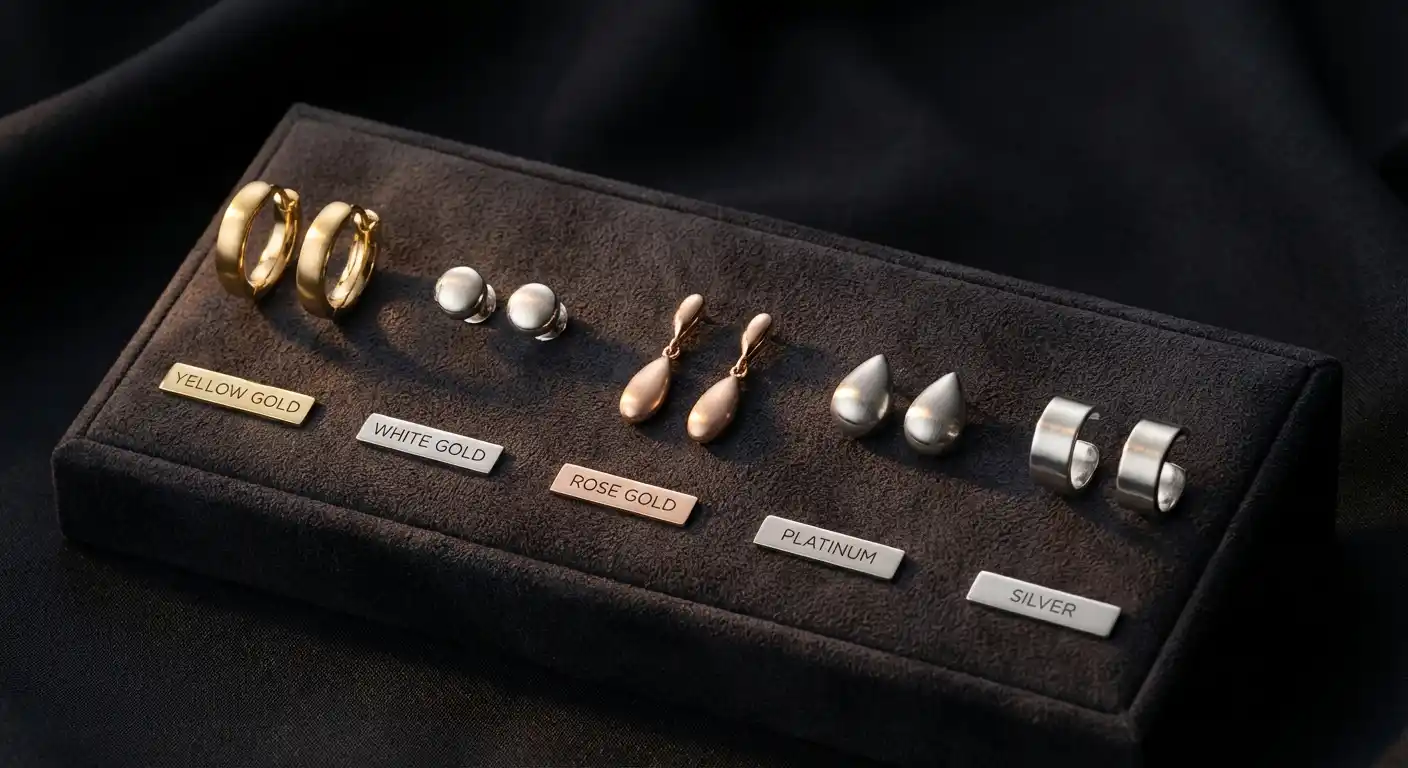
The non-gold fraction does all the work the karat mark takes credit for. The USGS notes that mixtures of silver, copper, nickel, platinum, palladium, tellurium, and iron with gold "create various color hues ranging from silver-white to green and orange-red." Color is an alloy outcome, not a purity outcome: at a fixed karat, shifting the copper-to-silver ratio is what produces the rose, warm, and green-tinted alloys.
White gold is the clearest case: the USGS reports that white golds in jewelry use are either nickel or palladium alloys, that nickel versions are cheaper but hard to make with good color and workability at once, and that manufacturers therefore pick the workable nickel alloy and "achieve satisfactory color by electroplating a thin layer of rhodium onto the finished jewelry pieces." It also warns that rhodium plating is unsuitable for pieces subject to abrasive wear, such as finger rings — which is why white gold turning yellow is a maintenance item rather than a defect.
The alloy also decides skin reactions. Writing in Cutis in 2021, Moon, Reeder, and Atwater report that nickel "remains the most common cause of contact allergy worldwide," that nickel sulfate was positive in 17.5 percent of patients patch tested in the 2015-2016 North American Contact Dermatitis Group cycle, and that nickel allergy "most often is associated with earrings and other jewelry." Our earring metals guide covers the per-metal detail.
And none of it is on the stamp. The USGS states flatly that "the marking conventions do not tell the purchaser of gold jewelry anything about the metals alloyed with the gold."
Is a Higher Karat Better? The Trade-Off by Piece Type
No. Higher karat is purer, warmer in color, and more tarnish-resistant; it is also softer. Which one wins depends on what the piece has to survive.
- Rings and bands take the most abuse. The USGS notes that the 10, 9, and 8 karat golds are used extensively "in such items as finger rings, where wear resistance is important." For an everyday ring, 14K is the balanced choice and 18K is a conscious trade of hardness for color.
- Earrings barely touch anything, so purity costs you little. Here the alloy question outranks the karat question, because the post sits in a piercing channel.
- Chains and bracelets are hundreds of small load-bearing joints. Hardness matters more than it looks, and construction and gram weight matter more than either; our guide to gold chains works through that math.
- Occasional and heirloom pieces are where 22K and 24K make sense — worn rarely, valued for color and metal content, and usually built heavy enough to compensate.
One honest limit: published hardness figures for karat golds vary widely, because the USGS notes karat golds have no universally accepted compositional standards. Treat "harder" as directional, not a spec.
Regional Convention: US 14K, European 18K, South Asian 22K
Karat preference is cultural infrastructure, not fashion. The USGS mineral commodity profile observes that "the karatage of alloys favored for gold jewelry customarily differs from country to country and region to region," that in industrial countries the bulk of jewelry bought is 18 or 14 karat, and that karatage in developing countries is typically high.
The specifics are sharper than most buyers expect. Per the same profile, 8 karat alloys account for nearly half the German market, 9 karat for about three-quarters of British purchases, and 10 karat for roughly one-eighth of US purchases but more than half of Canadian ones. Investment-oriented pieces run 21 to 23 karat, or 990 fine for chuk kam jewelry in Chinese and Southeast Asian markets.
India formalized its own convention: the Bureau of Indian Standards' hallmarking brief states that the mandatory hallmarking order of 23 June 2021 applies to 14, 18, and 22 carat gold, and that since 1 July 2021 a hallmarked article carries three marks — the BIS logo, the purity mark in the form "22K916," and a unique six-digit alphanumeric code laser-marked on the piece.
Practical takeaway: an 18K European piece and a 14K American piece are not graded on different scales — same scale, different convention. A 22K import will feel noticeably softer than anything in a US mall case.
Frequently Asked Questions
What is a karat in gold?
One part in 24 of the metal's weight. A karat is a purity fraction: 18K means 18 of 24 parts are gold, or 75 percent by weight.
What are karats in gold measured against?
Weight, not volume. Karat and fineness are both weight proportions, which is why 14K also appears as 583 or 585.
How do gold karats work in practice?
Divide by 24. 10K is 41.7 percent gold, 14K is 58.3 percent, 18K is 75 percent, 22K is 91.7 percent, 24K is effectively 100 percent. Multiply the fraction by the gram weight to get the gold content; multiply that by the spot price to get melt value.
Is the higher karat better?
Only for color and purity. Higher karat gold is softer and more easily scratched, and the USGS describes high-karat golds as low in strength, hardness, and abrasion resistance. For a ring worn daily, 14K generally outlasts 18K; for a piece bought as stored value, higher karat wins.
What is the difference between karat and carat?
Karat is gold purity out of 24 parts. Carat is gemstone weight, fixed at 200 milligrams since NIST's predecessor adopted the international metric carat in 1913. British and Indian usage spells both "carat," which is the root of the confusion.
What does 585 or 750 stamped on jewelry mean?
Fineness in parts per thousand. 585 is 14K, 750 is 18K, 916 is 22K, 417 is 10K — the same claims as the K numbers, expressed per thousand.
The twelve sections below are the permanent home for the deeper questions this guide raises. Each links out to a full article as it publishes.
Solid Gold, Gold Filled, Plated and Vermeil
Karat answers how pure. These four words answer how much, and in the US three of them carry legal definitions with numbers attached. Under 16 CFR 23.3, a mechanically bonded piece may be called gold filled only if the gold alloy is at least 10 karat and makes up at least one-twentieth of the weight of the metal in the article; below that fraction it must be labeled gold overlay or rolled gold plate with the fraction shown. Gold electroplate requires at least 0.175 microns of fine gold equivalent, and heavy gold electroplate at least 2.5 microns. Vermeil, under 16 CFR 23.4, requires a sterling silver base plated with gold of at least 10 karat fineness to a minimum thickness equivalent to 2.5 microns.
Those four constructions can carry the same karat stamp and still differ by orders of magnitude in how much gold is present. Our full breakdown of how solid, filled, plated and vermeil differ works through each threshold with the arithmetic.
Gold Filled Jewelry Worth Buying
Gold filled is the construction that makes the most sense at today's metal prices, because the FTC's one-twentieth-by-weight minimum puts far more gold on a piece than the 0.175-micron electroplate floor requires. It is a mechanically bonded layer rather than a dipped coating, which is why sellers and wearers generally report it outlasting plating by a wide margin — though we have found no government or standards source quantifying its wear life.
The caution is vocabulary. The USGS notes that "rolled gold" and "gold filled" are used interchangeably in most countries, and that the base-metal core under a gold filled sheet "may be plated with nickel to inhibit diffusion" during manufacture — which matters if you react to nickel. Listings almost never say which core they used.
Our picks for the best gold filled jewelry separate sellers that state the 1/20 marking from sellers that only imply it.
Is 10K Gold Worth It?
Often, yes — and the honest case for it is wear resistance, not price. The USGS reports that 10, 9, and 8 karat golds "lack some of the rich color and luster of gold" and are in some instances more susceptible to perspiration tarnish, but are used extensively in economically priced jewelry and in items such as finger rings "where wear resistance is important."
It is also legitimate gold in the legal sense: 10 karat is exactly the floor the FTC guides set for calling a US product gold at all. And it is not a fringe choice — the USGS profile puts 10 karat at about one-eighth of US jewelry purchases and more than half of Canadian ones.
The trade-off is color. At 41.7 percent gold, the alloy reads paler and more brassy under warm light. We work through whether 10K gold is worth buying for specific piece types in the dedicated article.
Reading the Stamp Inside Your Jewelry
The stamp is a legal claim with tolerances, and in the US it is optional. According to the USGS summary of the National Gold and Silver Stamping Act of 1906, as amended in 1976, a karat-marked part must be no more than 3 points below its nominal fineness — a 14K article nominally 583 fine must test at least 580 — while a whole article including solders may run up to 7 points below, with a 3-point limit for watch cases and flatware. The FTC's guides at 16 CFR 23.3 cite the same National Stamping Act tolerances.
Two things surprise people. First, the USGS states the law "does not require that jewelry be marked with the karat number, although most of it is so marked." Second, if a karat number is shown, the responsible manufacturer's or vendor's registered US trademark must appear next to it — so a bare "14K" with no maker's mark is a gap worth asking about.
A guide to what the numbers stamped inside mean, mark by mark, is in progress.
Checking Gold Yourself
Home testing can rule things out; it cannot certify purity. Density is the most honest check available without reagents, because the USGS gives pure gold a specific gravity of 19.3 against 11.4 for lead, and the gap between a gold alloy and a plated base metal is usually large enough to measure with a scale and a cup of water.
What density cannot do is distinguish 14K from 18K reliably, because alloy recipes vary and, as the USGS notes, karat golds have no universally accepted compositional standards. Acid and electronic testers read only the surface, which is precisely where plating lives.
A step-by-step method for checking gold at home, including what each test can and cannot prove, is planned for this series. When the answer has financial consequences, an assay is the only version that counts.
Tarnish, Discoloration and Green Skin
Gold itself is famously unreactive; the alloy is not. The USGS states that the 10, 9, and 8 karat golds are "in some instances more susceptible to tarnish from chemicals present in perspiration," and that the high-karat golds are the most resistant to tarnish and corrosion. The pattern follows the non-gold fraction, which is why a 10K piece can discolor on a wearer whose 18K piece never does.
Green or gray skin staining is usually attributed to the same non-gold metals reacting with sweat, cosmetics, and chlorides rather than to the gold. We have found no published, per-alloy data on how often it happens, and since karat marks disclose nothing about alloy content, no one can predict it from a listing. Allergy is a separate matter with real evidence behind it: the Cutis review names nickel as the most common contact allergen worldwide and jewelry as its usual source.
A full article on why gold can tarnish and turn skin green is coming in this series. Until then, our ring-metal cleaning guide covers safe removal.
Water, Sweat and Chlorine
Solid gold does not rust, and a shower will not dissolve it. The risk sits in three other places: the alloy metals, the plating, and the joints.
Perspiration is the documented one. The USGS attributes tarnish in lower-karat golds to chemicals present in perspiration, which makes sweat a worse everyday exposure than clean water. Pool and spa chemistry is the exposure jewelers most often warn about, and the mechanism usually described is chlorine attacking the alloy metals rather than the gold; we have not found a government or standards source quantifying that, so treat it as a precaution rather than a measured rate.
Plated and vermeil pieces are a different calculation entirely, because once a 0.175-micron or 2.5-micron layer wears through at a contact point, the base metal is exposed. An article on whether gold jewelry can get wet, by construction type, is planned.
How Long Plating Lasts
Nobody can tell you, and the reason is structural. The FTC guides set floors, not lifespans: 0.175 microns of fine gold equivalent for gold electroplate and 2.5 microns for heavy gold electroplate under 16 CFR 23.3, and 2.5 microns over sterling for vermeil under 16 CFR 23.4. A listing that says "18K gold plated" is making a purity claim about a layer whose thickness it has not disclosed.
The arithmetic is unforgiving. The FTC notes that 1 micron of 12 karat gold is equivalent to half a micron of 24 karat gold, so karat and thickness trade against each other in the same coating. A piece can be honestly described as 18K plated and still carry less gold than a cheaper heavy electroplate.
Our planned article on how long gold plating lasts collects what sellers do publish, and names the number that none of them do.
Resale, Scrap and Melt Value
Melt value is arithmetic; retail is not. Start from the USGS figure that a troy ounce is 20 pennyweight of 1.555 grams, or about 31.1 grams. At the $4,168 per ounce Fortune reported for October 16, 2026, that is roughly $134 per gram of pure gold — so one gram of 14K metal contains about 58.3 percent of that, near $78, before any refiner's fee.
Now the retail gap. The USGS mineral commodity profile reports that mass-market adornment jewelry carries "a markup of 200 percent to 400 percent above the value of the gold content," while investment-oriented pieces in high-karat markets are usually priced no more than 10 to 20 percent above gold content. That spread, not the karat number, is what determines how much of your purchase price you can ever recover.
A dedicated article on whether gold jewelry holds its value will work through scrap quotes versus resale.
Solid Gold on a Budget
"Solid gold" is a legal term with two conditions, not a marketing adjective. Per the FTC guides as summarized by the USGS, an article may be labeled solid gold if it is at least 10 karat purity and not hollow; 16 CFR 23.3 separately warns that hollow-center gold alloy articles should not be marked "solid." So the cheapest legitimate route into solid gold is a lower karat in a light gram weight — not a hollow 14K piece sold as solid.
This is the lever that record metal prices have made most useful. Dropping from 18K to 10K cuts the gold content per gram by 44 percent, which buys a wearable solid piece at a plated-jewelry price point.
Our forthcoming roundup of solid gold jewelry under $300 applies those two conditions to real listings, and reports gram weights where sellers state them.
Vermeil and Sensitive Skin
Vermeil is the one plated construction with a reason to exist for reactive skin, and it is because of what the regulation excludes. Under 16 CFR 23.4, vermeil requires a sterling silver base coated on all significant surfaces with gold of at least 10 karat fineness to a minimum thickness equivalent to 2.5 microns. The accompanying note makes clear that a piece whose sterling is covered with a base metal under the gold cannot be called vermeil without disclosure — so the standard rules out the hidden base-metal interlayer that ordinary plating often uses.
That matters because, per the Cutis review, nickel sulfate was positive in 17.5 percent of patients patch tested in the 2015-2016 North American Contact Dermatitis Group cycle, and the European Union limits nickel release from items in prolonged skin contact while the US does not. The same review reports that 8 to 32 percent of jewelry tested in the EU exceeded the nickel release limit.
An article on gold vermeil for sensitive skin is planned for this series.
When 18K Is Worth the Premium
When color is the point and abrasion is not. The USGS groups 18 and 14 karat together as the alloys "much used in jewelry of all types because of their pleasing appearance, excellent mechanical properties, and good corrosion resistance," so this is not a quality gap — it is a preference with a cost.
The cost is calculable. At 75 percent versus 58.3 percent gold, an 18K piece carries about 29 percent more gold than the same piece in 14K, and at the price levels described above that premium is larger in dollars than it has been in living memory. The return is a deeper, warmer color and better tarnish resistance.
Where we would spend it: earrings, pendants, and occasion pieces. Where we would not: a ring worn every day, or anything that sits against a watch. Our article on when 18K gold is worth the premium works through it piece by piece, and our platinum comparison covers the metal most people consider next.
Explore the full series
- Solid Gold vs Gold Filled vs Gold Plated vs Gold Vermeil — What the four labels legally mean, and how much gold each one actually contains.
- Best Gold Filled Jewelry That Survives Daily Wear — Six gold filled pieces measured against the 1/20 standard, and how to verify the stamp yourself.
About the Author
Alfreda Borror
Alfreda Borror is the founding editor of Opulent Opal, writing research-based buying guides on diamonds, birthstones, and fine jewelry.