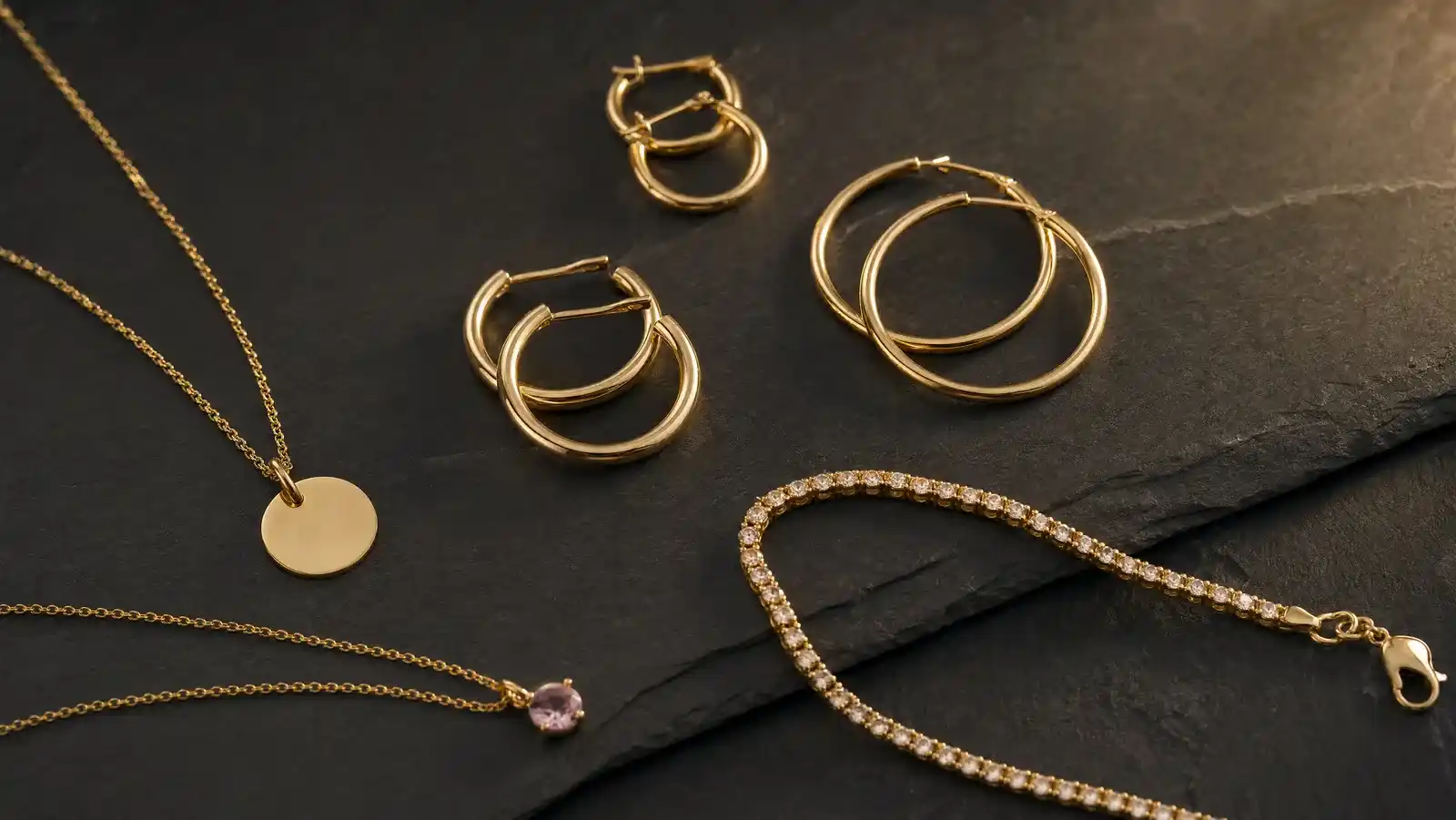
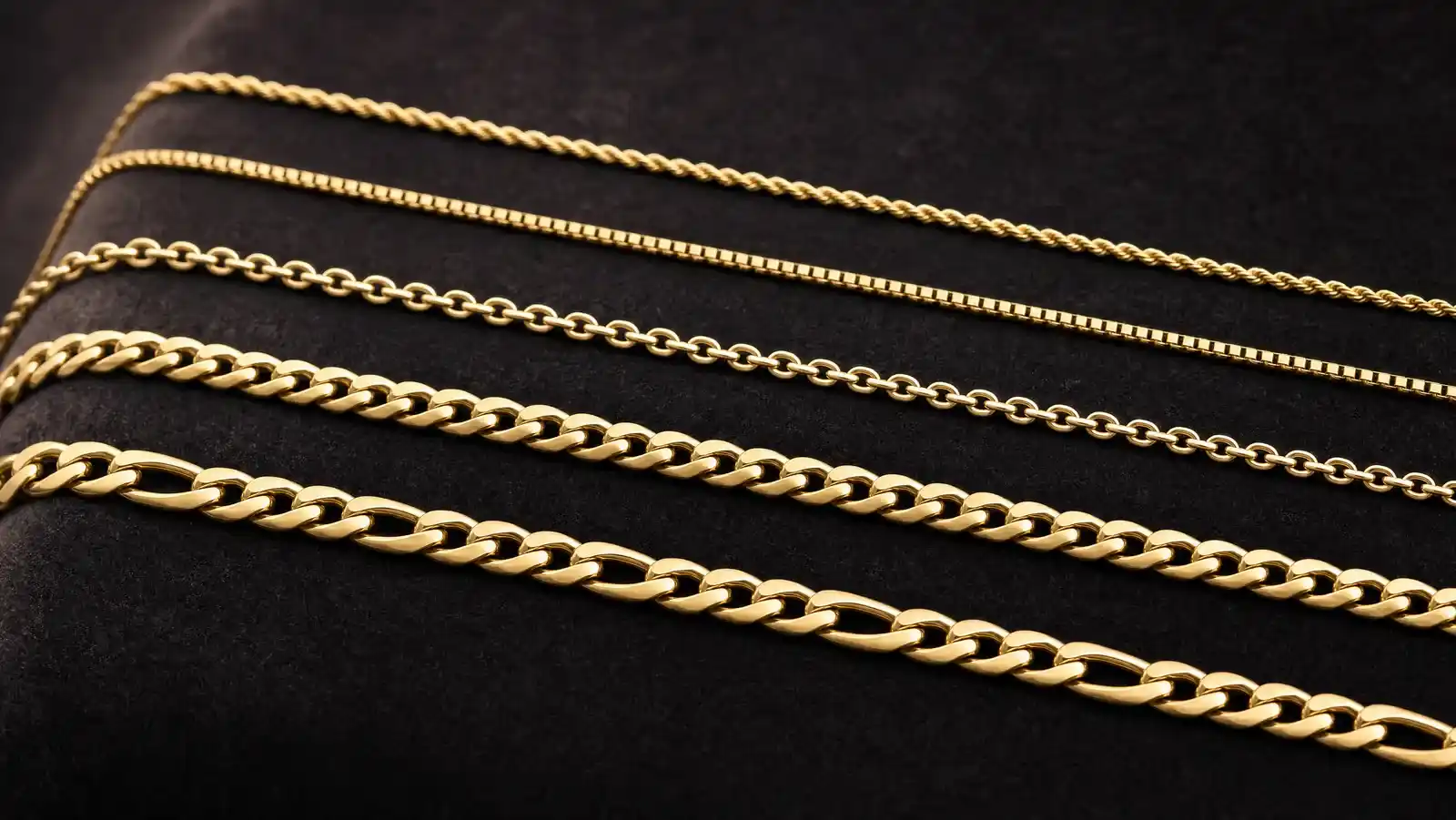
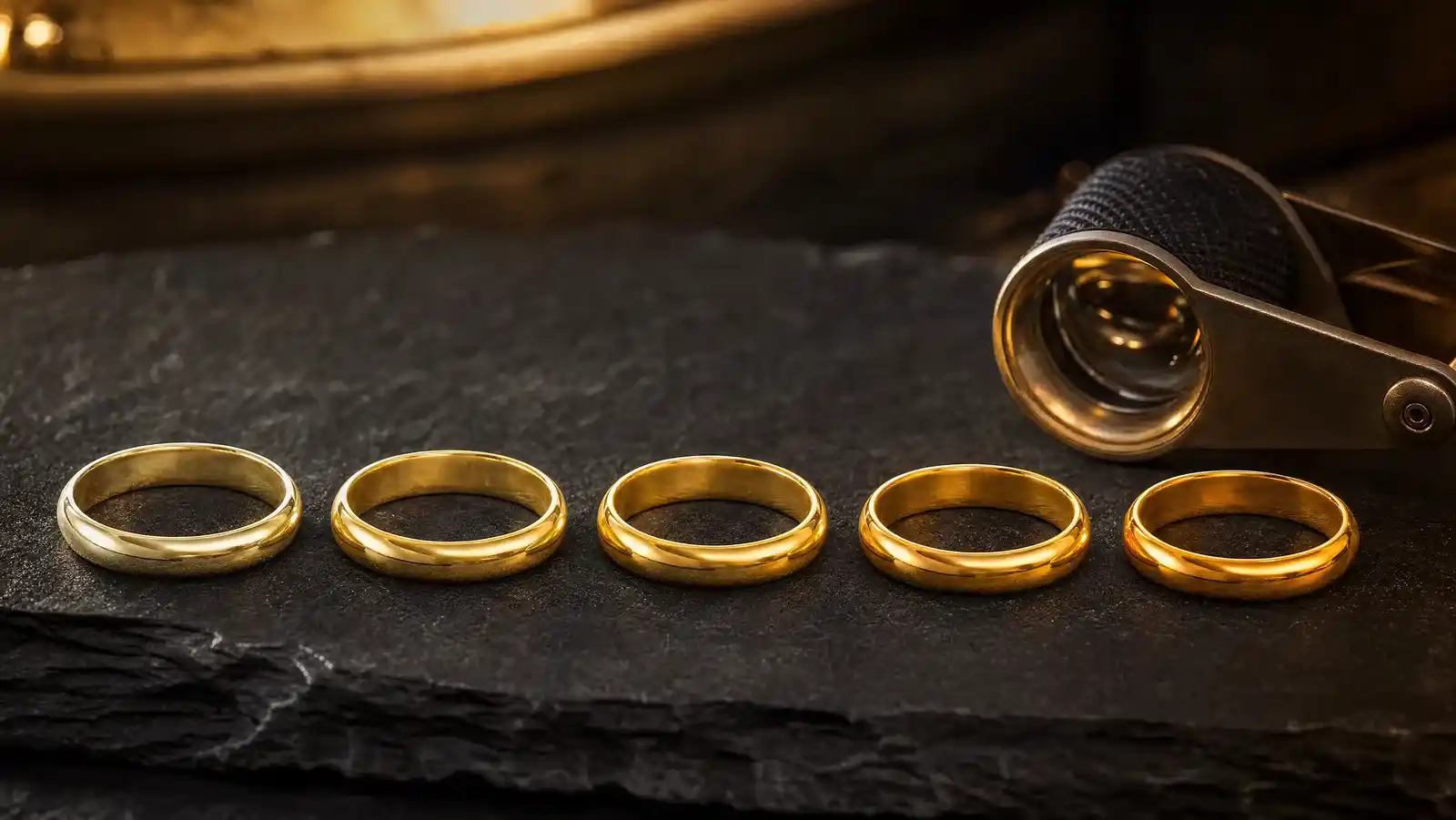
Solid Gold vs Gold Filled vs Gold Plated vs Gold Vermeil

This post may contain affiliate links. Read our affiliate policy
Solid gold is gold alloy all the way through. Gold filled, gold vermeil and gold plated are each a thin skin of gold over a cheaper core, and US labeling rules put a very different floor under each term. That is the whole answer: one of the four is metal, three are coatings, and the coatings differ from one another by more than fourteen times the gold.
The document that settles it is the Federal Trade Commission's Jewelry Guides, 16 CFR Part 23 — the agency's own statement of what it treats as deceptive when a piece is marked or described. It matters here more than anywhere else in fine jewelry, because gold filled vs gold plated vs vermeil is not a marketing distinction. Each term carries a number, two of those numbers are not even measured in the same unit, and almost no product listing prints either one. If you also need the purity side of this question, start with gold karats explained.
Gold Filled vs Gold Plated vs Vermeil: What the FTC Actually Requires
Here are the four terms with the thresholds attached, quoted from the guides rather than paraphrased from a retailer's glossary.
- Gold filled (and its siblings "rolled gold plate" and "gold overlay"). According to the FTC's jewelry guides at section 23.3(c)(2), the gold alloy must be at least 10 karat fineness, affixed on all significant surfaces "by soldering, brazing, welding, or other mechanical means," and the plating must constitute "at least 1/20th of the weight of the metal in the entire article." One twentieth is 5%. The same construction at one fortieth of the weight, 2.5%, can only be sold as gold plate, gold overlay or rolled gold plate.
- Gold vermeil. Section 23.4(b) allows the word only where the piece "consists of a base of sterling silver" coated on all significant surfaces with gold of not less than 10 karat fineness, with "a minimum thickness throughout equivalent to two and one half (2 1/2) microns (or approximately 100/1,000,000ths of an inch) of fine gold." Two requirements, not one: the thickness and the silver base.
- Gold plated / gold electroplate. Section 23.3(c)(3) sets the floor at an electroplating of at least 10 karat gold with "a minimum thickness throughout equivalent to 0.175 microns (approximately 7/1,000,000ths of an inch) of fine gold." Push the same plating to two and a half microns, the vermeil figure, and the guides allow "Heavy Gold Electroplate" instead.
- Solid gold. No coating, so no thickness rule applies. Karat fineness is the only specification. Section 23.3(c)(1) gives the acceptable form, with the karat number immediately before the word "Gold" and equally conspicuous, as in "14 Karat Gold," and section 23.3(b)(1) treats the unqualified word "Gold" as misleading for anything not composed throughout of fine, 24 karat, gold.
So the regulated distance between the weakest legal gold plate and a legal vermeil is 0.175 microns against 2.5 microns, a little over fourteen times the gold on the surface.
The Unit Nobody Reconciles
Read those four definitions again and you will notice the trap. Vermeil and electroplate are regulated by thickness. Gold filled is regulated by weight ratio. There is no conversion between the two, because the thickness you get out of a weight share depends on the geometry of the piece: the same 5% by weight is a thicker layer on heavy stock than it is on fine wire, since the fraction is fixed against the metal underneath rather than against the surface area.
The guides even flag the related karat confusion in a footnote: "A product containing 1 micron ... of 12 karat gold is equivalent to one-half micron of 24-karat gold." A micron of plating is not a micron of gold unless the plating is fine gold.
What follows is the part worth holding onto. Sellers publish the term. They almost never publish the micron figure behind it, and for gold filled no micron figure is required to exist at all. The deciding number in this comparison is missing from essentially every listing, which is why the term itself has to do the work.
Solid Gold: Karat Is Purity, "Solid" Is Not Thickness
"Solid gold" is used two ways, and only one of them is the FTC's.
In the trade and in everyday speech, solid gold means not plated: the alloy runs through the whole piece. In the guides, "solid" is about whether the piece is hollow. The note to section 23.3(c)(1) says a 14 karat piece with a hollow center "should not be marked or described as either '14 Kt. Solid Gold' or as 'Solid 14 Kt. Gold'," and that the hollow construction should be disclosed next to the word "Gold."
Both meanings are live in real listings, so a hollow 14 karat tube chain and a drawn-wire 14 karat chain can both be described loosely as solid gold while weighing very different amounts. Karat tells you the purity of the metal, not how much of it is there.
The purity arithmetic is simple, since a karat is one part in 24 by weight: 10K is 41.7% gold, 14K is 58.3%, 18K is 75%. Lower karat generally buys hardness, and it buys a lower price for the same shape, which is a real trade-off and a separate question, whether 10K gold is worth buying. The guides also note the stamping tolerance that applies to those marks: under the National Stamping Act, gold articles containing no solder are allowed three parts per thousand, and seven parts per thousand where the tested part contains solder.
How Much Gold Is in Gold Filled Jewelry
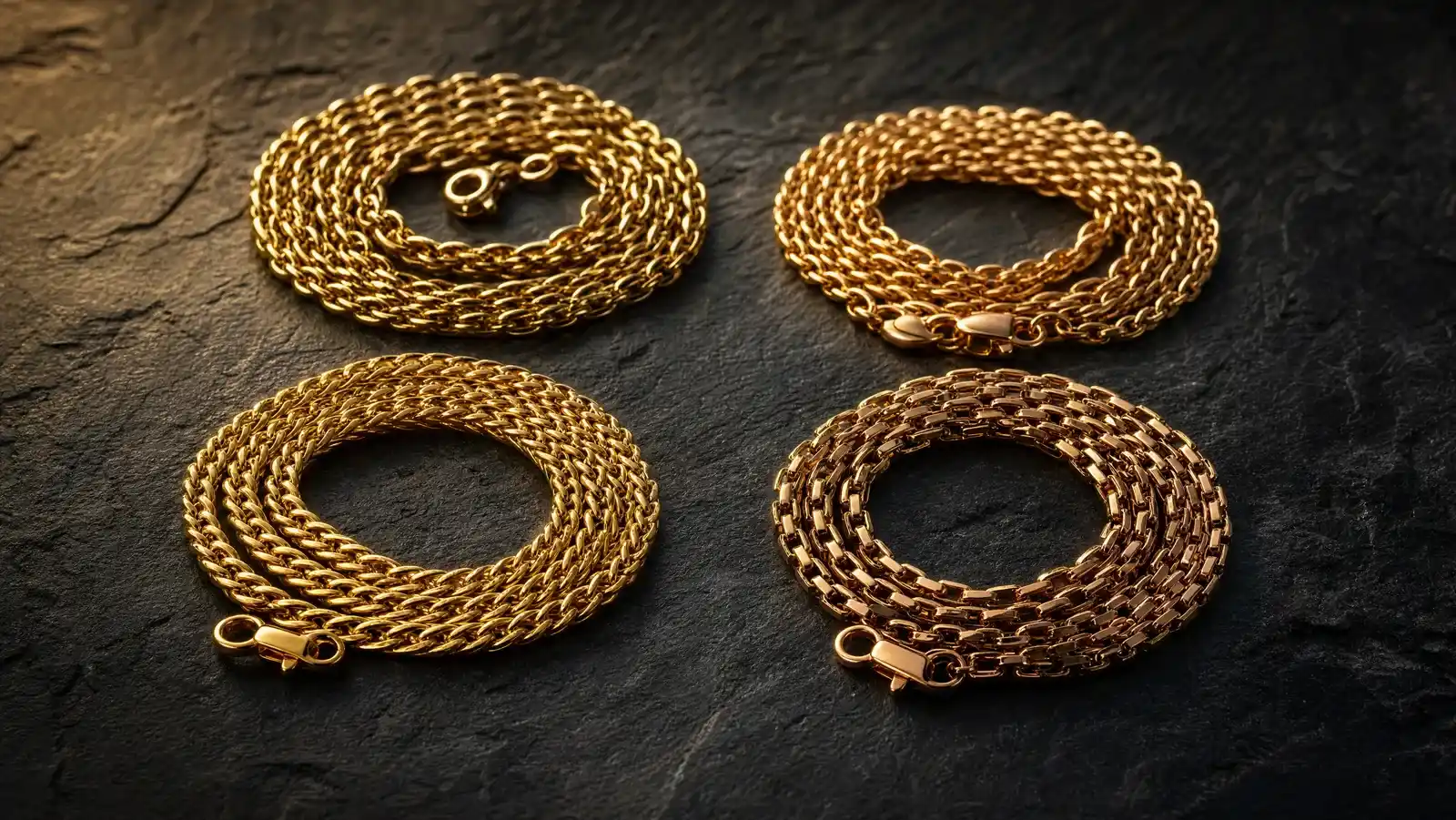
Five per cent of the weight of the metal in the piece, at 10 karat or better, mechanically bonded. That is the floor, and the common US specification sits exactly on it: suppliers write it "14/20," meaning one twentieth of the weight is 14 karat gold, bonded to a base core that chain sellers typically describe as brass.
Two consequences follow from the words "soldering, brazing, welding, or other mechanical means" in the regulation.
- The layer is bonded metal, not a deposit from solution. It is rolled or welded onto the core, which is why gold filled survives polishing and repair work that would strip an electroplate.
- It is thick enough to be worked. A jeweler can cut, bend and solder gold filled stock without immediately exposing the core, within limits.
Gold filled is the one option on this list that behaves like metal in daily wear while costing a fraction of solid gold, and it is the category we would check first for an everyday piece. If you want specific picks rather than the standard, see the gold filled pieces we recommend.
What Is Gold Vermeil, Exactly
Vermeil is the only term here that specifies what is underneath. The base must be sterling silver, and section 23.5(b)(2) of the same guides reserves "Sterling Silver" for metal that is "at least 925/1,000ths pure silver." So a vermeil piece is a precious-metal piece with a precious-metal coating, which is the real argument for it: even when the gold wears, what is exposed is silver rather than brass.
There is one specific abuse the guides call out by name. Note 1 to section 23.4 makes it "unfair or deceptive to use the term 'vermeil' to describe a product in which the sterling silver has been covered with a base metal (such as nickel) plated with gold" unless that construction is disclosed. A nickel barrier layer is cheap and it plates beautifully, and it is exactly the layer a wearer with a metal sensitivity does not want. If a listing says vermeil and says nothing about the layer structure, that silence is the thing to notice.
Gold Plated Is the Loosest Term on the Shelf
Seven millionths of an inch. That is what the guides accept as a legal gold electroplate, and nothing about the phrase "gold plated" on a product page tells you whether the piece sits at that floor or fourteen times above it at heavy gold electroplate.
The guides also require a karat designation immediately before the term, equally conspicuous, so a compliant listing should read "14 Karat Gold Electroplate" rather than just "gold plated." A description that gives the term without the karat number is already outside the guides' example of an acceptable marking, which is a useful free signal when you are reading two listings side by side.
Nobody can tell you how long gold plating lasts, because the variable that decides it, actual thickness, is the variable nobody discloses. What we can say from the standard alone is that the legal minimum is a flash of gold measured in tenths of a micron, and it is on the piece to look right in a photograph, not to survive a year on a wrist.
Side by Side
| Solid gold | Gold filled | Gold vermeil | Gold plated | |
|---|---|---|---|---|
| Base metal | None, alloy throughout | Base core, usually brass | Sterling silver, 925 minimum | Any metal |
| What the rule requires | Karat mark only | At least 1/20 of metal weight, 10K+, mechanically bonded | At least 2.5 microns, 10K+ | At least 0.175 microns, 10K+ |
| How it is measured | Purity | Weight ratio | Thickness | Thickness |
| Can the gold wear through | No | Eventually, no published figure | Yes | Yes, fastest |
| What shows when it does | Nothing | Brass | Silver | Base metal, sometimes nickel |
| Price band | Highest, and it moves with the metal price | A fraction of solid gold | Similar to gold filled, with silver value underneath | Lowest |
| Best suited to | Keeping, resale, daily wear | Daily wear on a budget | Dressier pieces, skin-contact pieces | One season, trend shapes |
Replating, Repairs and Sizing
This is where the four separate most sharply, and where the honest answer is partly "nobody publishes it."
Replating. Vermeil and plated pieces can be re-electroplated, because electroplating is a standard bench service and the original finish was applied the same way. What the guides regulate is how a piece may be sold, not what a repair must deliver, so the thickness you get back is between you and the jeweler, and it is worth asking for it in microns. Gold filled is different in kind: the bond is a factory mechanical process, so a worn gold filled piece can only be electroplated like anything else, which makes the restored surface a plating rather than a bonded layer. Solid gold never needs any of this.
Sizing and repair. Solid gold is the only one of the four a bench jeweler can cut, solder and finish without a cosmetic penalty. Gold filled tolerates careful work, and the suppliers who sell welding equipment into this market tell their own customers to use moderate power and shorter pulse times on gold filled chain to protect the gold layer, and to lower welder power slightly on 14 karat to prevent overheating or discoloration. On vermeil and plated pieces, local heat destroys the finish at the joint, so a repair usually implies a replate. If a piece needs to survive being altered, that is an argument for solid gold on its own.
Cleaning. All four respond to gentle handling and none respond well to abrasives or ultrasonic cycles when there is a coating involved. Our metal-by-metal cleaning guide covers the specifics.
Why Permanent Jewelry Runs on Gold Filled
Welded jewelry is fitted on the wrist and closed with a weld rather than a clasp, which means the piece is never taken off and never gets a rest. That rules out a flash electroplate immediately and makes the choice a two-horse race between solid gold and gold filled.
The chain suppliers who sell into permanent-jewelry studios list their stock as 14/20 gold fill, and their reasoning is the regulation we quoted: a mechanically bonded layer at a twentieth of the article's weight is thick enough to take a weld and thick enough to survive constant skin contact. Durability claims around these chains, including the five-year figures you will see quoted, come from the sellers themselves, and we have not found a controlled wear test from anyone else. Treat the construction as the verifiable part and the lifespan as a claim.
Why This Comparison Is Suddenly Everywhere
Gold is historically expensive. According to the World Gold Council, the LBMA Gold Price reached a high of US$5,405.00 on 29 January 2026, with spot gold touching an intraday US$5,595.47 the same day, and the council's mid-year review had gold down about 7% year to date against that peak as of late June 2026.
Buyers moved accordingly. The council reported that gold jewelry demand fell 23% year on year in the first quarter of 2026, to 300 tonnes, while the value of jewelry spending rose. People bought less gold and paid more for it, which is the exact condition that sends shoppers from a solid gold listing to a vermeil one and makes the wording on the second listing worth decoding.
Which One Should You Buy
- An everyday chain you will wear for years. Gold filled first, solid gold if the budget allows. A coating measured in tenths of a micron will not survive daily friction, and link style matters more than finish for how long a chain survives being worn.
- Earrings for sensitive ears. Solid gold, or vermeil read carefully. The post spends its life inside a piercing, and the guides' own warning about a nickel layer hidden under gold over sterling is the reason to insist on knowing the layer structure before buying; our guide to earring metals works through the alternatives.
- A piece you might resell or keep. Solid gold only. It is the sole option on this list whose material carries recoverable metal value; a coating does not, and vermeil's value is in its silver rather than its gold.
- One season, one trend, one event. Gold plated is a reasonable purchase if you buy it as a finish rather than as metal, and price it accordingly.
The Bottom Line
Four terms, three of them coatings, and one number each: a twentieth of the article's weight for gold filled, two and a half microns over sterling for vermeil, and 0.175 microns for a legal gold plate. Those thresholds, not the photography, are what separates two listings at very different prices. When a listing uses the term without the karat mark the guides ask for, or describes a coating without naming what is under it, read that as information.
For the purity half of the decision, and for how gold karats affect price once you have settled on solid gold, our pillar guide picks up exactly where this one stops.
About the Author
Alfreda Borror
Alfreda Borror is the founding editor of Opulent Opal, writing research-based buying guides on diamonds, birthstones, and fine jewelry.