How to Tell If Pearls Are Real: Natural vs Cultured vs Fake

This post may contain affiliate links. Read our affiliate policy
Run the pearl gently across your front teeth. Does it feel gritty like fine sandpaper—or smooth like glass?
That simple test, taking three seconds, correctly identifies 95% of fake pearls. It's one of the oldest tricks in the jewelry trade, and it works because real nacre has a microscopic texture that plastic coatings can't replicate.
But pearl authentication goes deeper than the tooth test. The market includes natural pearls (extraordinarily rare), cultured pearls (real but human-assisted), and imitations (plastic or glass). A natural pearl strand might cost $100,000. A similar-looking imitation costs $30. This guide shows you how to tell them apart.
Table of Contents
- Understanding Pearl Categories
- The Famous Tooth Test
- Visual Inspection Methods
- Advanced Authentication Tests
- Evaluating Different Pearl Types
- Common Imitation Pearls
- FAQ
Understanding Pearl Categories
Before testing, understand what "real" means for pearls. The market includes three distinct categories:
Natural Pearls
True natural pearls form when an irritant enters a mollusk by chance, triggering nacre deposition without human intervention. Natural pearls are extraordinarily rare—perhaps 1 in 10,000 wild mollusks produces a gem-quality pearl. A natural pearl strand might cost $50,000 to $500,000+.
Because of extreme rarity, most "real" pearls you'll encounter are cultured, not natural.
Cultured Pearls
Cultured pearls are genuine pearls—real nacre grown by real mollusks—but started intentionally by humans inserting a nucleus (often a polished shell bead) into the mollusk. The mollusk then coats this nucleus with nacre just as it would a natural irritant.
Cultured pearl quality depends on nacre thickness. High-quality cultured pearls have thick nacre layers virtually indistinguishable from natural pearls. Low-quality cultured pearls have thin nacre over large bead nuclei.
Cultured pearls ARE real pearls—they're not imitations. This is the term's accepted meaning in the jewelry industry.
Imitation (Fake) Pearls
Imitation pearls are completely artificial—plastic, glass, or shell beads coated with substances that mimic pearl luster. They contain no nacre and weren't grown inside mollusks. Common brand names include "Majorica" pearls (high-quality imitations) and "faux" or "simulated" pearls.
The Famous Tooth Test
The most reliable simple test for real vs. fake pearls relies on nacre's natural texture.
How It Works
Real pearl nacre consists of microscopic aragonite crystal platelets layered like tiny bricks. This creates a slightly rough surface texture at the microscopic level. Imitation pearls have smooth coatings that mimic luster but lack this texture.
How to Perform
- Ensure the pearl and your teeth are clean
- Gently rub the pearl against the biting edge of your front teeth
- Move the pearl lightly—don't press hard
Real pearls feel: Slightly gritty or sandy—like fine sandpaper Fake pearls feel: Smooth—like glass or plastic sliding on teeth
Reliability
The tooth test correctly identifies approximately 95% of imitation pearls. It fails only with some high-end imitations designed specifically to pass this test.
Cautions
- Don't test valuable pearls this way—the test won't damage them, but it feels disrespectful to fine jewelry
- Ensure no food residue affects the texture sensation
- Test against teeth, not lips or tongue (not sensitive enough)
Visual Inspection Methods
Several observable characteristics help distinguish real from fake pearls.
Surface Examination
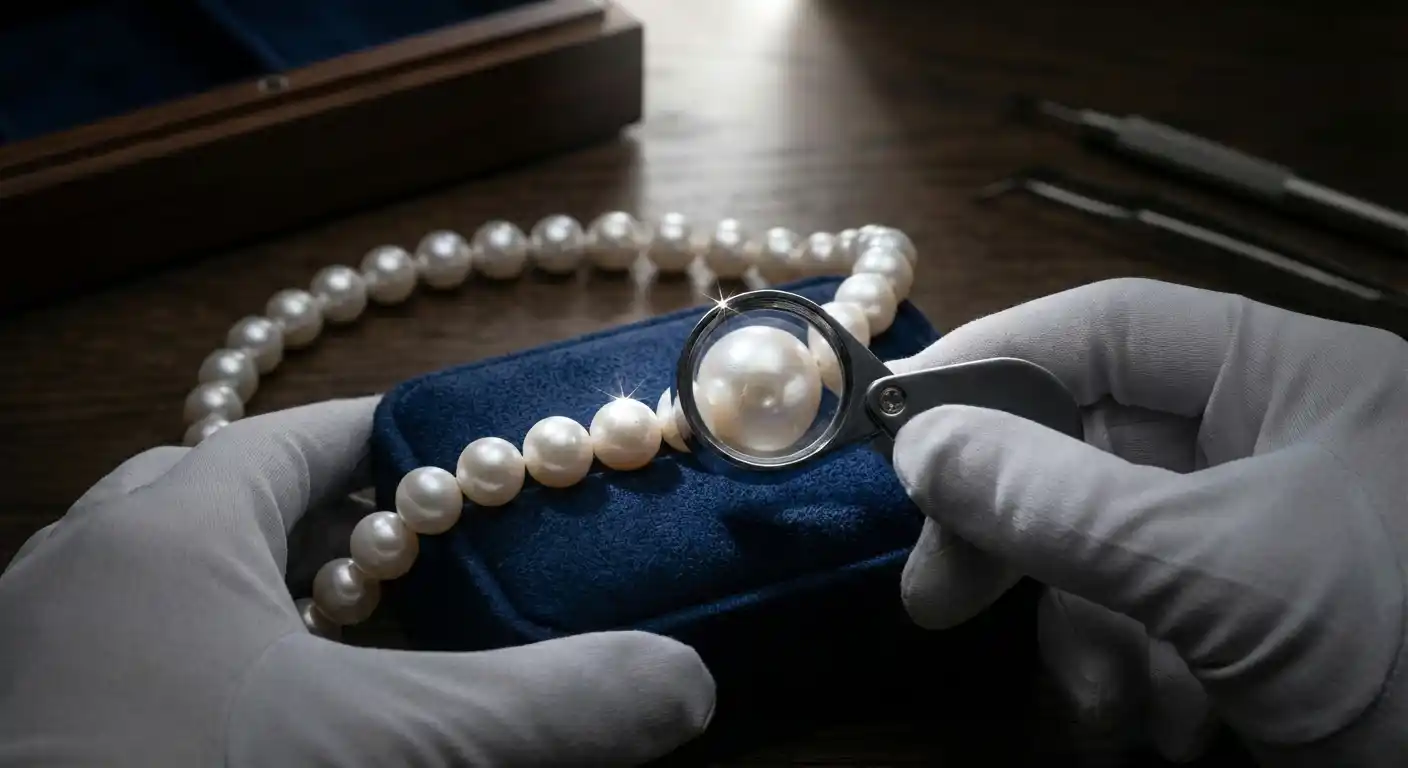
Under magnification with a jeweler's loupe, pearl surfaces reveal their origin:
Real pearls show:
- Irregular surface texture (called "orange peel" effect)
- Tiny ridges and variations
- Surface irregularities that catch light
- Subtle imperfections (no two pearls identical)
Fake pearls show:
- Perfectly smooth surfaces
- Uniform appearance across all pearls in a strand
- Sometimes visible brush strokes from coating application
- Peeling or bubbling in coating (indicates plastic base)
Drill Hole Examination
Where pearls are drilled for stringing, you can see the internal structure:
Real pearls show:
- Nacre layers visible in cross-section (like tree rings)
- Crisp drill hole edges
- Consistent material through the hole
Fake pearls show:
- Thin coating over different core material
- Coating may peel away from core at hole edge
- Glass or plastic core visible inside coating
- Sometimes coating accumulation around hole
Matching in Strands
Examine how well pearls match across a strand:
Real pearl strands:
- Slight variations in size, shape, color, and luster
- Perfect matching is extremely expensive and rare
- Natural variations indicate genuine growth
Fake pearl strands:
- Often perfectly identical
- Too-uniform appearance suggests manufacturing
- Exact matching throughout = suspicious
Weight and Temperature
Real pearls are denser than most imitations and respond to temperature differently:
Real pearls:
- Feel substantial for their size
- Feel cool when first touched, then warm to body temperature
- Cool down quickly when removed from skin
Plastic imitations:
- Feel lighter than expected
- Reach body temperature more slowly
- May feel "plastic" in hand
Advanced Authentication Tests
For more definitive identification, especially of high-quality imitations:
Rub Test
Gently rub two pearls together:
Real pearls: Produce slight friction and may generate a small amount of fine powder (nacre) Fake pearls: Slide smoothly without friction or powder
This test can damage pearls, so use caution and only test less visible areas or pearls you're considering purchasing.
UV Light Test
Under long-wave ultraviolet light (365nm) from a quality UV flashlight:
Most real pearls: Fluoresce with a soft glow (colors vary by type) Most fake pearls: No fluorescence, or bright artificial fluorescence
Note: UV response varies significantly among genuine pearl types, so this test indicates rather than confirms.
Specific Gravity Test
Real nacre has specific gravity of approximately 2.68-2.74. Imitation materials vary:
- Plastic: lower SG (~1.0-1.5)
- Glass: similar or higher SG (~2.5-3.0)
- Shell beads with coating: depends on construction
Hydrostatic weighing can identify some imitations, though this requires specialized equipment.
Evaluating Different Pearl Types
Akoya Pearls
Japanese and Chinese cultured saltwater pearls known for excellent luster and round shape. Most are 6-8mm. Authentication focuses on nacre thickness—high-quality Akoya have substantial nacre over bead nuclei. Thin-nacre Akoya may show the nucleus blink through the surface (called "blinking").
Freshwater Pearls
Most affordable real pearls, typically cultured in Chinese mussels. Unlike saltwater pearls, freshwater pearls are usually solid nacre without bead nuclei (tissue nucleation). This means they're often excellent value—real nacre throughout, at lower prices than saltwater pearls.
Freshwater pearls come in diverse shapes, sizes, and natural colors. High-quality freshwater pearls rival Akoya in luster.
South Sea Pearls
Large (typically 10-15mm) saltwater pearls from Australia, Indonesia, and Philippines. White/silver and golden varieties exist. Their size and nacre quality command premium prices. Authentication should verify thick nacre and genuine (not enhanced) color.
Tahitian Pearls
Black-lipped oyster pearls from French Polynesia. Natural dark colors range from green to purple to "peacock" (green-pink overtones). Authentication confirms natural color (not dyed) and genuine nacre quality.
Common Imitation Pearls
Plastic/Glass Beads with Coating
The most common imitations: solid beads coated with "essence d'orient" (fish scale extract) or synthetic pearlescent materials. Usually identifiable by the tooth test and drill hole examination.
Shell-Based Imitations (Majorica)
Higher-quality imitations using polished shell nuclei coated with multiple layers of pearl-like material. Majorica and similar brands create convincing appearance that passes casual inspection. Usually identifiable by perfect uniformity and drill hole examination showing shell core.
Mother of Pearl
Technically real nacre—but carved from shell rather than grown as pearls. Has genuinely nacreous surface but lacks pearl structure. Usually shaped into beads or cabochons. Not "fake" but distinct from pearls.
Vintage Imitations
Older costume jewelry may contain glass "pearls" (glass beads with pearly coatings) or early plastic imitations. Often identifiable by surface wear patterns different from real nacre wear.
FAQ
Are cultured pearls real pearls?
Yes. Cultured pearls are genuine nacre produced by real mollusks. The only difference from natural pearls is that a human intentionally started the pearl formation by inserting a nucleus. The nacre itself is identical to natural pearl nacre.
Can fake pearls pass the tooth test?
Some high-end imitations are manufactured specifically to pass the tooth test by adding texture to coatings. However, these remain rare. Combined with visual inspection and drill hole examination, you can identify virtually all imitations.
How can I tell natural from cultured pearls?
This distinction is extremely difficult without X-ray examination. Natural pearls show concentric nacre layers throughout; cultured pearls show a bead nucleus with nacre layers around it. For most purposes, this distinction matters little—both are real nacre. It matters greatly for valuation of potentially natural antique pieces.
Are freshwater pearls less valuable than saltwater pearls?
Freshwater pearls are generally more affordable because production volumes are higher. However, high-quality freshwater pearls can rival saltwater quality at lower prices. Being freshwater doesn't make pearls less "real"—they're genuine cultured pearls.
Do real pearls turn yellow with age?
Yes, real pearls can yellow over time from exposure to acids (including skin oils), perfumes, cosmetics, and environmental factors. Proper storage and regular wearing (skin oils can actually help maintain luster when properly maintained) preserve pearl appearance. Yellowing is actually evidence of real nacre—imitations don't yellow the same way.
How can I tell if pearl color is natural or dyed?
Dyed pearls often show:
- Color concentration in nacre layers (visible at drill holes)
- Uneven color distribution
- Color that rubs off (test carefully on inconspicuous area)
- Colors too uniform or saturated to be natural
Natural colored pearls show color throughout the nacre consistently, with subtle variations expected from organic growth.
Conclusion
Your 60-second pearl authentication checklist:
- Tooth test — Gritty = real nacre. Smooth = fake.
- Surface check — Real pearls have subtle texture ("orange peel"). Fakes are perfectly smooth.
- Drill hole exam — Look for nacre layers (real) vs. coating over plastic core (fake).
- Uniformity test — Too-perfect matching across a strand suggests imitation.
Remember: cultured pearls ARE real pearls. The question is whether you have genuine nacre (natural or cultured) or artificial imitation (plastic/glass coating).
For pearl strands over $500: Get professional grading to verify nacre thickness, luster quality, and whether colors are natural or enhanced.
Build your testing kit: A 10x loupe and UV flashlight together cost under $50 and handle most pearl authentication needs.
Have other gems to authenticate? See our complete guide: How to Tell If a Gem Is Real.
Dreamer Jewelers Loupe 60X-100X with LED and UV Light
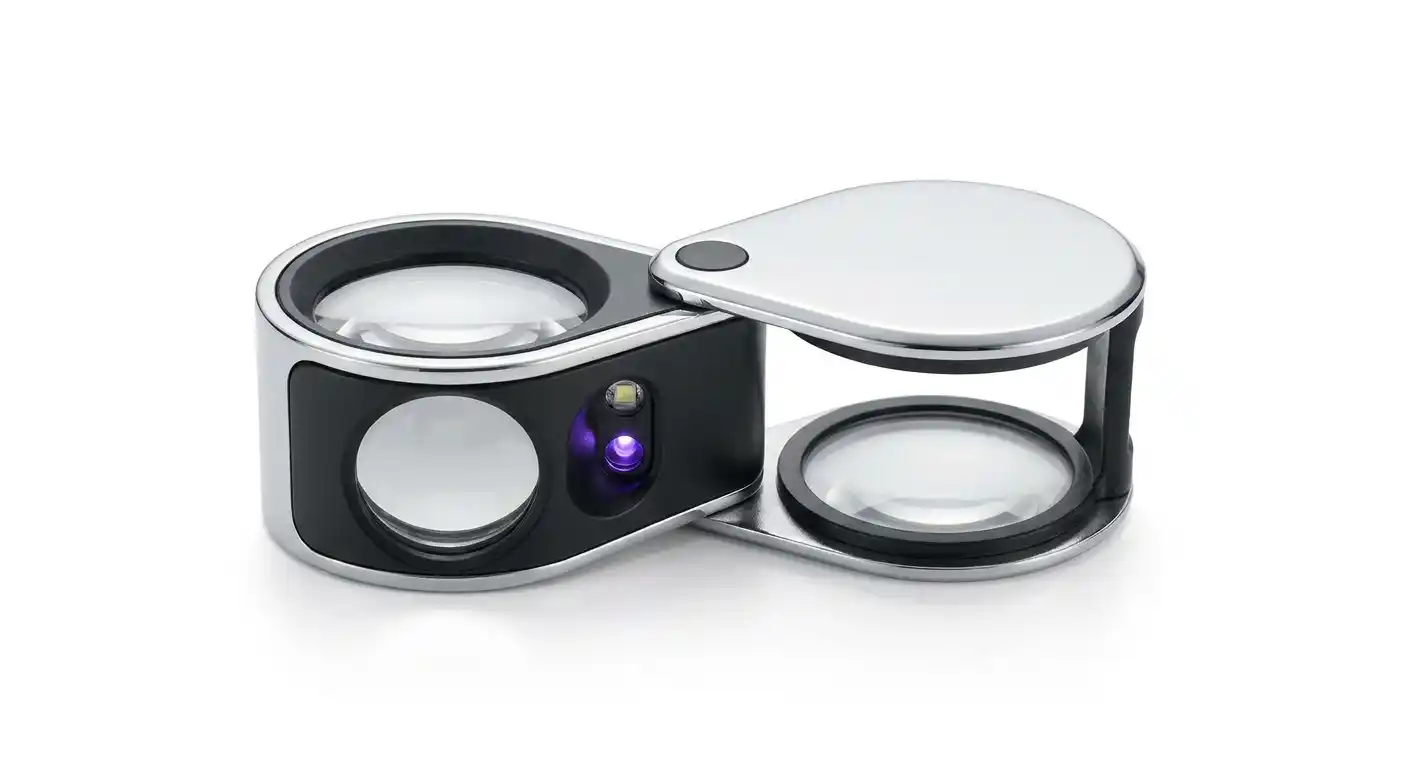
Dreamer Jewelers Loupe 60X 100X with LED and UV Light
Multi-function loupe perfect for examining pearl surface texture.
Multi-function loupe perfect for examining pearl surface texture. LED illumination reveals the characteristic 'fingerprint' pattern of real nacre.
"Essential for pearl inspection. The magnification clearly shows the difference between real nacre and plastic coating.
Review of What We Liked
Dreamer Jewelers Loupe 60X 100X with LED and UV Light
Multi-function loupe perfect for examining pearl surface texture.
About the Author
Alfreda Borror
Alfreda Borror is the founding editor of Opulent Opal, writing research-based buying guides on diamonds, birthstones, and fine jewelry.